The sudden disappearance of a US Navy surveillance drone over one of the world’s most sensitive maritime regions has raised serious questions about aerial security, surveillance continuity, and regional stability.
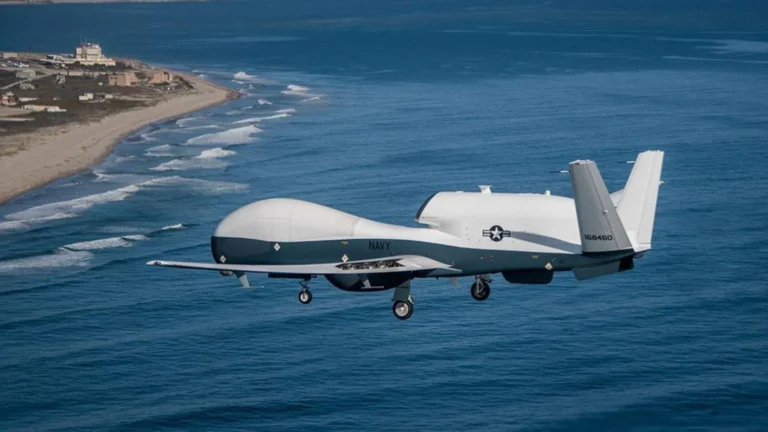
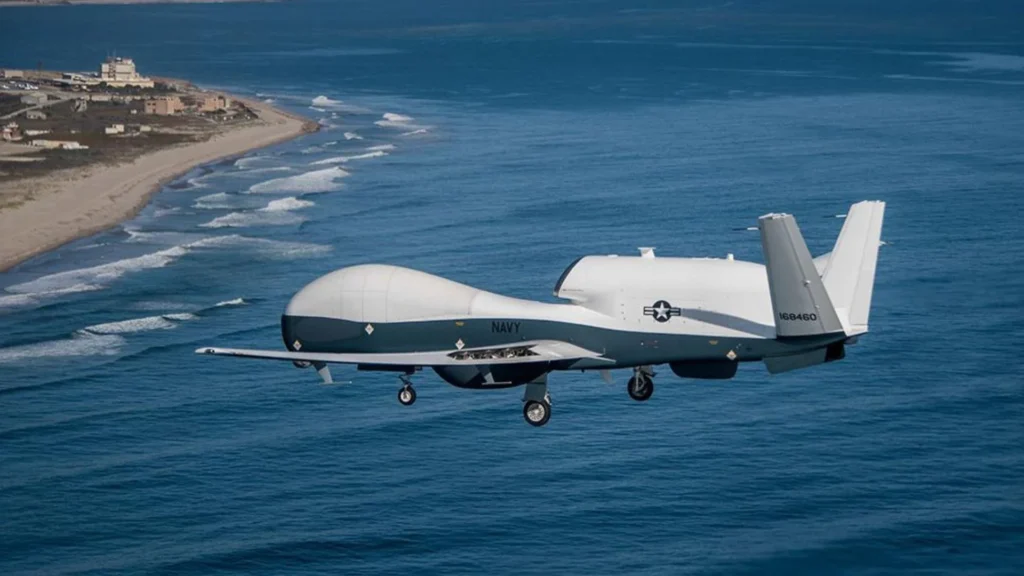
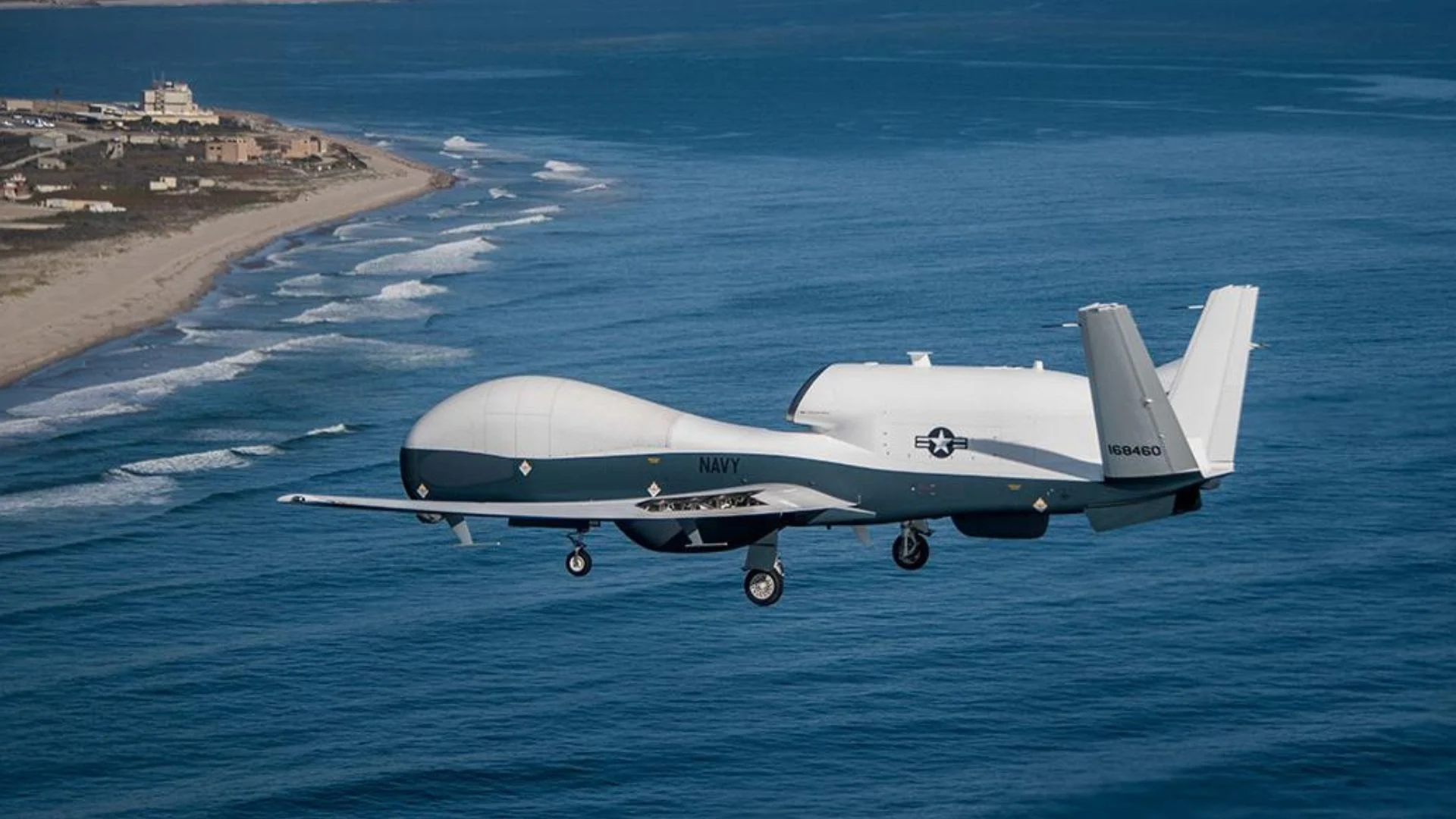
The $200M uncrewed MQ-4C Triton vanished from public flight tracking systems after declaring an in-flight emergency over the Persian Gulf near the Strait of Hormuz. Moments before disappearing, data showed it was rapidly losing altitude, deepening uncertainty over its fate.
So far, there has been no official confirmation from the US Navy regarding what happened. The silence has only intensified speculation, especially given the timing, just days after a fragile ceasefire agreement between the US and Iran.
READ ALSO: Missiles and Mixed Signals: Pyongyang’s Launches Strain Seoul’s Defense Shield
Disappearance Over a Strategic Lifeline
The drone had been conducting a routine surveillance mission over the Persian Gulf and the Strait of Hormuz, a narrow waterway that handles a significant portion of the world’s oil shipments.
According to publicly available flight data, the Triton had completed a nearly three-hour patrol and was heading back toward its base at Naval Air Station Sigonella in Italy. The flight path appeared normal until the aircraft crossed into Saudi Arabian airspace.
Then, the drone made a sudden turn northeast, toward Iranian territory. At the same time, it began descending sharply from its usual cruising altitude of around 50,000 feet to below 10,000 feet.
Shortly before disappearing, the aircraft transmitted a ‘7700’ emergency code. In aviation, this signal indicates a general emergency but does not specify the cause. There were also unconfirmed reports that the drone briefly transmitted ‘7400,’ a code linked to loss of communication between the drone and its ground controllers. Within moments, the aircraft vanished from tracking systems.
Despite growing attention, the US Navy has not released any official statement about the incident. The Office of the Chief of Information declined to comment when approached.
WATCH ALSO: Hyundai’s Atlas Humanoid Robot Wins Top Honor
Regional commands and the United States Central Command have also remained silent. Iranian authorities have not issued any response either. This lack of clarity has left analysts relying on open-source data and past patterns to understand what might have happened.
What Makes MQ-4C Triton Important
The Triton is not just any drone. It is one of the most advanced maritime surveillance platforms in the world. Developed by Northrop Grumman, the MQ-4C is based on the RQ-4 Global Hawk but is specifically designed for long-duration oceanic missions.
It plays a crucial role in monitoring ship movements, tracking threats, and ensuring safe maritime operations. The drone is equipped with an advanced radar system, an Active Electronically Scanned Array (AESA). This allows it to scan vast ocean areas and detect even small vessels.
It also uses Synthetic Aperture Radar (SAR), which can produce high-resolution images similar to satellite photos. These images can be captured in all weather conditions, day or night. In addition, the Triton carries electro-optical and infrared cameras. These sensors help operators visually identify targets.
Another key feature is its ability to collect electronic intelligence. The drone can passively detect signals from ships, radars, and communication systems, helping build a detailed picture of activity in the region.
Growing Role in Modern Surveillance
In recent years, the US Navy has been expanding Triton’s capabilities. New upgrades focus on improving its signals intelligence (SIGINT) and electronic intelligence (ELINT) systems. This makes the drone even more valuable in modern warfare, where information and awareness are as important as firepower.
The Triton often works alongside the P-8A Poseidon, a crewed aircraft with its own advanced sensors. They provide a powerful surveillance network over critical sea routes.
READ ALSO: MirrorBot Reveals What Happens When Strangers Finally Look Up
As of 2025, the Navy operates 20 Triton drones and plans to acquire more. Each unit costs over $238 million, reflecting its advanced technology and strategic importance.
This is not the first time a high-altitude US drone has faced trouble in the region. In 2019, Iran shot down a US surveillance drone over the Gulf of Oman. That drone was part of the earlier Broad Area Maritime Surveillance program, which helped pave the way for the Triton. That incident raised concerns about the vulnerability of such aircraft, especially in contested environments.
Although Iran’s air defense systems have reportedly weakened after recent conflicts, they still pose risks in certain areas. However, there is no evidence at this stage that hostile action caused the Triton’s disappearance.
Experts also point to another possibility, electronic interference. The Persian Gulf region often experiences GPS jamming and signal disruptions. These can affect both navigation systems and flight tracking data.
Open-source tracking platforms have previously highlighted gaps in coverage in this area. In some cases, aircraft may appear to disappear when they are actually continuing to fly outside tracked zones.
A similar situation occurred earlier this year, when rumors spread that another Triton was going down. Later, officials confirmed that the drone had safely returned to base.
Still, the rapid loss of altitude in this case makes it different and more concerning.
The timing of this incident adds another layer of significance. The US and Iran recently agreed to a temporary ceasefire after weeks of tensions. A key part of this agreement is ensuring safe passage through the Strait of Hormuz. This narrow waterway is vital for global trade and energy supply.
Triton drones play a major role in monitoring this route. They help track ships, detect threats, and maintain situational awareness. Any disruption to these surveillance operations can affect both military planning and commercial security.
For now, the fate of the missing MQ-4C Triton remains unknown. There are no confirmed reports of a crash, recovery, or interception. Without official statements, the incident remains a mystery.
WATCH ALSO: HMND-01 Alpha Shows How Simulations Fast-Track Humanoid Robots
What is clear, however, is the importance of such platforms in modern security environments. The Triton is more than just a drone. It is a key part of a larger surveillance system that supports military operations, protects trade routes, and maintains stability in volatile regions.
As tensions remain high and negotiations continue, incidents like this will draw close attention. More details may emerge in the coming days. Until then, the disappearance of the Triton stands as a reminder of both the capabilities and the risks of operating in one of the world’s most sensitive regions.