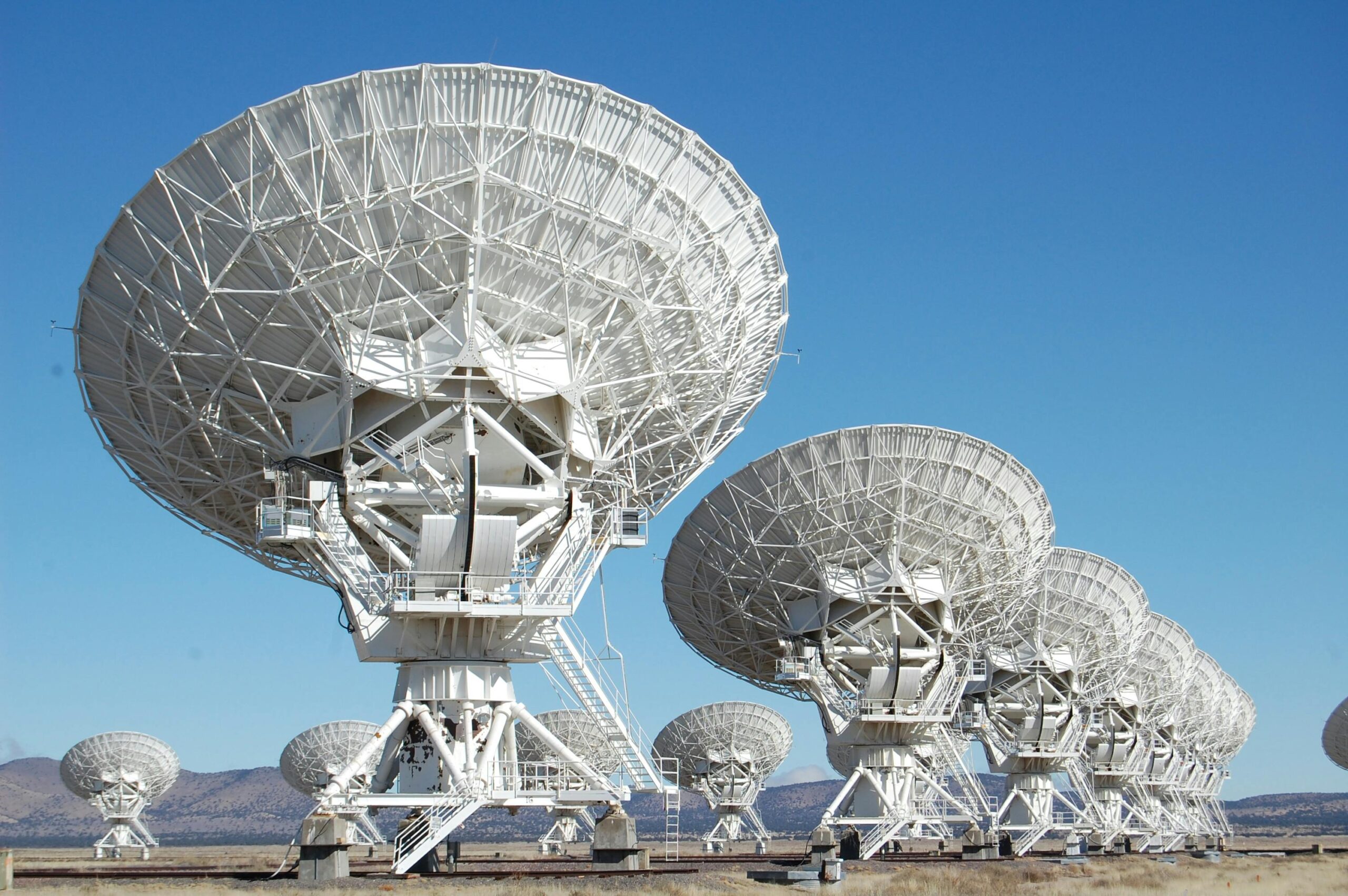
Astronomers using South Africa’s MeerKAT radio telescope have discovered the most powerful natural microwave laser in the universe. The signal, coming from a galaxy merger 8 billion light years away, is the brightest and most distant hydroxyl maser ever measured.
The discovery is a cosmic beacon so powerful that researchers have named it a gigamaser. It emits 100,000 times more power than a typical star, all concentrated in an incredibly narrow slice of the microwave spectrum at 1667 megahertz.
The international team found the signal while scanning the sky for distant galaxies rich in molecular hydrogen. The source is H-ATLAS J142935.3-002836, a system where two galaxies are colliding. Light from this event has traveled 8 billion years to reach us, from a time when the universe was much younger than its current age of 13.8 billion years.
READ ALSO: https://modernmechanics24.com/post/hkust-first-perovskite-solar-cell/
The signal comes from hydroxyl molecules—simple combinations of hydrogen and oxygen. When galaxies slam together, gravity compresses gas and dust, sending these molecules into a frenzy. Radio waves from the active galactic core, often powered by a massive black hole, then cause the molecules to release their energy in perfect synchronization.
This creates coherent microwave radiation using the same principle that powers lasers on Earth. The wavelength is about 18 centimeters, roughly the length of a dinner plate.
The galaxy merger creates perfect conditions for this amplification. It accelerates star formation and feeds the central black hole. New stars heat surrounding dust, making it glow brightly in infrared. Compressed gas forms small pockets where masers can burst into action.
WATCH ALSO: https://modernmechanics24.com/post/boston-dynamics-atlas-balance-agility/
The signal is detectable at such vast distance because of gravitational lensing. A galaxy positioned directly in the line of sight bends the radio waves, acting as a natural magnifying glass. Without this cosmic coincidence, predicted by Einstein’s theory of general relativity, the signal would be too faint for any telescope to detect.
These powerful masers serve as excellent markers for when galaxies underwent massive mergers in the distant past. Such collisions drive star formation and black hole growth, both crucial factors in how present-day galaxies evolved. The gigamaser offers a rare window into this process at a time when galactic mergers were far more common.