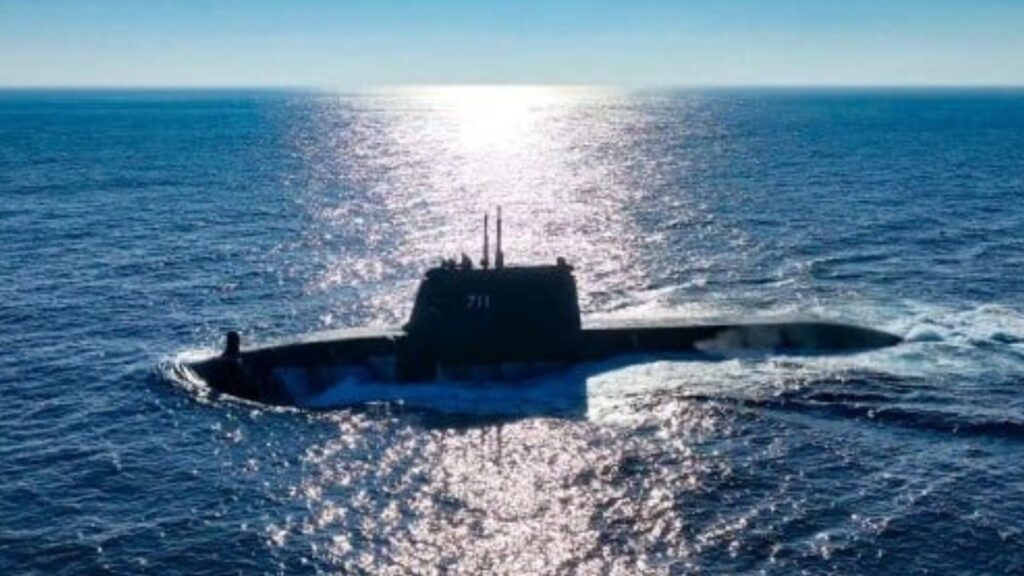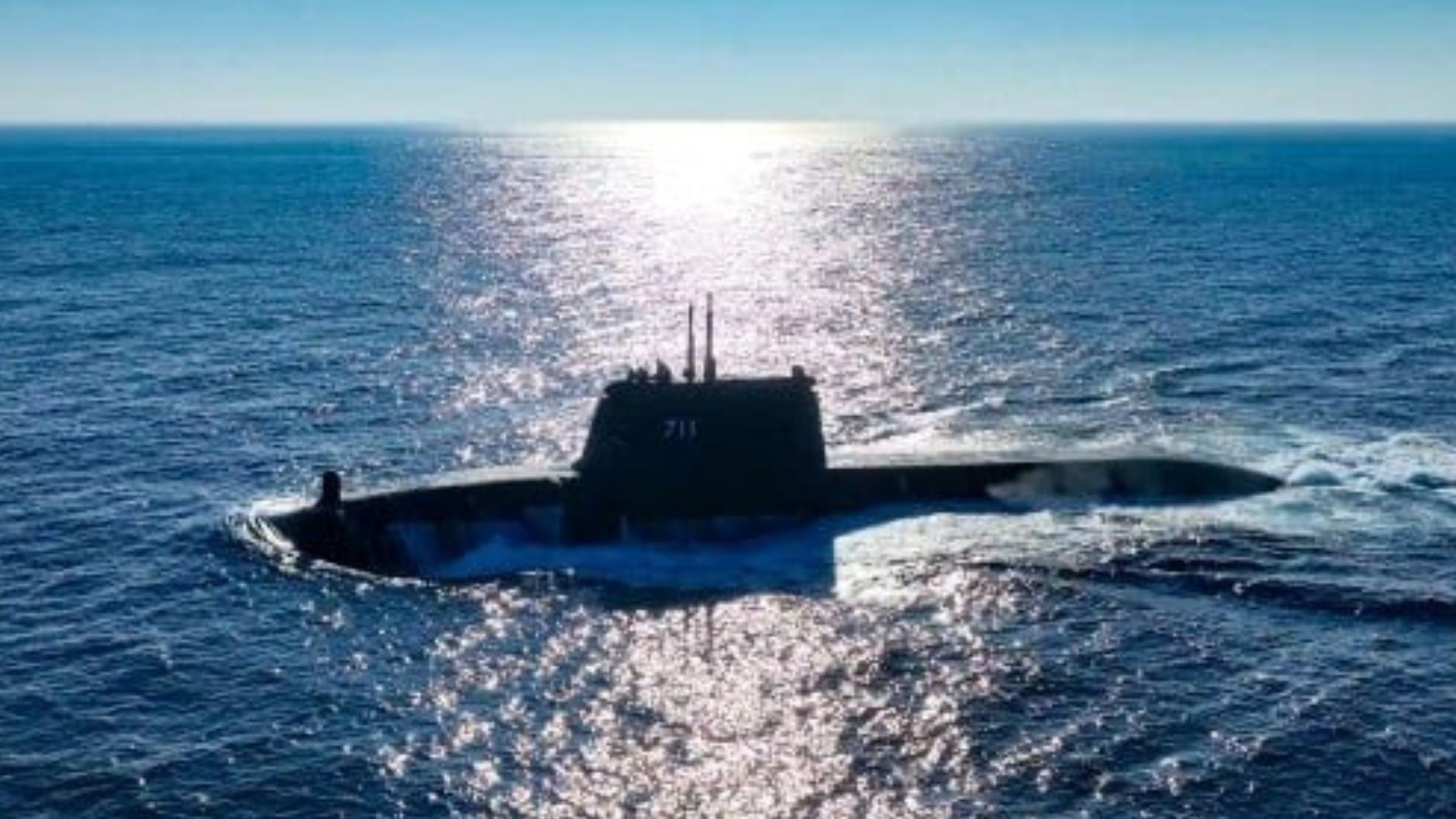
Taiwan’s Hai Kun submarine completed a series of shallow-water dives as pressure mounts to meet delivery deadlines and unlock a frozen defence budget.
The submarine, built by CSBC Corp, Taiwan, is central to Taiwan’s Indigenous Defence Submarine (IDS) programme. It aims at strengthening its naval deterrence amid rising military pressure from Beijing.
Over the past two weeks, the prototype has completed four shallow-water submerged tests. The first submerged test took place on January 29, followed by three more tests.
This marks a major step towards potential navy delivery, possibly as early as June if testing continues smoothly. CSBC released official footage showing the submarine departing port, diving, operating at periscope depth, and resurfacing.
The video showed rudder-control checks and mast-deployment tests. It also included the first public footage of an acoustic decoy system developed by the National Chung-Shan Institute of Science and Technology.
READ ALSO: https://modernmechanics24.com/post/europe-hypersonic-missile-vs-oreshnik/
In a statement, CSBC said, “We carried out the tests in accordance with established procedures. We will continue with system calibration and further submerged testing after completing safety evaluations.” The company added, “We will proceed step by step, with safety and quality requirements taking priority before delivery.”
Though officials didn’t confirm an exact delivery date, they indicated a June timeline if progress continued.
The Hai Kun programme faced political challenges after earlier testing milestones were delayed. Initially, undersea trials and weapons testing were scheduled to finish between September and October, with delivery planned for November. That deadline was missed.
As a result, opposition lawmakers froze NT$1.8 billion (US$56 million) allocated for follow-on submarines. The frozen funds are part of a larger NT$284 billion programme to build seven more submarines.
Lawmakers said the budget would remain frozen until the prototype completed full sea trials. Lin Pei-hsiang of the Kuomintang (KMT) said that funding could be gradually unfrozen if progress continues smoothly. Any further decision will require internal discussion and review.
Another KMT legislator, Wu Tsung-hsien, said, “Lawmakers have the responsibility to ensure defence budgets are properly used.”
Defence Minister Wellington Koo Li-hsiung stated that the funds would not be used until Hai Kun completes all sea trials. He also warned that contractual penalties would apply if delivery deadlines were missed.
WATCH ALSO: https://modernmechanics24.com/post/china-new-massive-battle-tank-live-fire/
Why It Matters for Taiwan’s Defense
Defence ministry spokesman Sun Li-fang said, “Submarines play a critical role in escort missions, intercepting hostile fleets and providing deterrence.”
Taiwan currently operates four submarines, but two are mainly used for training due to their age. The other two are also ageing despite upgrades. This makes the new indigenous submarine programme vital for operational readiness.
Beijing considers Taiwan part of China and has increased military pressure on the island in recent years. Since 2016, cross-strait tensions have intensified, especially after Taiwan’s government rejected Beijing’s one-China principle.
For this, strengthening undersea warfare capability is mandatory for deterrence and maritime defence.
Technical Challenges Ahead
Military expert Chi Tung-yun said submarine testing is complex. “Performance varies at different depths because of changes in temperature, propulsion speed, and power consumption,” he explained. “The full range of test objectives cannot be completed in just a few dives.”
He stressed that stealth is the most critical feature. “Extremely low acoustic signatures are required. Testing must verify whether hull welding quality and structural behaviour under underwater pressure produce detectable noise or vibration.”
Su Tzu-yun, a senior analyst at Taiwan’s Institute for National Defence and Security Research, said the successful acoustic decoy launch showed meaningful progress. He noted that the fading light in the test footage suggested the submarine may have exceeded its planned 50-metre test depth.
Chen Kuo-ming, editor of Defence International magazine, said the next phase will focus on dive depth, stability, and pressure tolerance. “This includes endurance trials, underwater noise assessment, and system integration,” he said. “Combat evaluation, including torpedo firing tests, will only take place after those stages are completed.”
Analyst Wu Ming-chieh added that deeper dives will follow gradually. “Safety, propulsion performance, structural integrity, and pressure resistance remain the priorities,” he said.
READ ALSO: https://modernmechanics24.com/post/china-first-humanoid-robot-for-autism/
Future Ahead
With shallow-water tests completed, Hai Kun now moved to deeper dives and more complex integration trials. Many components were brought from multiple foreign markets, making system integration more challenging.
For Taiwan, the stakes are high. The success of the Hai Kun submarine is not just about one vessel. It is about its capability to build advanced defence systems at home and strengthen its naval deterrence in an increasingly tense security environment.