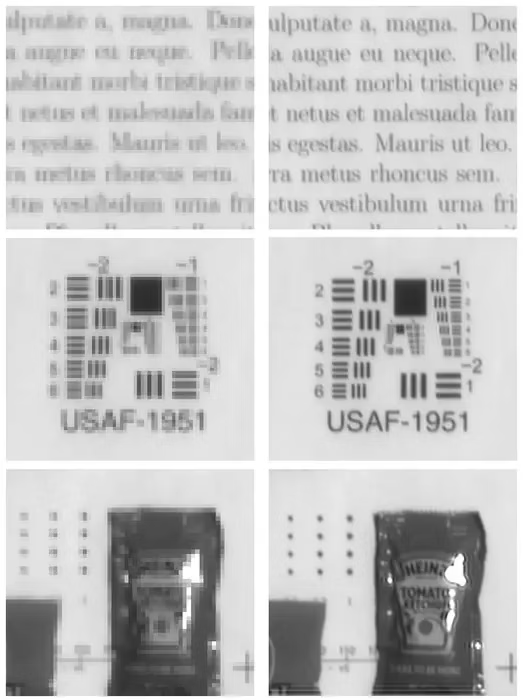
Most photographers learn early on that the key to a sharp image is a steady hand. Conventional wisdom holds that the more still a camera is, the clearer the shot will be. But a new study led by engineers at Brown University challenges that long-standing assumption. Surprisingly, the researchers have shown that a moving camera, paired with the right computational tools, can actually produce sharper and higher-resolution images than a perfectly steady one.
Breaking Conventional Thinking
“We all know that when you shake a camera, you get a blurry picture,” explained Pedro Felzenszwalb, professor of engineering and computer science at Brown. “But what we show is that an image captured by a moving camera actually contains additional information that we can use to increase image resolution.”
The key lies not in the motion itself but in how the motion interacts with a clever algorithm. This new image-processing method is capable of extracting extra visual data hidden within blurred exposures. With it, even ordinary cameras could potentially deliver results comparable to gigapixel-quality imaging, a level typically reserved for highly specialized equipment.
Such advancements could revolutionize both everyday photography and more specialized fields like scientific imaging, archival documentation, and aerial surveillance.
Why Cameras Blur
To understand the breakthrough, it helps to know how digital cameras form images. Cameras record scenes by averaging the light intensity that falls onto a grid of tiny pixels. This method imposes a hard limit on resolution: if a detail is smaller than a single pixel, the information is effectively lost, smeared across the pixel instead of being represented precisely.
This limitation means fine textures—like the delicate lines of a painting or the intricate weave of fabric—get blurred because they fall below the pixel scale. Traditionally, image sharpness could only be improved by increasing sensor resolution or using expensive optics.
Using Motion to Reveal Detail
Felzenszwalb’s team approached the problem from a different angle. They reasoned that motion, rather than being an obstacle, could be used as a tool. When a camera moves, tiny points of light in the scene leave streaks or tracks across multiple pixels. The team’s algorithm interprets these tracks as additional data, using them to reconstruct fine details that the original pixel grid would have obscured.
In effect, the camera’s motion spreads hidden information across the sensor, and the algorithm reassembles it into a super-resolution image—sharper than what the pixel array alone would allow.
Testing the Idea
To put their theory into practice, the researchers mounted a conventional camera onto a moving stage, giving them precise control over motion patterns. They experimented in two main ways.
- In one set of tests, the team captured multiple images, shifting the camera slightly between each exposure. The algorithm then combined these shots into a single, high-resolution reconstruction.
- In another scenario, they allowed the camera to move during a single exposure, generating a blurred image that the algorithm could decode into a clearer, sharper result.
Both approaches demonstrated the same outcome: motion, far from degrading the image, actually enabled higher resolution when processed correctly.
Defying Earlier Assumptions
“There was some prior theoretical work that suggested this shouldn’t be possible,” Felzenszwalb noted. “But we show that there were a few assumptions in those earlier theories that turned out not to be true. And so this is a proof of concept that we really can recover more information by using motion.”
This overturns decades of thinking in both photography and computer vision, offering a new way to rethink the relationship between hardware and computational imaging.
Looking Ahead
The team sees numerous applications for their technique. Museums and archives, for example, could use motion-assisted imaging for super-resolution photography of artworks and artifacts, capturing details invisible to the naked eye without requiring exotic equipment. Similarly, the method could prove valuable for aerial photography, where some degree of camera motion is inevitable.
Longer term, the researchers envision their algorithm being adapted for use in consumer devices. “There are existing systems that cameras use to take motion blur out of photos,” Felzenszwalb said. “But no one has tried to use that to actually increase resolution. We show that’s something you could definitely do.”
If integrated into future smartphones or DSLRs, this technology could allow casual photographers to achieve results once thought possible only in professional or scientific settings.
Next Steps
For now, the Brown University team is focused on refining the algorithm and exploring partnerships with industry leaders who could bring the technique into the commercial market. Their work, recently presented at the International Conference on Computational Photography and posted on arXiv, signals a major step forward in computational imaging.
By rethinking the role of motion, Felzenszwalb and his colleagues have shown that the once-dreaded “shaky hands” of photography may, in fact, be an asset. If their vision comes to fruition, the simple act of moving a camera could unlock levels of clarity and resolution that push the boundaries of what photography can achieve.