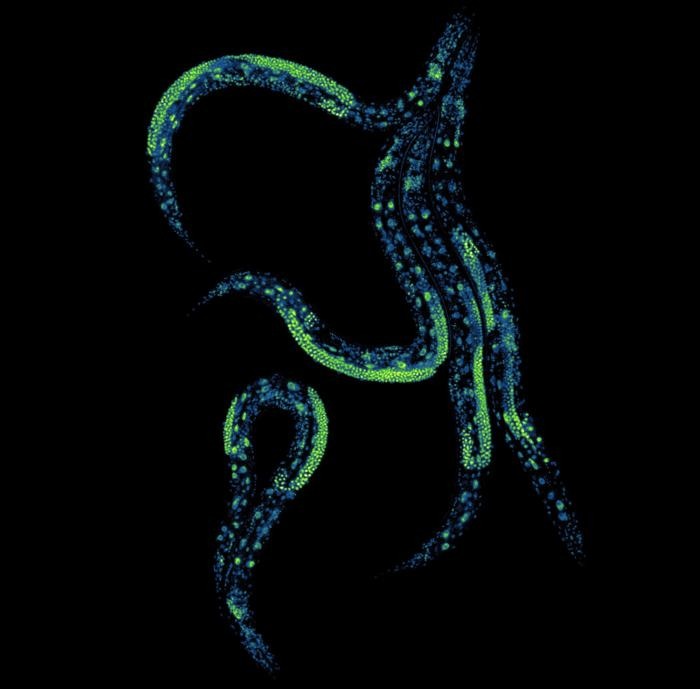
Researchers from the Centre for Genomic Regulation in Barcelona and the University of Cambridge have, for the first time, achieved precise, lifelong control over protein levels in specific tissues of a living animal. Using a retooled plant hormone system, the team can now “dial” protein concentrations up or down in the worms’ intestines and neurons, a breakthrough that unlocks new ways to study the systemic biology of ageing and disease.
Imagine being able to adjust the volume of specific songs playing in different rooms of your house, all from a single master control, without ever stopping the music. That’s the level of precision a new biological tool brings to studying proteins in a living organism. For the first time, scientists can now fine-tune how much of a specific protein is present in different tissues throughout an animal’s entire life, a feat that could revolutionize our understanding of complex processes like ageing. The breakthrough, led by Dr. Nicholas Stroustrup, researcher at the Centre for Genomic Regulation (CRG), is described in a new paper published in the journal Nature Communications.
READ ALSO: https://modernmechanics24.com/post/frontier-supercomputer-nuclear-ai-era/
Until now, researchers studying proteins in model organisms like the nematode worm C. elegans have often been stuck with a blunt instrument: turning a protein completely on or off by manipulating its gene. But biology is rarely so binary. “To unpick nuance in biology, sometimes you need half the concentration of a protein here and a quarter there, but all we’ve had up till now are techniques focused on wiping a protein out,” explained Dr. Stroustrup, senior author of the study. This lack of finesse has made it difficult to trace how subtle molecular changes in one tissue ripple through the entire body over a lifetime, a critical gap in understanding systemic diseases and ageing.
The new method, reported by the CRG, is a sophisticated adaptation of a tool borrowed from plants. Plants use a hormone called auxin to control growth, and scientists had previously engineered an auxin-inducible degron (AID) system for lab use. In simple terms, it works by tagging a target protein for destruction only when auxin is present. Remove the hormone, and the protein returns. However, this system had limitations for whole-animal studies, particularly in achieving independent control in different tissues.
The international team, which included collaborators from the University of Cambridge, engineered their way past these limits. They created a “dual-channel” AID system by developing two different versions of the key enzyme (TIR1) that responds to distinct auxin compounds. By placing these different enzymes in specific tissues—like the intestine or neurons—they could independently control the levels of the same protein in each location. “We wanted to be able to control proteins like you turn the volume up or down on a TV, and now we can ask all sorts of new questions,” said Dr. Stroustrup.
WATCH ALSO: https://modernmechanics24.com/post/chinese-company-new-humanlike-robot/
The engineering feat was significant. The team tested over one hundred thousand nematode worms to find the perfect combination of synthetic switches that wouldn’t interfere with each other. They also solved a major technical hurdle: getting the system to work in reproductive tissues, where previous AID systems often failed. This makes their tool functional across the worm’s entire body.
“Getting this to work was quite an engineering challenge,” said Dr. Jeremy Vicencio, postdoctoral researcher at the CRG and study co-author. “Now that we’ve cracked it, we can control two separate proteins simultaneously with incredible precision. It’s a powerful tool that we hope will open up new possibilities for biologists everywhere.” The implications are profound. Researchers can now design experiments to determine the exact amount of a protein needed to maintain health, or see how tweaking a protein in the gut affects function in the brain over time. This finesse is crucial for studying ageing, a whole-body process governed by complex conversations between organs. By moving beyond simple on/off switches, this tool provides the calibration needed to finally unravel these intricate molecular dialogues.
READ ALSO: https://modernmechanics24.com/post/argonne-expands-ai-infrastructure-with-new-supercomputers/