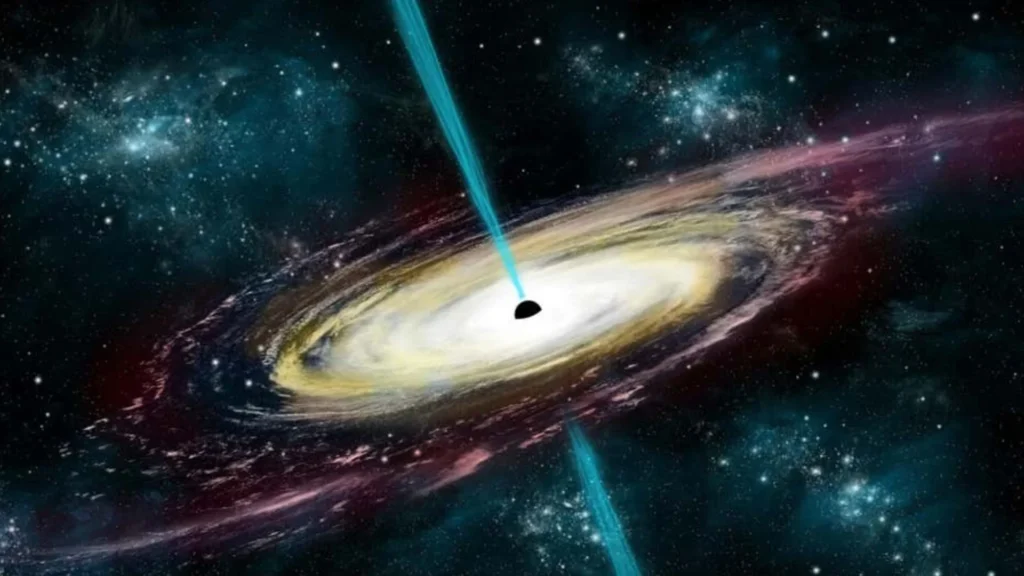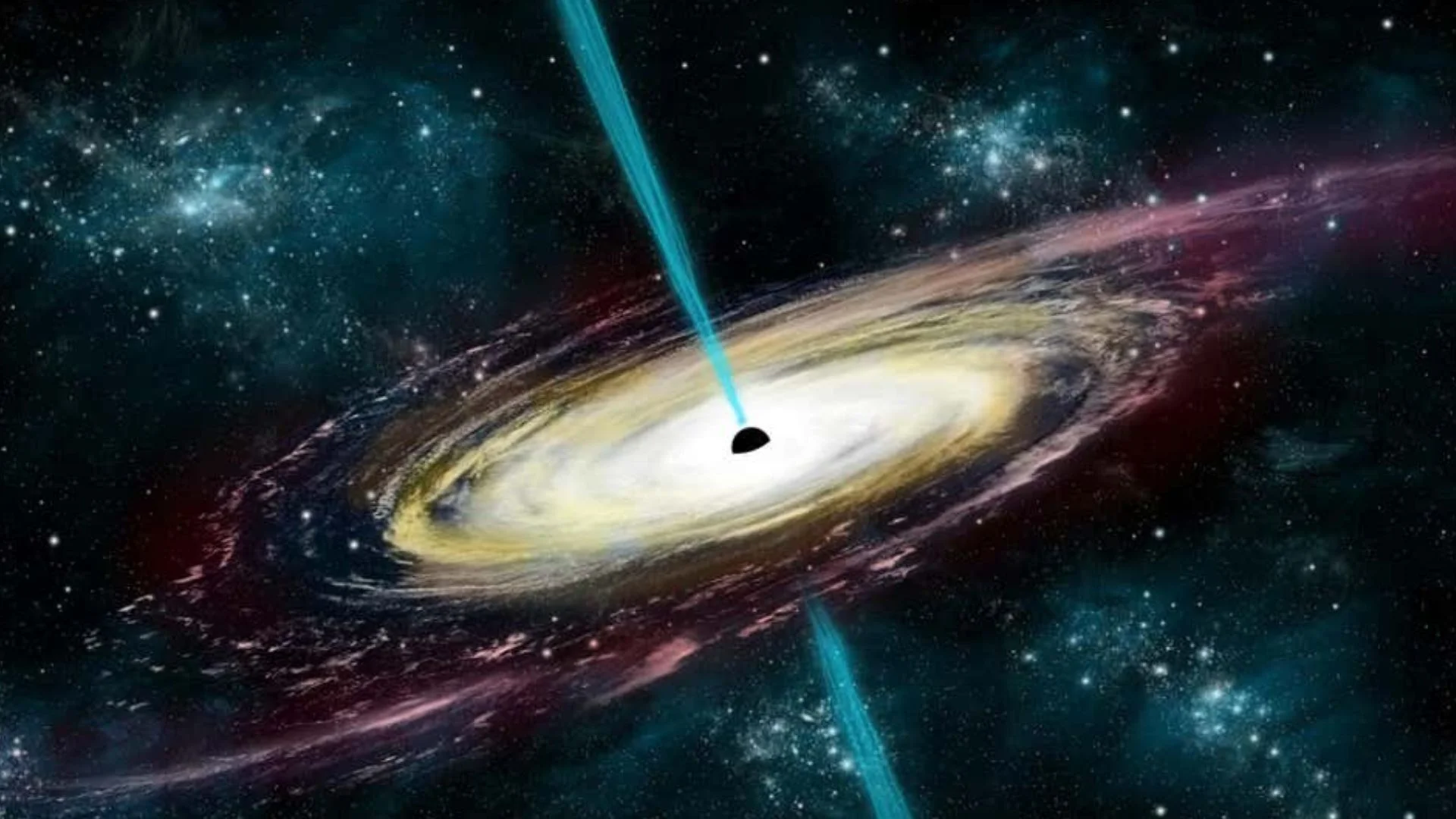
Astronomers have discovered a rare and fascinating phenomenon at the center of the galaxy Markarian 501: two supermassive black holes orbiting each other at a very close distance.
This discovery sheds new light on one of the most important processes in the universe: how galaxies grow and evolve over time.
The research was led by Silke Britzen from the Max Planck Institute for Radio Astronomy. The study has been accepted for publication in the Monthly Notices of the Royal Astronomical Society. Scientists believe this is the first time such a close pair of supermassive black holes has been directly identified just before merging.
READ ALSO: Germany’s Agile Robots Teams with Google DeepMind on AI Humanoid
Supermassive black holes are found at the centers of almost all large galaxies. These objects are extremely massive, ranging from millions to billions of times the mass of the Sun. However, their growth has remained a mystery.
Scientists have long suspected that mergers between black holes, especially during galaxy collisions, play a major role in building such enormous masses. While galaxy collisions are common, observing the final stages of black hole mergers has been very difficult, until now.
Black Hole Jets in Markarian 501 Show a Cosmic Dance
The breakthrough came from studying powerful particle jets emitted from the center of Markarian 501. These jets travel at nearly the speed of light and are typically linked to supermassive black holes. By analyzing high-resolution radio data collected over 23 years, the team noticed something unusual, not one, but two jets.
One jet is pointed almost directly toward Earth, making it bright and easy to observe. The second jet, however, is tilted in a different direction, which made it harder to detect earlier. When scientists carefully tracked this second jet, they observed that it moves in a repeating pattern.
WATCH ALSO: BYD SEAL Delivers Lightning-Fast Acceleration for Effortlessly Smooth Drives
The second jet appears to emerge from behind the larger black hole and then circle it counterclockwise. This movement repeats over time, suggesting that two black holes are orbiting each other and influencing the jets. Silke Britzen described the discovery clearly, saying they not only detected the second jet but also followed its motion over time.
At one point in June 2022, the system briefly aligned in a way that created an Einstein ring, a ring-shaped appearance caused by gravitational lensing. In this case, the gravity of the front black hole bent the light from the second jet behind it. This rare observation provided strong evidence supporting the existence of two black holes in the system.
Although the black holes cannot be seen directly as separate objects, scientists used the motion and brightness changes of the jets to estimate their behavior. They found that the two black holes orbit each other every 121 days, which is very fast considering their massive size.
The distance between them is only about 250 to 540 times the distance between Earth and the Sun, extremely close on a cosmic scale. Each black hole is estimated to have a mass between 100 million and one billion times that of the Sun. Because of this tight orbit and enormous mass, scientists believe the pair could merge in as little as 100 years.
READ ALSO: China Builds Artificial Floating Island to Unlock Secrets Hidden in Deep Seas
Even advanced instruments like the Event Horizon Telescope are not powerful enough to directly image the two black holes separately due to their great distance from Earth. However, scientists expect to detect the merger in a different way: through gravitational waves.
As black holes spiral closer, they will produce low-frequency gravitational waves that can be detected by pulsar timing arrays. In 2023, scientists already found evidence of a gravitational wave background, likely caused by many such black hole pairs. Markarian 501 now stands out as one of the best candidates to directly link these signals to a real system.
Co-author Héctor Olivares explained that if gravitational waves from this system are detected, scientists may observe their frequency increasing over time as the black holes move closer. This would allow researchers to track a supermassive black hole merger in real time.
This discovery offers a rare opportunity to understand a key phase in galaxy evolution. For the first time, scientists are not just predicting such events; they are watching one unfold.