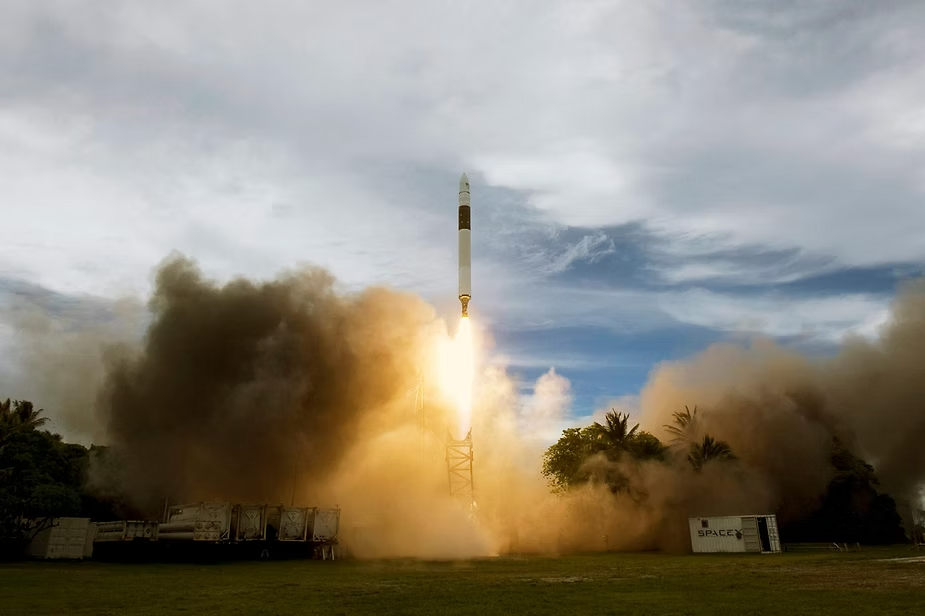
Chinese aerospace entities are in a heated race to achieve the nation’s first successful orbital-class rocket landing, with three reusable vehicles—the state-backed Long March 12A and commercial contenders Zhuque-3 and Tianlong-3—now positioned at the Jiuquan Satellite Launch Centre.
A successful landing by any would make China the second nation after the United States to accomplish this feat, a critical step for building China’s massive internet satellite constellations and competing on the global launch market.
The competition is particularly tight between the Long March 12A, developed by the Shanghai Academy of Spaceflight Technology (SAST), and the Zhuque-3 from private firm LandSpace. Both are similar in size, use liquid methane and liquid oxygen propellant, and are reportedly aiming for December launch windows that will see them attempt to reach orbit and bring their first stages back to Earth about 400km downrange.
According to a Beijing-based rocket engineer familiar with the matter, the technical readiness of the two rockets is “on par,” but there have been “internal considerations” about which should get the historic first attempt.
READ ALSO: https://www.modernmechanics24.com/post/sex-toy-use-women-60-plus-usa
“The state-owned contractors may try to leverage their influence to go first,” the source stated, speaking on condition of anonymity. “Pulling off China’s first rocket landing would be huge.”
This high-stakes environment was further illustrated when LandSpace’s planned launch of the Zhuque-3 was initially delayed following the Tiangong space station’s debris incident in early November and has since been postponed again from its rescheduled date on the final weekend of the month.
Meanwhile, the Long March 12A appears to be pressing forward. Photos shared by space enthusiasts on social media show the rocket being rolled out and raised on the pad, apparently in preparation for a major engine test. The Tianlong-3, developed by Space Pioneer, is also designed for reuse but is not expected to attempt a landing on its debut flight, positioning it slightly behind in this immediate historic contest.
The technological parallels to Western systems are striking. Texas-based SpaceX achieved the world’s first such landing nearly a decade ago with its Falcon 9 rocket, which remains the only rocket that routinely returns and reuses its booster.
The design of the Zhuque-3, a 66-meter-tall rocket built from stainless steel and powered by nine Tianque-12A engines, has even drawn commentary from Elon Musk. He noted last month that it “surpassed the Falcon 9 on multiple key metrics” by adding “aspects of Starship – such as stainless steel and methalox – to a Falcon 9-like architecture.”
The commercial and strategic imperative for this capability is immense. In its reusable mode, the Zhuque-3 can carry 18 tonnes to low-Earth orbit, enabling it to launch roughly 18 satellites at a time. This capacity is vital for efficiently constructing China’s planned mega-constellations, including the state-owned Guowang and Shanghai’s Qianfan project, each expected to involve more than 10,000 satellites.
READ ALSO: https://www.modernmechanics24.com/post/hyundai-crater-concept-debut-la-2025
The Long March 12A, capable of lifting 12 tonnes, is similarly poised to support this national infrastructure push. The first stage of the Zhuque-3 is designed to fly at least 20 times, a key factor in driving down launch costs.
While the immediate focus is on this first landing, the companies are already looking to the next generation. Landspace is informally working on a Starship-scale rocket known as Zhuque-X, which will be powered by a new, more powerful engine called the Lanyan-20.
As of September, this 200-tonne thrust class engine had conducted over 30 test firings, reaching about half of its planned thrust. This forward-looking development underscores that the current race at Jiuquan is just the first chapter in China’s ambitious, multi-pronged drive to master and advance reusable launch technology.
WATCH ALSO: https://www.modernmechanics24.com/post/china-40000t-sichuan-assault-ship