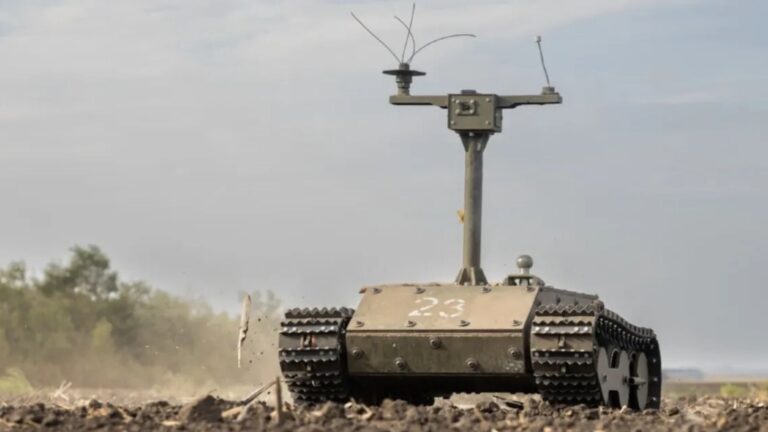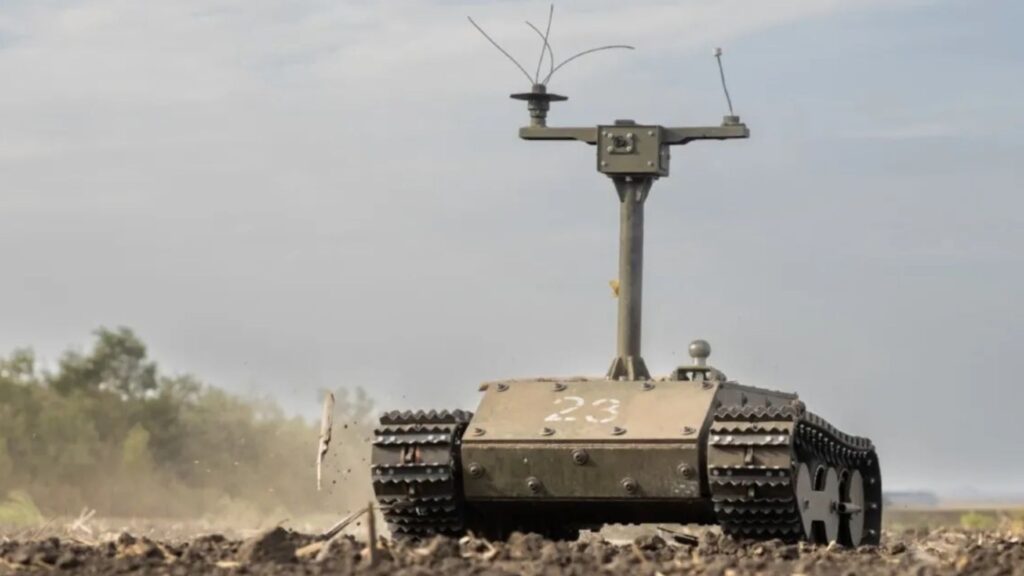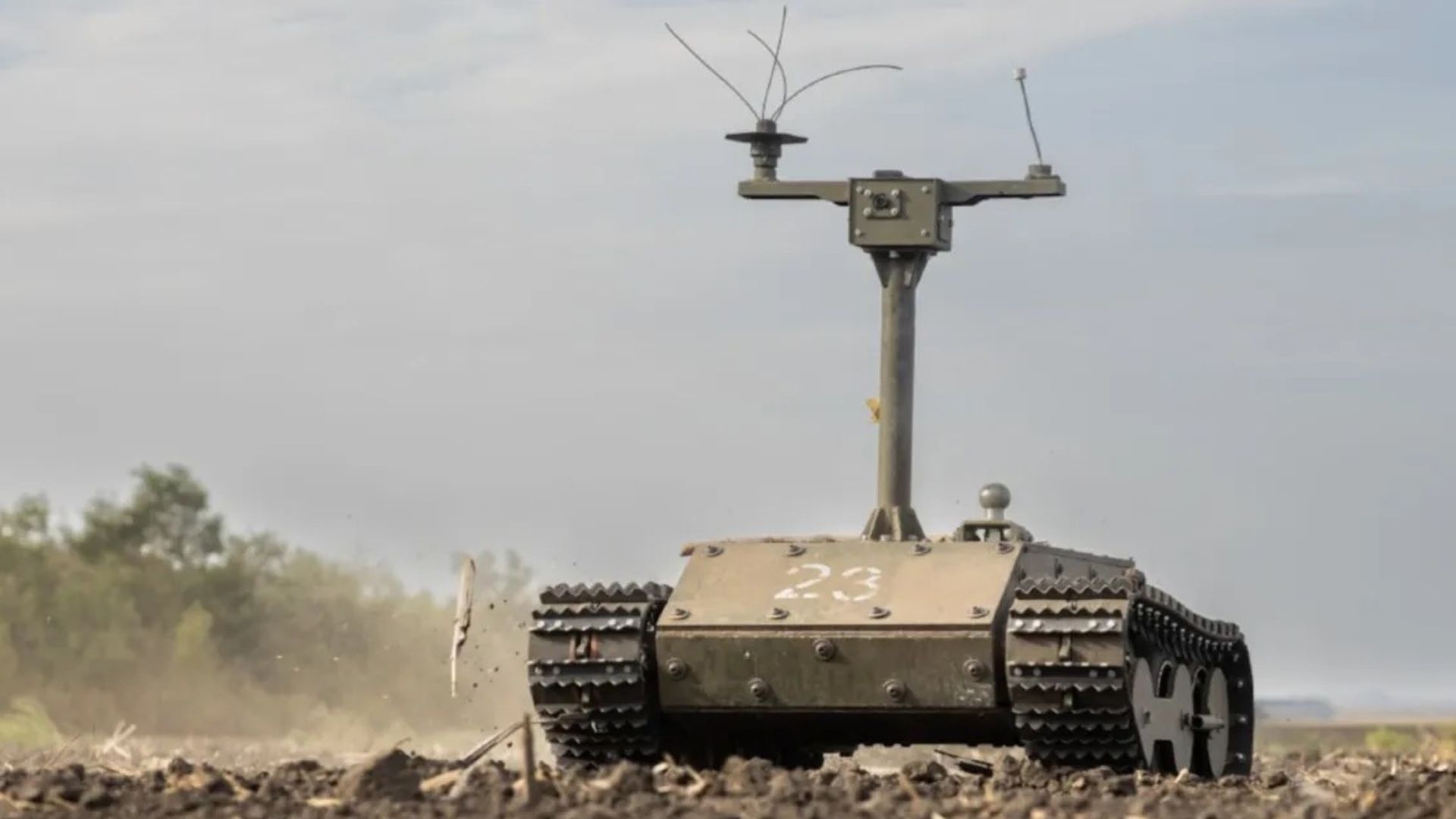
The Ukrainian military has started deploying large numbers of uncrewed ground vehicles (UGVs), also known as armed ground robots.
These robotic machines can move across the battlefield, carry weapons, and perform dangerous missions without putting soldiers directly at risk.
The war in Ukraine has rapidly evolved into one of the most technologically advanced conflicts in modern history. Since Russia launched its full-scale invasion, both sides have relied on drones, automated systems, and new battlefield technologies.
Uncrewed aerial drones already dominate the skies over Ukraine. At sea, uncrewed boats have successfully targeted Russian naval vessels in the Black Sea. Now, Ukraine is expanding the use of robotic systems on land.
According to Ukrainian military officials, these robots have already demonstrated their value during combat operations. There have been reports that UGVs helped repel Russian assaults and even captured enemy soldiers.
Some battlefield incidents suggest that robotic systems from both sides have already encountered each other, with no human troops present at the scene.
Oleksandr Afanasiev of the Ukrainian army’s K2 Brigade says robotic combat is already a reality. “Robot wars are already happening,” he said. Afanasiev commands what he describes as the world’s first UGV battalion.
One common use of these robots involves mounting machine guns on them. “They open fire on a battlefield where an infantryman would be afraid to turn up,” Afanasiev said. “But a UGV is happy to risk its existence.”
READ ALSO: https://modernmechanics24.com/post/china-largest-compressed-air-energy/
His unit also uses explosive-filled kamikaze robots that can drive toward enemy positions and detonate. These battery-powered machines are particularly dangerous because they move quietly across the ground.
Unlike aerial drones, they do not produce loud buzzing sounds that warn the enemy about an incoming attack.
A deputy commander in Ukraine’s 33rd Detached Mechanised Brigade, known by the callsign Afghan, described several successful missions using ground robots.
He said one Ukrainian robot armed with a machine gun ambushed a Russian armored personnel carrier. In another case, a robotic system helped defend a Ukrainian position for several weeks.
Despite these advances, Ukrainian officers say robots do not operate completely on their own.
WATCH ALSO: https://modernmechanics24.com/post/blue-dogs-spotted-in-chernobyl-zone/
“Modern UGVs are part-autonomous,” Afghan said. “They can move on their own, observe the battlefield, and detect the enemy. But a human operator still makes the decision to open fire.”
He added that human control is important to avoid mistakes. “Robots can misidentify a target or attack a civilian. That’s why the final decision must be made by an operator,” Afghan said.
Most armed robots are therefore controlled remotely through internet connections by operators positioned at a safe distance from the battlefield.
UGVs can carry different types of weapons, including machine guns and grenade launchers. They can also plant landmines, install barbed wire, transport supplies, and evacuate wounded soldiers.
However, the majority of ground robots are still used mainly for logistics rather than combat.
READ ALSO: https://modernmechanics24.com/post/uofg-space-test-facility-win-tech-award/
Military analysts believe their combat role will expand significantly in the future.
Valerii Zaluzhnyi, Ukraine’s former commander-in-chief and current ambassador to the United Kingdom, says future warfare will involve coordinated swarms of drones operating in the air, on land, and at sea.
“In the near future, we will see dozens or even hundreds of drones attacking from different directions and heights at the same time,” Zaluzhnyi said.
Ukraine’s growing reliance on robotic systems is partly driven by the dangers on the battlefield. Drones have made it extremely risky for soldiers to operate near the front lines, expanding the so-called “kill zone” to 20–25 kilometers from the line of contact.
“Ukraine can afford to lose robots,” Afanasiev said. “But it cannot afford to lose battle-ready soldiers.”
Russia is also developing its own robotic systems. One example is the Kuryer combat robot, which Russian reports say can carry heavy machine guns or flamethrowers and operate autonomously for up to five hours.
Russian forces have also deployed small kamikaze vehicles known as “Lyagushka,” or “Frog,” to attack Ukrainian positions.
WATCH ALSO: https://modernmechanics24.com/post/chinese-firm-unveils-humanoid-robot-that-mimics-meditation/
Yuriy Poritsky, CEO of Ukrainian robotics company Devdroid, says clashes between Russian and Ukrainian robots are likely to increase.
“Sooner or later, our strike UGV will meet their strike UGV on the battlefield,” he said. “Robot wars may sound like science fiction, but this is already our reality.”
Demand for these systems is growing rapidly. Ukrainian manufacturer Tencore produced more than 2,000 ground robots for the military in 2025.
Its director, Maksym Vasylchenko, expects production to reach about 40,000 units in 2026, with many equipped for combat missions.
“Strike drones will become indispensable,” he said.
Vasylchenko believes the future could bring even more advanced machines. According to him, robots may eventually fight in human-like forms on future battlefields.