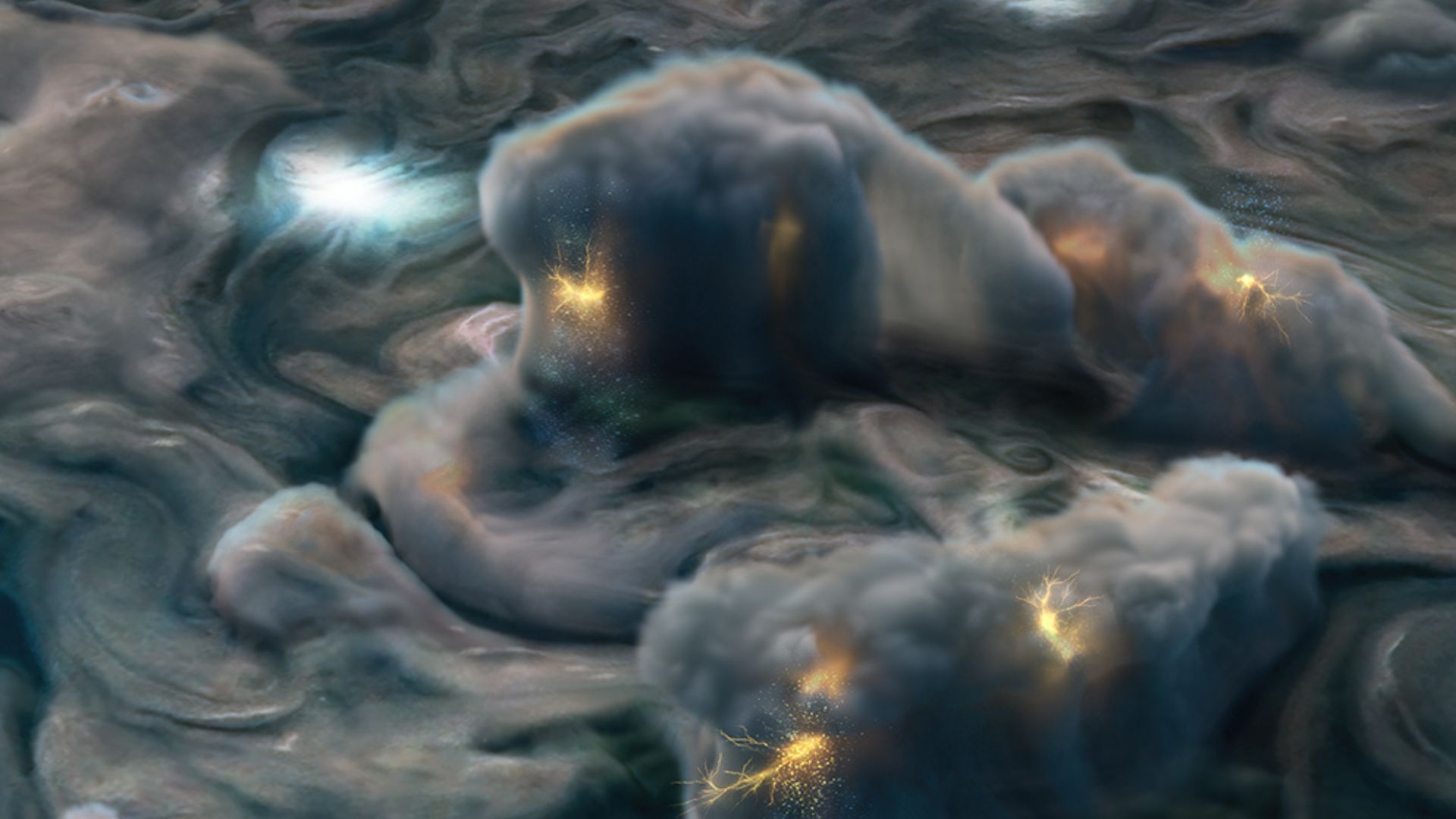
A new study reveals that Jupiter generates lightning far more powerful than anything ever recorded on Earth, offering fresh insights into the nature of massive space storms.
Scientists say some of Jupiter’s lightning bolts can be up to 100 times stronger than those on our planet. These findings are helping researchers better understand how storms work, not just on Jupiter, but also on Earth.
Lightning on Earth is already extremely powerful. A single strike can carry about one gigaJoule of energy. That is enough to destroy trees, damage buildings, and even shut down power systems.
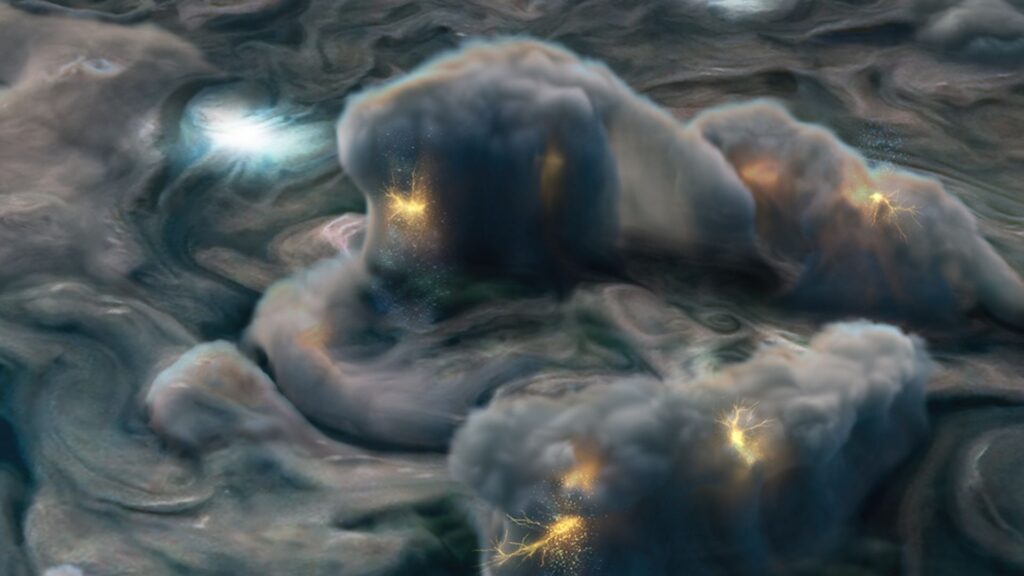
But Jupiter takes this to another level. According to recent research published in AGU Advances, lightning on the gas giant can release much more energy, sometimes hundreds or even thousands of times stronger than Earth’s typical lightning. This makes Jupiter’s storms some of the most intense in the solar system.
Jupiter’s Lightning
Even though lightning is common on Earth, scientists still do not fully understand it. There are still mysteries about how lightning forms and behaves. For example, researchers only recently discovered brief flashes called transient luminous events that occur high above thunderstorms.
READ ALSO: US Argonne Lab Proposes 3D Printing for Next-Gen Nuclear Reactor Parts
By studying Jupiter, scientists hope to learn more about these processes. Jupiter’s extreme conditions provide a natural laboratory. Its storms are bigger, stronger, and last much longer than those on Earth.
Jupiter is famous for its massive storms. Some of them are so large that they can swallow Earth entirely.
One example is the Great Red Spot. This giant storm has been active for over 200 years. It stretches more than 10,000 miles across and has wind speeds of around 200 miles per hour. Over time, storms like this have produced countless lightning flashes.
To understand Jupiter better, scientists have been studying data from NASA’s Juno spacecraft. Juno has been orbiting Jupiter since 2016. It uses advanced instruments to scan the planet’s atmosphere. One of these tools can detect radio signals produced by lightning.
Earlier missions had already seen lightning on Jupiter. However, most observations were made on the night side of the planet. These mainly captured very strong flashes.
Because of this, scientists were unsure if Jupiter also had weaker lightning, as Earth does.
WATCH ALSO: YouTuber captures lightning in a bottle during stunning experiment
Jupiter’s Storms changed during a calmer period in 2021 and 2022. During this time, scientists were able to focus on specific storms in Jupiter’s North Equatorial Belt. They used data from Juno, the Hubble Space Telescope, and even citizen scientists.
Michael Wong, a planetary scientist involved in the study, said the team finally had precise data. He explained that they could directly measure lightning’s power once they knew exactly where to look.
During several passes over Jupiter’s storms, Juno recorded lightning signals about three times per second. In one case, it detected 206 pulses in a short period.
In total, researchers studied over 600 lightning bursts. They found a wide range of energy levels. Some were similar to lightning on Earth. But others were far more powerful, up to 100 times stronger. Further calculations suggested that some lightning strikes could carry between 500 and 10,000 times more energy than those on Earth.
What Makes Jupiter’s Lightning So Strong?
Scientists believe Jupiter’s atmosphere plays a key role. Unlike Earth, which has a nitrogen-rich atmosphere, Jupiter is mostly made of hydrogen. Hydrogen behaves differently from nitrogen. It requires more energy to rise in a storm. But when it does rise, it releases a huge amount of energy.
READ ALSO: US Navy’s New AI-Powered Hammerhead Mines Target Enemy Subs Automatically
Wong said scientists are still exploring this idea. He explained that the difference could be due to the type of gases or the height of the storms. Jupiter’s storms are much taller than those on Earth. This could also contribute to stronger lightning.
While the discovery is exciting, many questions remain. Scientists still want to understand exactly how Jupiter’s lightning forms and why it varies so much in strength.
At the same time, these findings could improve our understanding of Earth‘s weather. By studying the most extreme storms in the solar system, researchers hope to unlock the secrets of lightning across the solar system.