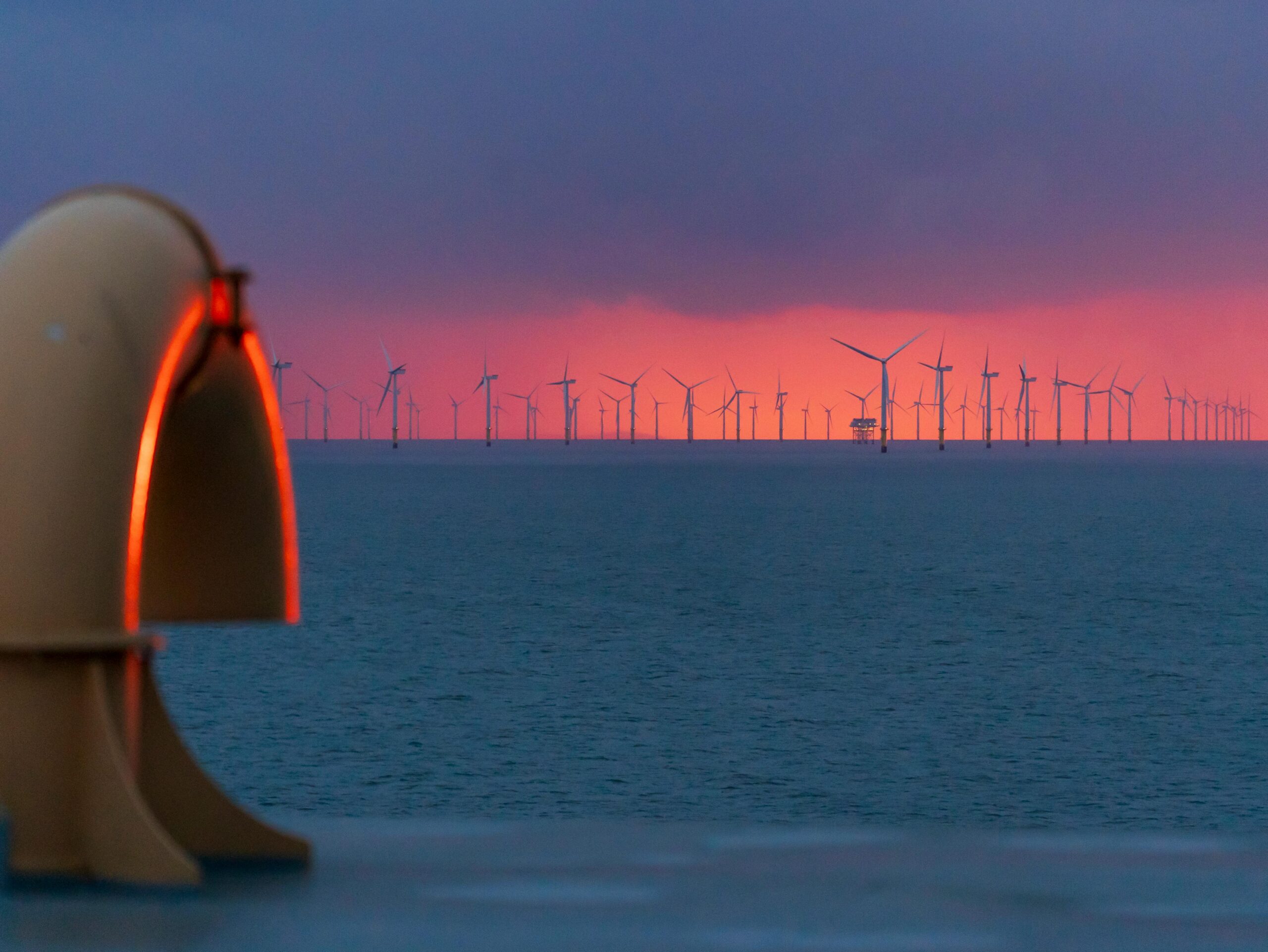
A consortium led by TODA Corporation has launched Japan’s first commercial floating wind farm, the Goto Floating Wind Farm, using a groundbreaking hybrid spar-type floater that combines a steel upper section with a concrete lower section. Located off Nagasaki, this 16.8 MW pilot project marks a critical step toward Japan’s goal of deploying 10 GW of offshore wind by 2030 and is the world’s first commercial use of this innovative hybrid floating design.
For a nation with limited shallow coastal waters, the dream of large-scale offshore wind power has long been anchored to a technological hurdle: how to build in deep water. Japan’s answer has now officially begun spinning. On January 5, the Goto Floating Wind Farm started commercial operations, transforming over a decade of planning into a tangible foundation for the country’s renewable energy future. This isn’t just Japan’s first foray into floating wind; it’s a global debut for a novel hybrid design that could make building in deep seas more feasible and affordable.
Why is this so crucial for Japan? The geography is the defining challenge. Traditional fixed-bottom turbines are impossible in waters deeper than about 50-60 meters. Japan’s continental shelf drops off sharply, leaving vast swathes of its prime offshore wind resources over deep water. Floating technology is the only key to unlocking this potential. The Japanese government has set ambitious targets, aiming for 10 gigawatts (GW) of offshore wind by 2030 and a staggering 45 GW by 2040, with floating turbines expected to contribute at least 15 GW. The Goto project, though a modest 16.8 MW from eight Hitachi 2.1MW turbines, is the essential proof-of-concept to get this industry off the ground.
READ ALSO: https://modernmechanics24.com/post/students-revive-1903-flight-legacy/
The project’s crown jewel is its innovative foundation. Designed and built by TODA Corporation, the floater is a hybrid spar-type structure. This means it uses a heavy, stable base to keep the turbine upright. The clever part is the material mix: a steel upper section married to a concrete lower section. This hybrid approach aims to optimize cost and construction logistics. Concrete, often cheaper and easier to source for large, heavy structures, forms the ballasted base, while steel is used for the connecting column. According to the project consortium, this is the world’s first commercial application of such a hybrid spar design, a potential game-changer for reducing the Levelized Cost of Energy (LCOE) for floating wind.
The farm floats roughly 7 kilometers (4 miles) off Fukue Island in water depths of 130-140 meters (426-459 feet), conditions where fixed foundations are unthinkable. The development consortium is a who’s who of Japanese industry giants, including Eneos Corporation, Osaka Gas, Inpex, Kansai Electric Power, and Chubu Electric Power. In line with Japan’s focus on regional energy security, all power generated will be supplied to local consumers in the area.
The path to this launch hasn’t been smooth. Japan’s offshore wind industry has been hampered by high costs, complex regulations, and the sheer engineering challenge of its deep coastal waters. The Goto farm is also the first project to come to fruition under a dedicated support program from Japan’s Minister of Economy, Trade and Industry and Minister of Land, Infrastructure, Transport and Tourism. Its success is seen as a vital litmus test.
The data gathered on performance, maintenance, and environmental impact in the harsh conditions of the East China Sea will be invaluable. It will de-risk future, larger projects and provide a blueprint for the 45 GW pipeline Japan hopes to build. For a resource-poor island nation seeking energy independence and a clean power transition, the Goto Floating Wind Farm is more than just eight turbines—it’s the first concrete (and steel) step into a deep-water future.
READ ALSO: https://modernmechanics24.com/post/worlds-largest-hualong-one-online/