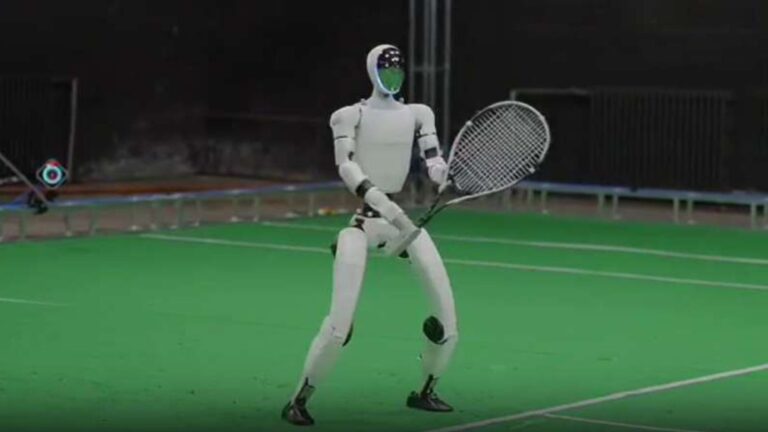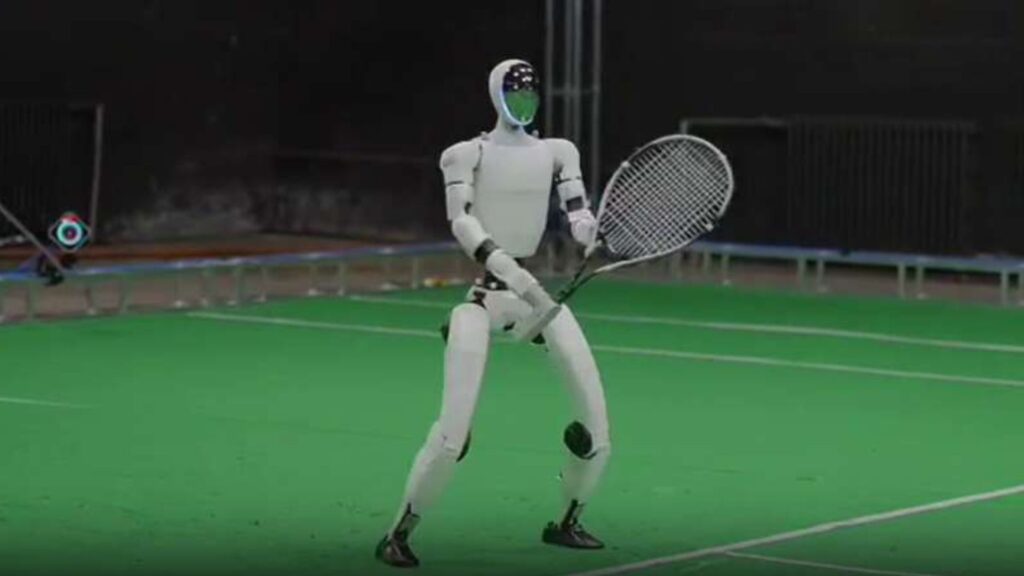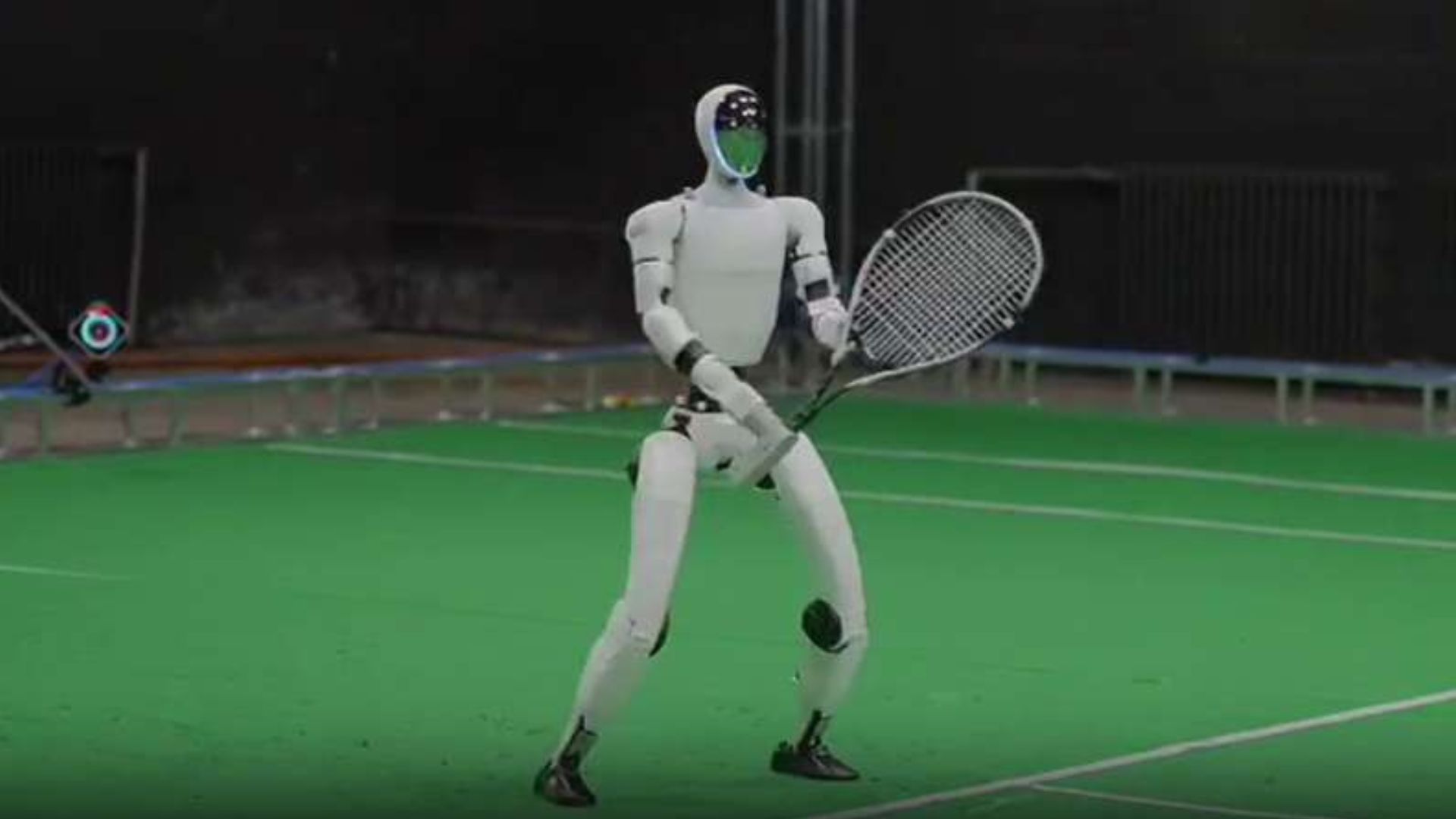
Researchers have taught a humanoid robot to play tennis using imperfect motion data from amateur players. The robot can return balls with high accuracy and move naturally. This solves a long‑standing challenge in teaching robots athletic skills.
The team calls their system LATENT. It was developed by researchers in China working with Galbot, a Chinese AI robotics company. Their findings appear in a preprint paper on arXiv.
READ ALSO: Anthropic Seeks Chemical Weapon Experts; AI Safety Concerns Deepen Globally
Teaching robots sports like tennis is hard. These tasks require fast reactions and precision. Past methods used complex human motion data that was often too difficult for robots to replicate.
LATENT makes learning easier by using fragmentary motion data. The team collected 5 hours of motion-capture data on basic tennis moves—like forehand, backhand, and footwork—from amateur players. They then built a latent action space that lets the robot correct and combine these movements.
READ ALSO: Sun’s Hidden Engine Found 200,000 Kilometers Below Surface; Scientists Track Magnetic Mystery
After training with reinforcement learning and simulations, they deployed the system on a Unitree G1 humanoid robot. In real‑world tests, the robot played multi‑shot rallies with humans and adapted to different areas of the court. It achieved a 96.5% success rate, meaning it returned incoming balls within 2.5 meters of the target.
The system still has limits. It relies on motion capture equipment, so it cannot yet see or react on its own. It also has not been tested in a full two‑player match.
WATCH ALSO: Boston Dynamics Atlas humanoid robot demonstrates remarkable mobility, balance
Despite these limits, LATENT shows that robots can learn athletic skills from imperfect human data. The researchers say the approach could be extended to other sports or tasks where obtaining perfect motion data is difficult.