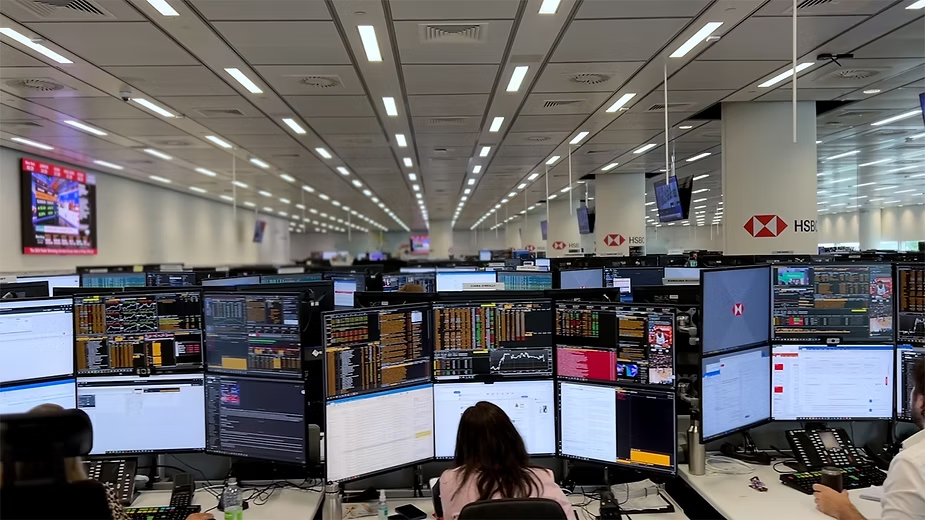
HSBC has announced the world’s first-known demonstration of quantum-enabled algorithmic trading, revealing how today’s quantum computers can deliver measurable benefits to real-world financial problems. In a pioneering trial with IBM, the bank achieved up to a 34% improvement in predicting trade outcomes in the European corporate bond market compared to widely used classical methods.
A New Frontier in Algorithmic Trading
Corporate bond trading often relies on algorithmic strategies to quote prices in competitive bidding processes. These algorithms must rapidly integrate market data, risk factors, and customer demand, allowing traders to respond to client inquiries in real time. While traditional computer models handle much of this work, the complexity of these variables leaves room for improvement — and that’s where quantum computing steps in.
HSBC and IBM’s trial explored whether hybrid quantum-classical techniques could improve how requests for quotes are managed in over-the-counter (OTC) markets, where trades occur directly between two parties rather than through exchanges. By running production-scale trading data on multiple IBM quantum systems, the teams showed that quantum resources can uncover patterns in noisy, complex datasets that classical methods often miss.
The outcome: a significant boost in predicting the probability of winning customer inquiries, offering a competitive edge in one of the world’s most data-intensive markets.
WATCH ALSO: https://www.modernmechanics24.com/post/successful-launch-of-agni-prime-by-india
Tangible Results from Today’s Quantum Hardware
“This is a ground-breaking world-first in bond trading,” said Philip Intallura, HSBC Group Head of Quantum Technologies. “It means we now have a tangible example of how today’s quantum computers could solve a real-world business problem at scale and offer a competitive edge, which will only continue to grow as quantum computers advance.
“We have been relentlessly focused on the near-term application of quantum technology. Given the trial delivered positive results on current quantum computing hardware, we are confident we are on the cusp of a new frontier of computing in financial services, rather than something far away in the future.”
The trial demonstrated that IBM’s Heron quantum processor, when paired with classical systems, was able to unravel subtle pricing signals in market data better than classical-only workflows. This improvement highlights how quantum techniques can complement — rather than replace — existing computational strategies.
Why Quantum Matters in Finance
Quantum computing represents a new paradigm in computation, harnessing the principles of quantum mechanics to process information in exponentially larger and more dynamic spaces than classical systems can access. For industries like finance, where vast amounts of noisy data drive decision-making, this capability opens the door to solving optimization problems that are otherwise intractable.
“Such explorations show what becomes possible when deep domain expertise is integrated with cutting-edge algorithm research,” said Jay Gambetta, Vice President, IBM Quantum. “By combining classical strengths with the rich computational space of quantum computers, we can unlock entirely new applications poised to transform industries as quantum systems continue to scale.”
WATCH ALSO: https://www.modernmechanics24.com/post/worlds-largest-fusion-project-iter-progress
A Glimpse into the Future of Trading
The success of this project signals that quantum-enabled workflows could become part of mainstream trading strategies sooner than many expected. HSBC’s experiment suggests a future where parking trading algorithms in hybrid classical-quantum environments may deliver faster, smarter, and more reliable decision-making tools.
For example, better predictive models could help traders price risk more accurately, respond to customer requests more competitively, and uncover new market opportunities hidden in complex data streams.
IBM’s quantum computers are already accessible via the cloud, supported by Qiskit, an open-source software stack designed to accelerate development of quantum algorithms. As the hardware continues to advance, HSBC believes these early demonstrations could evolve into robust, production-ready systems.
A Quantum Leap for Financial Services
By showing practical, measurable benefits on today’s hardware, the trial marks a turning point for the financial sector’s relationship with quantum computing. HSBC and IBM have provided the first empirical evidence that quantum approaches can outperform classical ones in algorithmic bond trading — a result that may redefine the technological landscape of global markets.