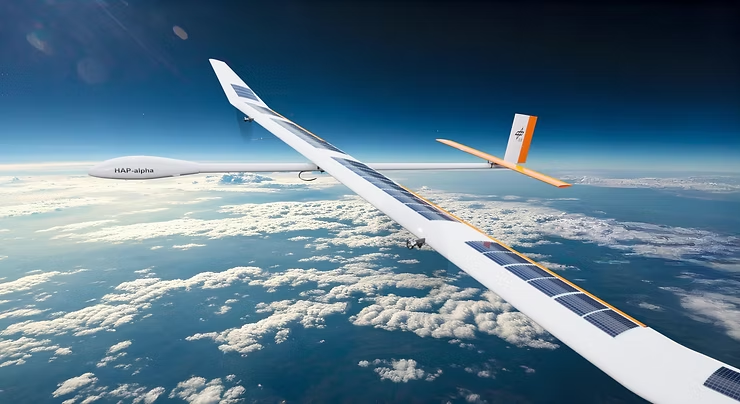
High-altitude uncrewed aircraft are capable of operating for long durations in the lower stratosphere, undertaking a variety of Earth observation and communication missions such as tracking maritime traffic, assisting in disaster relief, and delivering internet connectivity.
The German Aerospace Center has reached a significant milestone in the development of its solar-powered, high-altitude platform HAP-alpha by completing a Ground Vibration Test (GVT). The trials were conducted at the National Experimental Test Center for Unmanned Aircraft Systems in Cochstedt, Germany. Additional evaluations are planned, with the first low-altitude flight trial scheduled for 2026, weather permitting.
“With HAP-alpha, DLR is showcasing its full-spectrum expertise in designing, developing, and operating an entirely new type of aircraft,” said Markus Fischer, DLR Executive Board Member for Aeronautics. “This underscores our role in advancing innovation, strengthening Germany’s technological and industrial standing, and creating new opportunities for collaboration and knowledge sharing with public partners.”
The HAP-alpha platform features a flexible, ultra-light structure, weighing just 138 kilograms with a 27-metre wingspan. Built at DLR’s Braunschweig site, it is intended to reach altitudes of around 20 kilometres and serve as a testbed for advanced sensor systems and long-duration high-altitude technologies.
Key Milestone in Flight Readiness
The recently completed Ground Vibration Test (GVT) marks a crucial step in assessing the vibration behaviour of an aircraft. The purpose of the test is to detect critical vibrations that might occur during takeoff, flight, or landing, which is essential for determining an aircraft’s safety and airworthiness.
For HAP-alpha, this successful GVT represents a major advancement toward its first flight trials, expected next year, which will initially focus on basic low-altitude manoeuvres.
READ ALSO: Driving Innovation: Engineering the Next Generation of Green Race Cars
“The successful Ground Vibration Test is a significant step in the development of our high-altitude platform,” said Julian Sinske from the DLR Institute of Aeroelasticity, which conducted the test. “It shows that we are on the right track to overcoming complex aeroelastic challenges and preparing the platform for flight.”
During the GVT, electromechanical vibrators were used to stimulate the structure, while numerous sensors recorded its dynamic responses. The extremely lightweight and highly flexible design of HAP-alpha presented a unique challenge during the process.
The data gathered will be used to refine simulation models for more accurate predictions of flight performance—particularly during manoeuvres, turbulence, and wind gusts.
“This enables the team to move forward with complete system tests, marking the final phase of ground evaluations before transitioning to flight testing,” added Florian Nikodem, HAP project leader at the DLR Institute of Flight Systems.
READ ALSO: Feeling is believing: Bionic hand ‘knows’ what it’s touching, grasps like a human
READ ALSO: Next-Gen Shape Memory Alloy Designed to Withstand Space’s Harsh Cold
Testing Sensor Systems and Technologies
Through the HAP-alpha project, the German Aerospace Center (DLR) is strengthening its expertise in developing advanced, solar-powered aircraft capable of long-duration operations at high altitudes. Beyond its role as a flight platform, HAP-alpha will serve as a testbed for sensor systems and related technologies under realistic stratospheric conditions.
In addition to the aircraft itself, DLR is creating two specialised sensor systems and refining data evaluation methods for their use:
- MACS-HAP (Modular Aerial Camera System – High Altitude Platform): a high-resolution imaging system.
- HAPSAR (High Altitude Platform Synthetic Aperture Radar): a radar system designed for all-weather, day-and-night monitoring.
Through these developments, DLR aims to establish sustainable, long-endurance high-altitude platforms capable of supporting a broad range of future applications in Earth observation, environmental monitoring, and communications.