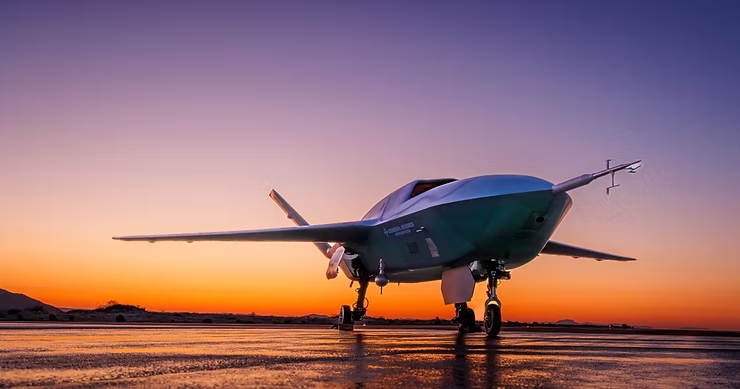
General Atomics is making a bold move to accelerate the delivery of a European Collaborative Combat Aircraft (CCA). The plan brings together the company’s U.S. and German aerospace divisions in a unified effort to build an advanced uncrewed fighter jet. The aircraft will be based on a proven American platform, customized with European mission systems, and assembled in Europe.
The new fighter is derived from the U.S. Air Force’s YFQ-42A prototype, which is currently undergoing ground tests and is expected to make its first flight later this summer. It was designed and developed by General Atomics Aeronautical Systems, Inc. (GA-ASI) in San Diego. The European version will be adapted and produced with the support of General Atomics’ German affiliate, General Atomics Aerotec Systems GmbH (GA-ATS), located in Oberpfaffenhofen near Munich.
By tapping into the existing infrastructure and investments on both sides of the Atlantic, General Atomics aims to fast-track Europe’s uncrewed fighter capabilities and help meet the urgent acquisition timelines set by European defense leaders. This initiative also sets the stage for future collaboration and homegrown defense partnerships, building on both companies’ strong track records in global aircraft delivery.
“We’re excited to bring together our expertise in uncrewed systems with the advanced sensor and weapons capabilities of Europe’s defense industry, starting with our affiliate GA Aerotec Systems GmbH in Germany,” said GA-ASI CEO Linden Blue. “With a combat-proven CCA already in production, we’re ready to deliver these systems at scale — with key European technologies onboard — to help NATO build and sustain a capable, cost-effective fighter force.”
READ ALSO: China’s 3D-Printed Mini Jet Engine Succeeds in Historic Flight
GA-ASI is a global leader in unmanned aerial systems, having delivered over 1,200 aircraft across 30 years, with nearly 9 million total flight hours logged. The company has developed three major uncrewed combat aircraft, including the MQ-20 Avenger® (launched in 2009) and the XQ-67A Off-Board Sensing Station for the U.S. Air Force (2024). The YFQ-42A, based on the XQ-67A design, is on track to fly just 18 months after its predecessor — a testament to the rapid pace of innovation at GA-ASI.
Global collaboration is a key priority for General Atomics. The company’s aircraft, developed by GA-ASI, are used not only by the United States but also by countries such as the U.K., Spain, France, Italy, the Netherlands, Japan, India, and many others worldwide. Its extensive supply chain for uncrewed aerial systems (UAS) reaches deep into these partner nations, where critical components — including airframes, subsystems, and advanced sensor payloads — are produced.
READ ALSO: Researchers Build Stable Solar Panel Without Silicon
READ ALSO: Scientists Establish Novel 2D “Health State Map” to Define Metabolic Health
General Atomics Aerotec Systems (GA-ATS), the company’s German aerospace affiliate, brings decades of experience in aircraft manufacturing and maintenance. For over 40 years, the facility has built and serviced aircraft, performed maintenance and overhaul work on NH-90 helicopters for the German military, and supported the production and modification of the Do-228 multi-role aircraft.
The site also handles engine overhauls for the TPE-331-10 turboprop — an engine used in both the Do-228 and the MQ-9A/B uncrewed aircraft.
According to GA-ASI CEO Linden Blue, this wealth of experience will be instrumental in shaping Europe’s new Collaborative Combat Aircraft, which will be based on the YFQ-42A platform.
“European nations are vital and irreplaceable allies to both the United States and General Atomics,” Blue said. “We’re offering a well-developed, proven aircraft design as a starting point, and we look forward to working closely with Germany and other European partners to integrate these aircraft into NATO and European air forces as part of a new era in defense capabilities.”