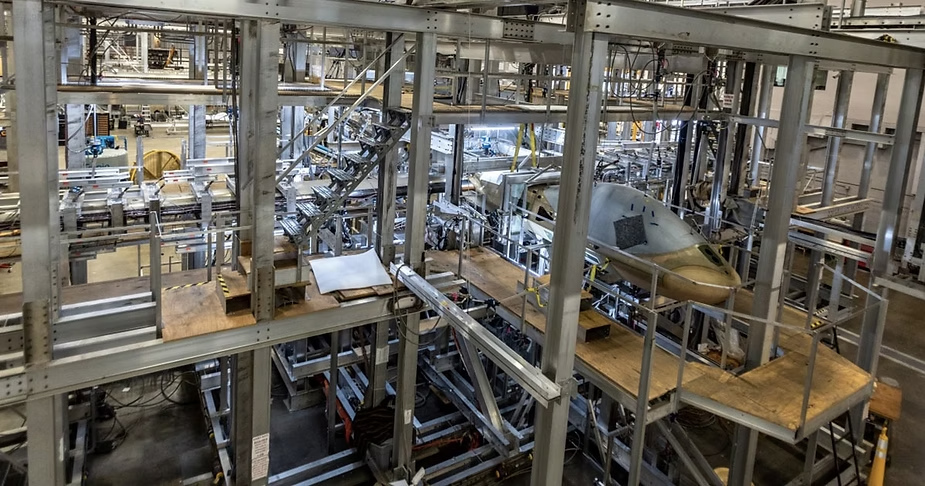
General Atomics Aeronautical Systems, Inc. (GA-ASI) has completed an extraordinary 120,000 hours of full-scale fatigue testing on its MQ-9B remotely piloted aircraft, simulating three complete lifetimes of operation.
The testing campaign, conducted at Wichita State University’s National Institute for Aviation Research, validates the airframe’s structural integrity for certification to the NATO STANAG 4671 standard and involved intentionally damaging critical components to prove the aircraft’s resilience to operational wear and tear.
What does it take to prove an aircraft can withstand decades of rigorous service? For General Atomics, the answer involved putting their premier drone through the equivalent of multiple lifetimes of punishment in a controlled laboratory setting. The recently completed full-scale fatigue testing represents one of the most comprehensive structural validations ever conducted on an unmanned aircraft system.
The numbers alone are staggering. 120,000 total operating hours of testing, equivalent to 40,000+ flight hours per aircraft lifetime, conducted over nearly three years of continuous evaluation. But this wasn’t just about accumulating hours—it was about systematically proving the MQ-9B’s durability under conditions far more demanding than normal operations.
READ ALSO: https://www.modernmechanics24.com/post/china-unveils-as700-airship-in-shaoxing
David R. Alexander, President of GA-ASI, explained the methodology behind this massive testing campaign: “The first two lifetimes simulated the operation of the aircraft under normal conditions, and the third intentionally inflicted damage to the airframe’s critical components to demonstrate its ability to tolerate operational damage that could occur over the lifetime of the aircraft.”
This statement, reported by GA-ASI, reveals the thoroughness of the approach—not just testing for normal wear, but deliberately creating damage scenarios to prove the aircraft’s resilience.
The testing, which ran from December 13, 2022, through October 31, 2025, served multiple critical purposes. Beyond supporting certification to the rigorous NATO STANAG 4671 standard, the results will help shape maintenance schedules and inspection protocols for operators worldwide. This means military planners can have unprecedented confidence in the aircraft’s structural reliability when planning long-term missions and maintenance cycles.
WATCH ALSO: https://www.modernmechanics24.com/post/mono-rail-arunachal-army-innovation-16000ft
The location of this extensive testing program—Wichita State University’s National Institute for Aviation Research—carries symbolic weight. Wichita has long been known as the “Air Capital of the World,” and conducting these tests at a premier aviation research facility underscores the program’s seriousness and technical credibility. Using a production airframe specifically built for the test campaign, rather than a prototype, added another layer of real-world relevance to the results.
For the growing list of MQ-9B operators, including the United Kingdom’s Royal Air Force (currently taking delivery of the Protector RG Mk1 variant), Belgium, Canada, Japan, and the U.S. Air Force in support of Special Operations Command, these test results provide crucial operational assurance.
The aircraft has already demonstrated its capabilities in numerous U.S. Navy exercises including Northern Edge, RIMPAC, and Integrated Battle Problem, but structural validation through such extensive testing takes confidence to another level.
The strategic importance of this validation extends beyond individual aircraft reliability. As GA-ASI notes with over 9 million flight hours across its Predator line of UAS, the company’s reputation for building durable, long-endurance platforms is well-established. The MQ-9B represents the next evolution, with the SkyGuardian and SeaGuardian models designed for even more demanding multi-mission requirements.
READ ALSO: https://www.modernmechanics24.com/post/naarea-robotics-for-microreactors
From a maintenance and logistics perspective, the testing outcomes are equally significant. By identifying potential structural issues before they occur in operational service, maintenance teams can develop targeted inspection protocols that maximize aircraft availability while ensuring safety. In military operations where aircraft availability can directly impact mission success, this predictive capability represents a substantial advantage.
The completion of this testing milestone comes at a pivotal moment for global military aviation. With unmanned systems taking on increasingly critical roles in intelligence, surveillance, reconnaissance, and strike missions, proving their structural reliability becomes as important as demonstrating their technological capabilities. The MQ-9B’s successful completion of this rigorous testing program positions it as a benchmark for the industry.
As David R. Alexander noted, this achievement “validates years of GA-ASI design and analysis efforts.” For potential future customers and existing operators alike, that validation provides the confidence needed to invest in and rely upon these systems for missions where failure is not an option. In the world of military aviation, where structural integrity can mean the difference between mission success and catastrophe, 120,000 hours of testing speaks louder than any marketing claim ever could.
WATCH ALSO: https://www.modernmechanics24.com/post/japan-autonomous-tractor-revolution