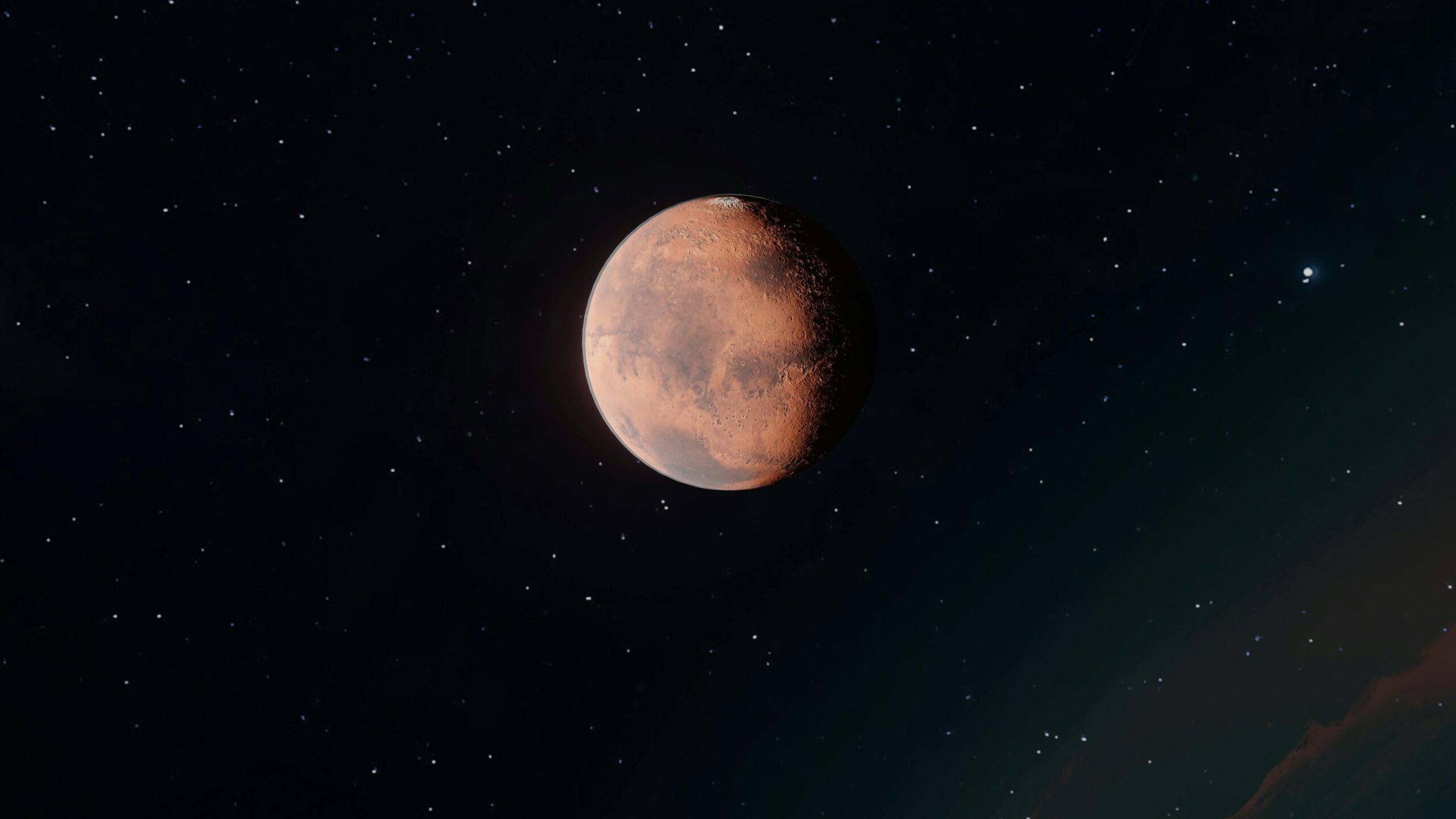
A University of California, Riverside (UCR) astrophysicist has run the numbers, and a surprising celestial suspect has emerged in the long-standing case of Earth’s periodic ice ages: Mars. New computer modeling led by Stephen Kane, an associate professor of astrophysics at UCR, suggests the gravitational tug of the Red Planet has been subtly yanking Earth’s orbit over multimillion-year timescales, amplifying the climate swings that plunge our planet into deep freezes.
For decades, scientists have understood that long-term climate cycles are paced by changes in Earth’s orbit and tilt, known as Milankovitch cycles. The gravitational influences of Jupiter and Venus create a steady 405,000-year “metronome” in Earth’s orbital eccentricity. But what has puzzled researchers is a more recent, dominant 100,000-year cycle of intense glaciations that began roughly 2.6 million years ago. According to the new research published in Nature Communications, the missing piece might be our planetary neighbor.
“I knew Mars had some effect on Earth, but I assumed it was tiny,” said Professor Kane, whose findings were first reported by New Atlas. “I’d thought its gravitational influence would be too small to easily observe within Earth’s geologic history. I kind of set out to check my own assumptions.” His sophisticated orbital simulations told a different story. They revealed that Mars exerts a gravitational pull just strong enough to interact with Earth’s own orbital wobbles, creating a complex 2.4-million-year “Grand Cycle.”
READ ALSO: https://modernmechanics24.com/post/nasa-exoplanet-satellite-separation/
This grand cycle doesn’t cause ice ages by itself but acts as a powerful amplifier. It makes the climatic shifts governed by the shorter Milankovitch cycles more extreme. During parts of this multimillion-year beat, the transitions between glacial periods and warm interglacial periods become more frequent and severe. The evidence for this cycle is etched into Earth itself, found in deep-sea sediment cores that show periodic hiatuses—gaps where powerful currents scoured the ocean floor, preventing sediment accumulation. These energetic periods align with the proposed Martian influence.
The implications stretch far beyond orbital mechanics. This amplified climatic volatility may have been a crucial driver in human evolution. As noted in the Nature Communications paper, some anthropologists theorize that the rapid shifts between wet and dry periods in Africa—potentially linked to these grand cycles—transformed forests into grasslands. This environmental pressure could have forced early hominins to adapt, potentially catalyzing the development of bipedal walking and larger brains. Without Mars’s subtle pull, according to Kane’s models, the Earth’s climate over the past few million years might have been far more stable, and less dramatically transformative.
WATCH ALSO: https://modernmechanics24.com/post/cartoon-robot-learns-kitchen-chores-2/
Professor Kane’s work reframes our place in the solar system, showing how planetary orbits are part of an intricate, interconnected dance that directly shapes a planet’s climate history. While Venus and Jupiter provide the steady rhythm, it seems Mars has been the unpredictable drummer, adding the complex fills that have, quite literally, changed the face of our world and perhaps the course of our own species’ story.