An international research team working with the European Space Agency (ESA) has developed Europe’s first simulator for Galactic Cosmic Rays.
The facility has been set up at the GSI Helmholtz Centre for Heavy Ion Research in Darmstadt, Germany.
The simulator will help scientists study the effects of cosmic radiation on astronauts and spacecraft. Researchers published their findings in the journal Life Sciences in Space Research.
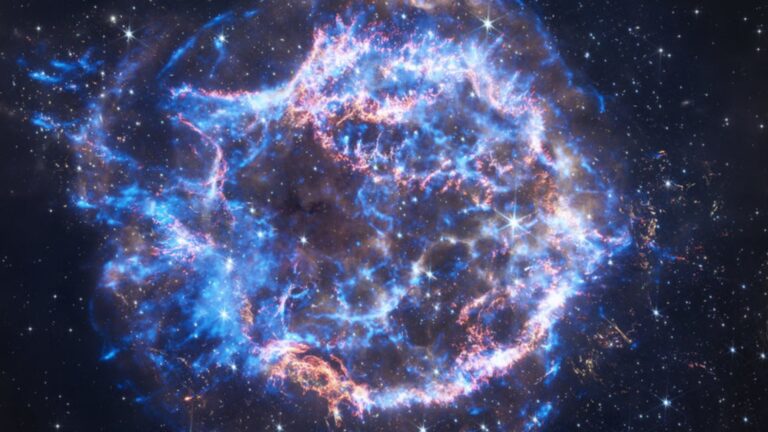
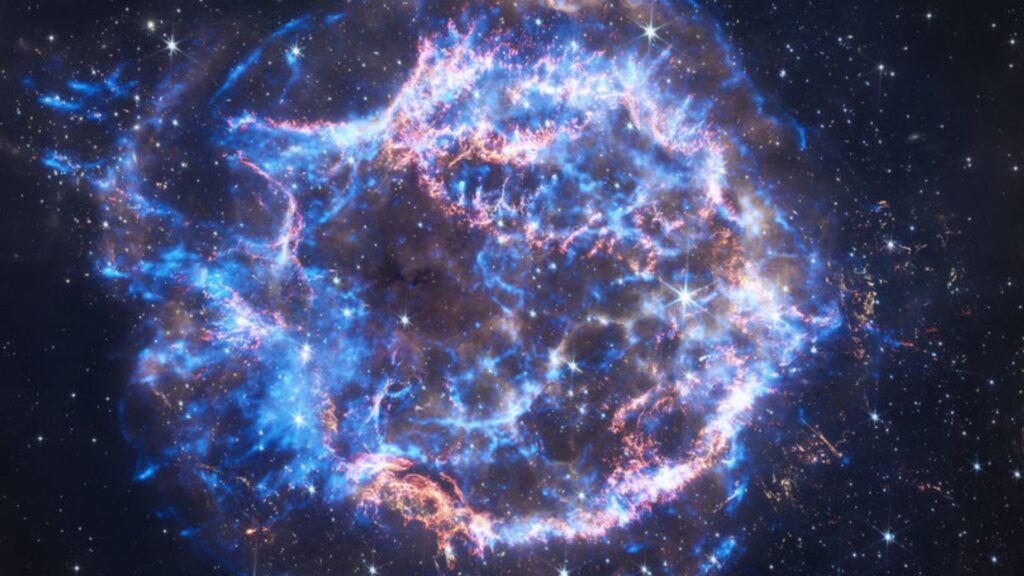
Cosmic radiation is one of the biggest dangers in space. Outside Earth’s magnetic field, astronauts are exposed to high-energy particles that travel through the universe. These particles mainly come from events such as exploding stars in the Milky Way.
Scientists call them Galactic Cosmic Rays (GCRs). They mostly contain protons and helium nuclei. Some particles are heavier and carry much higher energy. These high-charge and high-energy particles can cause serious biological damage.
Studies show that in deep space, a proton may pass through every cell in an astronaut’s body every few days. Helium nuclei may strike cells every few weeks. More energetic heavy particles can pass through cells every few months.
READ ALSO: Terrific ‘Black Rain’ Falls On Iran After US-Israel hit Tehran’s Oil Fields
When these particles hit spacecraft shielding, they create secondary radiation such as neutrons and fragments. This makes radiation exposure even more complex and dangerous during long missions to the Moon or Mars.
Cosmic radiation can increase the risk of cancer. It may also damage cells and affect the human nervous system. Electronic systems inside spacecraft can also fail due to radiation exposure.
Marco Durante, professor at the Technical University of Darmstadt and head of the biophysics research department at GSI/FAIR, explained the importance of the new system.
“Until now, Europe had no reliable way to simulate Galactic Cosmic Rays,” Durante said. “Our team developed this simulator with ESA support so researchers can study radiation doses on human tissue and spacecraft systems.”
The project is part of the FAIR Phase-0 research program. Scientists used powerful ion accelerators at GSI to recreate deep-space radiation conditions in the laboratory.
READ ALSO: UC Irvine Researchers Hijack AI Drones Using Just an Umbrella: FlyTrap Vulnerability
The research team, led by Christoph Schuy, used high-energy ion beams made from naturally occurring elements. The simulator uses a hybrid method. Scientists adjust the energy of iron ion beams and pass them through special beam modulators.
These modulators shape the radiation to resemble the particle mixture found in deep space.
“Our results match the radiation levels measured during space missions,” Schuy said. “This method can reproduce the radiation environment inside a lightly shielded spacecraft.”
He added that the facility will soon be opened to scientists worldwide for more research on space radiation.
With this project, Europe now has a major tool to study cosmic radiation. Only one other similar simulator exists at the Brookhaven National Laboratory in the US, supported by NASA.
WATCH ALSO: New Intelligence Platform Powers Top Research Robot
Both facilities currently produce particle beams with energies of about one gigaelectronvolt per nucleon. However, the upcoming Facility for Antiproton and Ion Research (FAIR) in Darmstadt will significantly expand these capabilities.
When completed, FAIR will reach energies of up to ten gigaelectronvolts per nucleon. This will make the Darmstadt simulator the most accurate system in the world for recreating cosmic radiation.
ESA and GSI have collaborated for many years on research into space radiation and astronaut protection. Scientists already use the facility to simulate Solar Particle Events using technology originally developed for cancer therapy.
Both organizations also run the annual ESA-FAIR Space Radiation School. The program trains students in heavy-ion biophysics and its applications in medicine and space exploration. The next session will take place in August 2026.