Astronomers led by UC Berkeley have directly imaged the violent aftermath of two massive collisions around the star Fomalhaut, just 25 light-years away. The observations, spanning 20 years, reveal dust clouds from colliding objects at least 60 km wide—the first such events ever seen outside our solar system.
For decades, the brilliant star Fomalhaut has captivated astronomers as a nearby laboratory for studying planet formation. Now, a team from the University of California, Berkeley has captured something unprecedented: the flickering “holiday lights” of cosmic destruction. By analyzing images from the Hubble Space Telescope taken between 2004 and 2023, researchers have directly witnessed the violent aftermath of two separate collisions between giant, comet-like objects in Fomalhaut’s outer debris disk.
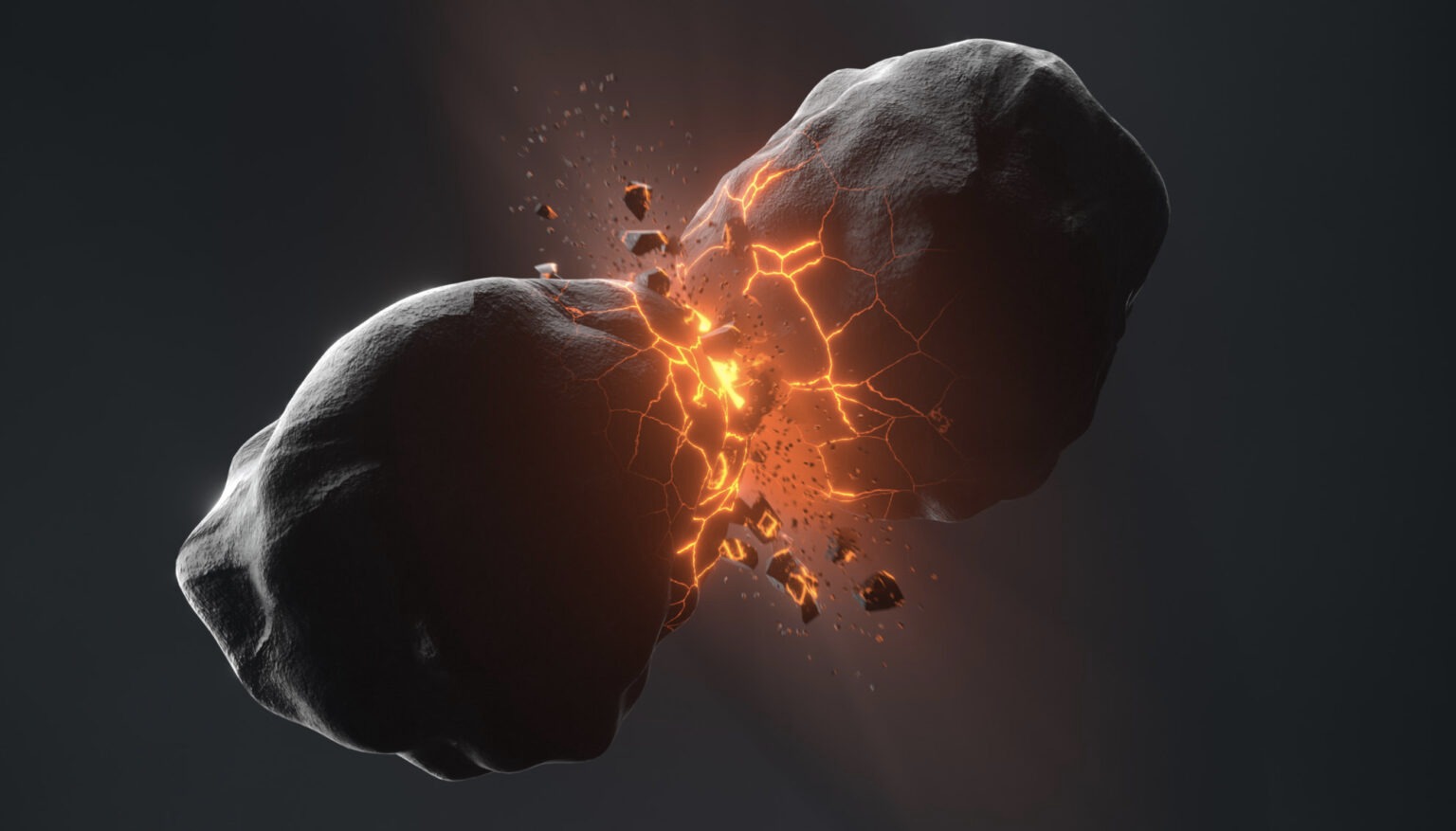
“We just witnessed the collision of two planetesimals and the dust cloud that gets spewed out of that violent event, which begins reflecting light from the host star,” said Paul Kalas, adjunct professor of astronomy at UC Berkeley and lead author of the study published in Science. “We do not directly see the two objects that crashed into each other, but we can spot the aftermath of this enormous impact.”
READ ALSO: https://modernmechanics24.com/post/china-mind-control-robot-telepathy-tech/
The story has an intriguing twist. The first collision’s dust cloud, spotted in 2004, was initially mistaken for an exoplanet—dubbed Fomalhaut b—and announced in 2008 as one of the first planets ever directly imaged in visible light. But by 2014, the “planet” had vanished. The new 2023 Hubble image revealed a second bright spot, Fomalhaut cs2, not far from where the first appeared, confirming both were likely short-lived debris clouds from colossal impacts.
Based on their brightness, the colliding bodies were each at least 60 kilometers (37 miles) in diameter—roughly four times larger than the dinosaur-killing asteroid that struck Earth. These planetesimals are likely volatile-rich, similar to icy comets in our own solar system. “The Fomalhaut system is a natural laboratory to probe how planetesimals behave when undergoing collisions,” said co-author Mark Wyatt, professor of astronomy at the University of Cambridge. This provides unique clues about their composition and the frenetic environment of a young planetary system.
The frequency of these events is startling. Theory suggests such massive collisions should be rare, happening perhaps once every 100,000 years in a given system. Observing two within 20 years around the same star, reported Science, suggests either incredible luck or that our models of early solar system violence need revision. “Over tens of thousands of years, the dust around Fomalhaut would be ‘sparkling with these collisions’,” Kalas remarked.
READ ALSO: https://modernmechanics24.com/post/xudabao-unit-3-clears-cold-functional-tests/
At 440 million years old, Fomalhaut is a cosmic toddler compared to our 4.5-billion-year-old sun, offering a direct glimpse into our own solar system’s violent infancy. “It’s like looking back in time,” Kalas explained. “That’s the time period we are seeing, when small worlds are being cratered with these violent collisions or even being destroyed and reassembled into different objects.”
The discovery also serves as a cautionary note for the next generation of planet-hunting telescopes, such as the planned Habitable Worlds Observatory. “These collisions that produce dust clouds happen in every planetary system,” Kalas warned. “We have to be cautious because these faint points of light orbiting a star may not be planets.” The team will use the James Webb Space Telescope to monitor the expanding cloud and unravel more secrets from this dynamic stellar nursery.