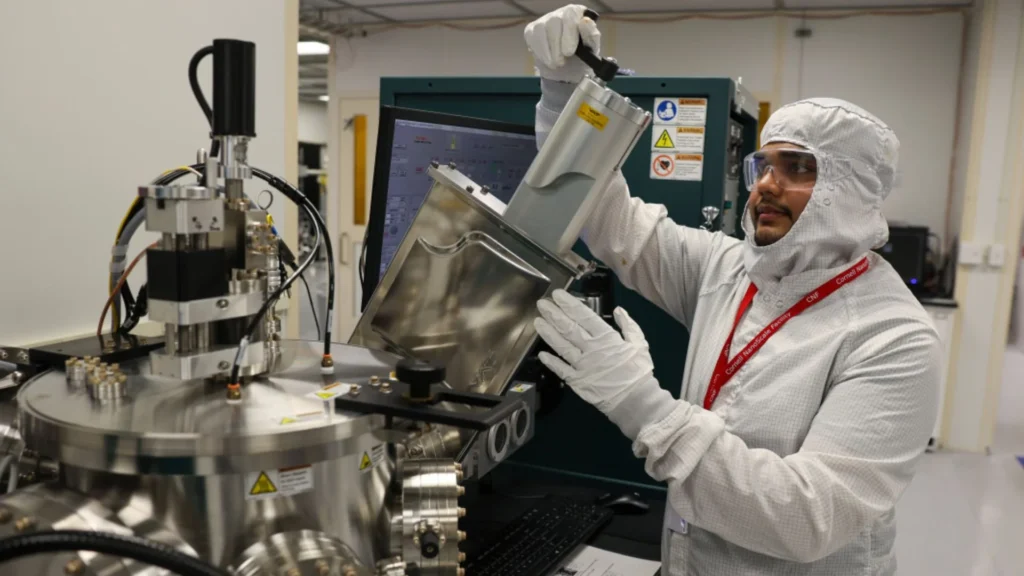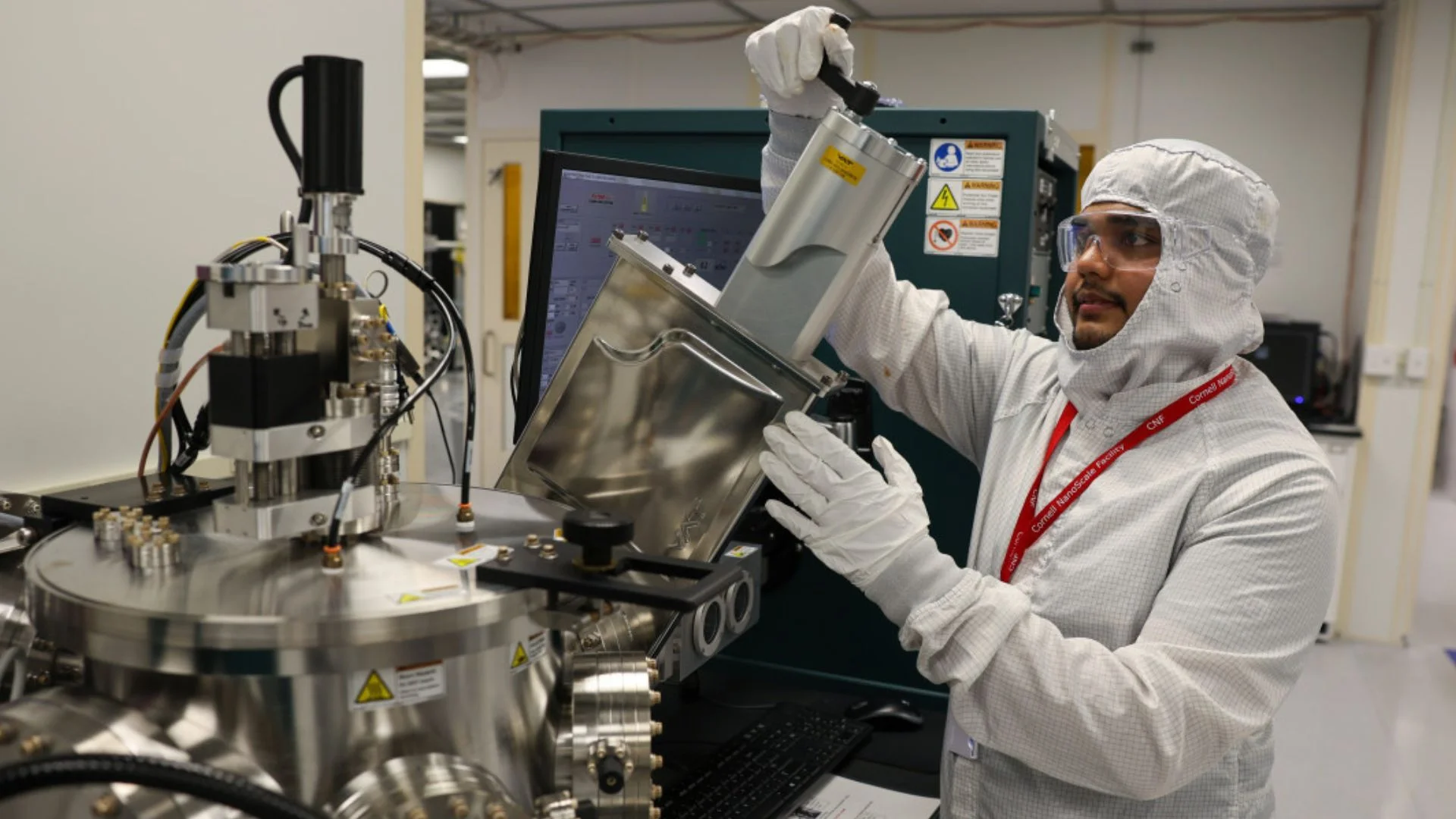
Inside Cornell’s NanoScale Science and Technology Facility, a student in cleanroom gear carefully operates a 3D lithography system, where even a tiny error can erase hours of work.
Muthangi, a Master of Engineering (M.Eng.) student in the Semiconductor and Quantum Materials Pathway at Cornell’s Duffield College of Engineering, is developing new methods for creating semiconductor test chips. These chips help manufacturers detect tiny defects early, improving the reliability of microchips used in electronics, medical devices, and transportation systems.
“Some days I’m in the cleanroom fabricating, and other days I’m reading research papers to understand why something didn’t work,” Muthangi said. “If the output is different from expected, I switch gears and explore a new approach.”
READ ALSO: Tufts University Creates Color-Changing Paint That Measures Impact Force Without Sensors
His work focuses on high-resolution test chips capable of measuring smaller variations than conventional tools. By improving the precision of these measurements, manufacturers can produce microchips that are more reliable at scale.
Muthangi is working closely with Xallent, a Cornell spin-off company based in Albany, New York. The company develops high-precision semiconductor testing tools. The collaboration enables Xallent to leverage Muthangi’s data and Cornell’s advanced fabrication capabilities to refine its engineering processes. At the same time, Muthangi gains hands-on experience in a project with direct industry impact.
Inside CNF, the fabrication process is complex. It starts with lithography, where microscopic patterns are etched onto substrates. Metal deposition and etching follow, creating and refining the tiny structures. Each step requires careful evaluation of thickness, surface quality, and structural integrity.
WATCH ALSO: United Launch Alliance’s Atlas V rocket delivers success for Amazon Leo
“That blend of deep technical knowledge and hands-on practice is central to our Materials Science and Engineering M.Eng. program,” said Kintu Early, director of the program and a professor of practice. “The projects our students work on, with industry or faculty, prepare them for careers in critical and fast-changing industries.”
Muthangi came to Cornell with a background in computer science and limited exposure to the cleanroom environment. With guidance from faculty and staff, he quickly built the technical expertise needed for this demanding work.
Beyond technical skills, the program has shaped Muthangi’s career goals. He aims to work in semiconductor process or manufacturing after graduation. Long-term, he hopes to combine this knowledge with artificial intelligence to improve the design and production of microchips.
“If you look around, almost everything relies on a chip,” he said. “As devices shrink, we need to keep improving how we test and make them. I want to be part of that.”
READ ALSO: France Deploys Tiger Attack Helicopters to Stop Drones in Middle East
Muthangi’s work highlights the key role of precision in semiconductor manufacturing. With microchips powering everything from phones to medical devices, even small improvements in testing and fabrication can have a big impact on the future of technology.