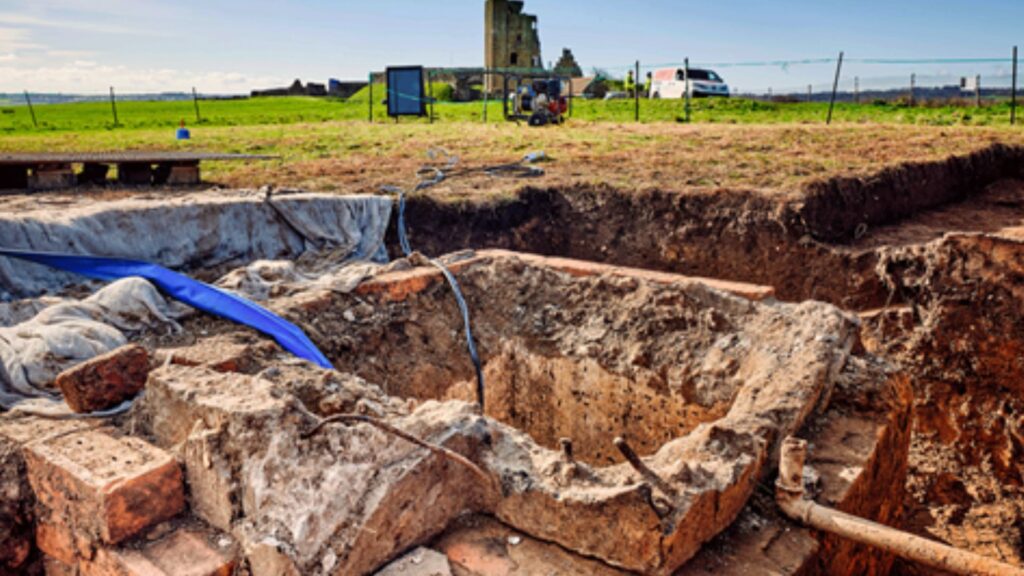
A long-lost Cold War nuclear monitoring bunker has been rediscovered beneath the grounds of Scarborough Castle after remaining hidden for more than five decades.
Experts from English Heritage located the forgotten underground lookout post during an archaeological investigation on the castle’s headland. The structure was built in the early 1960s to monitor potential nuclear explosions during the Cold War.
The bunker was part of a nationwide network operated by the Royal Observer Corps. These observation posts were designed to detect nuclear blasts and track radioactive fallout across Britain in the event of a nuclear attack.
Researchers say the bunker was constructed around 1963–64, when tensions between global powers created fears of nuclear war. The post remained active only for a few years before it was sealed and buried in 1968. Since then, its exact location has been lost.
After analysing historical records and conducting a detailed ground survey, archaeologists finally identified the likely site. Excavation work began on March 7. Within days, the team uncovered the sealed entrance to the underground structure.
Engineers carefully opened the entrance and lowered cameras inside the chamber to assess the condition of the bunker.
Officials say the structure appears similar to many other Cold War observation posts built across the UK.
READ ALSO: University of Pennsylvania Trains Tiny Robots to Swim Mazes Using Light
These bunkers followed a standard design. They included communication equipment, monitoring instruments, and small bunk beds for observers who would have worked inside during emergencies.
At its peak, the Royal Observer Corps operated more than 1,500 such monitoring posts across the country. Over 20,000 volunteers served in the organisation, helping track potential nuclear threats during a tense period in global history.
Kevin Booth, Head of Collections at English Heritage, said many people in Britain lived close to these bunkers without even knowing they existed.
“Wherever you lived in Britain, you were probably no more than a few miles from an ROC post, yet few people knew they existed,” Booth said.
WATCH ALSO: Humanoid Robots Are Learning to Work Like Humans in Warehouses
He added that the bunker’s location within the castle grounds reflects the headland’s long history as a strategic observation site.
“It seems strange to have a Cold War bunker built inside Scarborough Castle,” Booth said. “But the headland has been an observation post for thousands of years. It served as a Bronze Age settlement, a Roman signal station, a medieval castle, and even a World War I gun battery. In the 1960s, it watched for nuclear Armageddon.”
The discovery forms part of a heritage project marking the 100th anniversary of the Royal Observer Corps in 2025.
The project, supported by the National Lottery Heritage Fund, also aims to find former members of the corps and preserve their stories.
READ ALSO: China’s New AI Radar Can Spot Real Drone Threats While Ignoring Decoys
Helen Featherstone, Director for England North at the National Lottery Heritage Fund, said the discovery helps highlight the important work carried out by thousands of volunteers.
“It’s really exciting that this lost bunker has been uncovered while marking 100 years of the Royal Observer Corps,” Featherstone said. “The discovery deepens our understanding of their story and shines a spotlight on their role in protecting the UK.”
Researchers will continue examining the bunker in the coming weeks to document its structure and historical significance. The find offers a rare glimpse into Britain’s Cold War preparations and the hidden network built to watch for the unthinkable.