Carnegie Mellon University researchers have created a simulation tool that predicts how sprayed concrete behaves with over 90% accuracy, enabling robots to print stronger structures around rebar.
This breakthrough in spray-based concrete 3D printing could revolutionize construction in -earthquake prone regions by allowing for more complex, resilient designs while cutting material waste.
For years, the promise of 3D-printed buildings has been hampered by a fundamental limitation: the inability to reliably print around the steel rebar that gives concrete its strength. Extrusion-based printers, which work like a precise pastry bag squeezing out layers of material, simply can’t navigate the complex web of reinforcement bars without collisions.
This has confined most 3D-printed concrete to simpler, less critical structural elements. But what if a robot could spray concrete freely, coating rebar from all angles just as a human worker might?
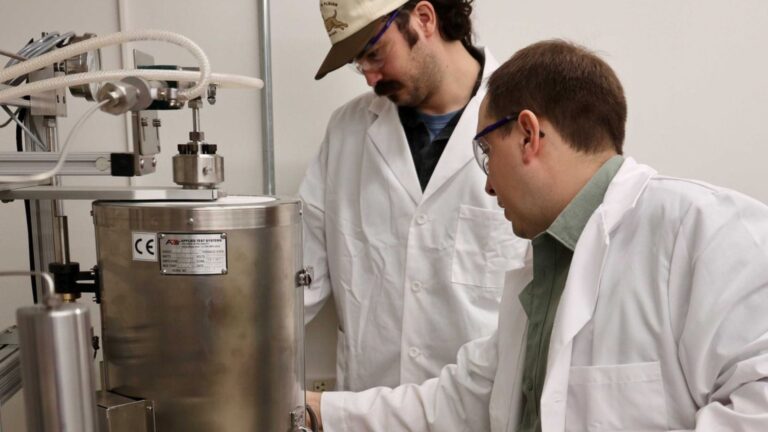
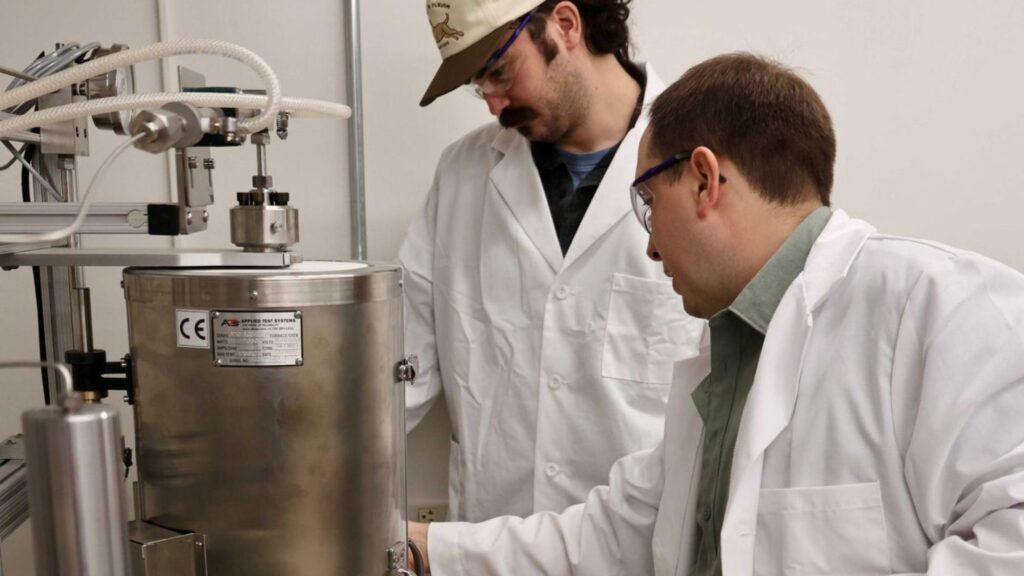
This is the future being engineered at Carnegie Mellon University. A team led by Kenji Shimada, a professor of mechanical engineering, has developed a computational simulator that accurately models the messy, complex physics of spray-based concrete printing.
“Spray-based concrete 3D printing is a new process with complicated physical phenomena,” explained Professor Shimada. “In this method, a modified shotcrete mixture is sprayed from a nozzle to build up on a surface, even around rebar.”
READ ALSO: https://www.modernmechanics24.com/post/baguette-sized-missile-to-transform-modern-warfare
The implications are profound, particularly for constructing buildings in seismically active areas like Japan and California. The ability to seamlessly integrate reinforcement into 3D-printed structures is a game-changer for structural integrity.
To make this technology viable, we must be able to predict exactly how the concrete will spray and dry into the final shape,” Shimada stated, according to the team’s research paper. “That’s why we developed a simulator for concrete spray 3D printing.
This simulator isn’t just a theoretical exercise; it’s a practical tool for contractors. It models the viscoelastic behaviors of shotcrete, accounting for real-world challenges like dripping, particle rebound, and how the material spreads and solidifies.
Before ever turning on a robot, a construction team can feed a CAD design into the simulator, test various printing paths, and determine if the spray method is feasible for their project, potentially saving immense time and resources.
WATCH ALSO: https://www.modernmechanics24.com/post/china-launches-80000-ton-fujian-aircraft-carrier
The team didn’t just validate their model in the lab—they took it to the field. Collaborating with Shimizu Corporation in Tokyo, where spray-printing robots are already in use, the researchers put their simulator to the test. The results, published in IEEE Robotics and Automation Letters, were striking.
The simulator predicted the height of sprayed concrete with 90.75% accuracy. More importantly, it demonstrated an exceptional ability to model printing over rebar, achieving accuracy rates of 92.3% for width and 97.9% for thickness.
A key breakthrough was making this powerful tool practical. Soji Yamakawa, the lead research scientist on the project, highlighted the computational innovation. “By making wild assumptions, we were able to successfully simplify a super complex physics simulation into a combination of efficient algorithms and data structures and still achieved highly realistic output,” Yamakawa reported. This efficiency turns what would typically be a days-long calculation into a usable tool.
The work is far from over. The research team, including Kyshalee Vazquez-Santiago, a mechanical engineering Ph.D. candidate, is now focused on incorporating environmental factors like humidity, further optimizing performance, and adding plastering simulations to create smoother finished surfaces.
READ ALSO: https://www.modernmechanics24.com/post/epfl-scientists-decode-nanopores-for-advanced-biosensors