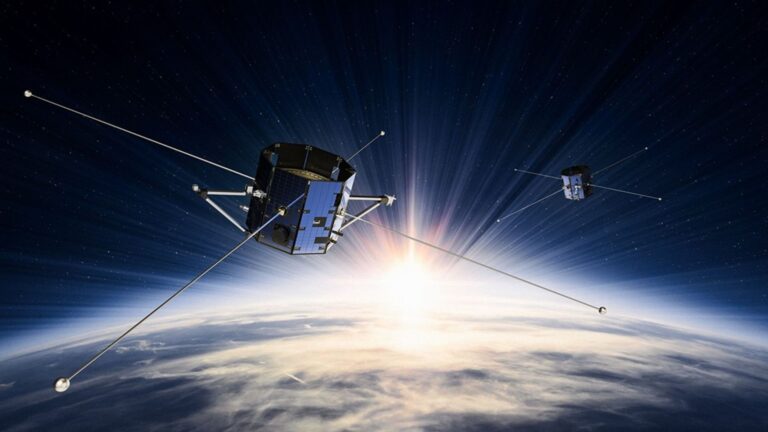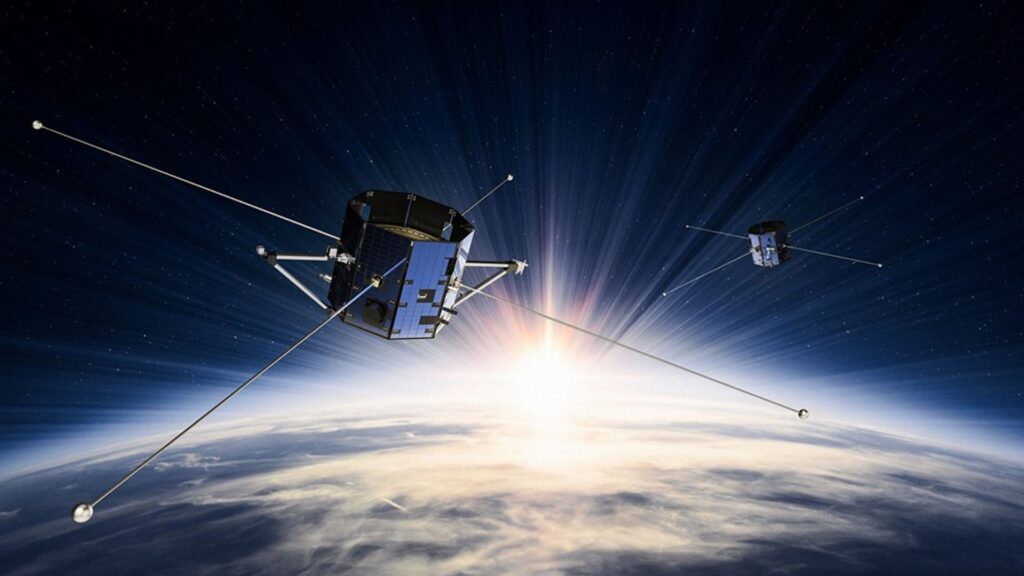
DFH Satellite Co. researchers led by senior engineer Su Zhenhua have built a space power prototype that delivers 2.6 megawatts of pulsed energy with unprecedented 0.63-microsecond synchronization accuracy. This breakthrough, reported in Advanced Small Satellite Technology, solves a decades-old engineering dilemma, providing the massive yet precisely controlled power required for next-generation space technologies including particle beam weapons.
For years, the concept of space-based particle beam weapons has tantalized military strategists. The idea of firing a stream of atoms or subatomic particles at nearly light speed to disable enemy satellites or missiles sounds like science fiction. Yet turning this vision into reality has consistently stumbled over one fundamental obstacle: power. The problem isn’t just generating massive energy—it’s delivering that energy with near-perfect precision.
Particle accelerators aboard satellites require electromagnetic fields to push charged particles at exactly the right moments as they race through different sections. These energy pulses must maintain synchronization with errors no greater than millionths or even billionths of a second. Otherwise, the beam loses focus, efficiency plummets, and the weapon becomes useless. This created what seemed like an unsolvable engineering trade-off: systems delivering megawatts of power were typically slow to control, while ultra-precise systems couldn’t handle massive energy bursts.
The Chinese team, according to their peer-reviewed study, has apparently broken this technological barrier. “Existing pulsed power supplies typically have an output power of less than 1 megawatt and synchronisation control accuracy worse than 1 millisecond,” wrote Su Zhenhua and colleagues. Their ground-tested prototype shatters both limitations simultaneously, achieving both massive power output and microsecond-level precision.
READ ALSO: https://www.modernmechanics24.com/post/scientists-discover-gyromorphs-for-photonic-chips
So how did they accomplish this? Rather than relying on a single miracle component, the team completely redesigned the power system architecture. The system works through a sophisticated layered approach. First, satellite solar panels provide baseline electricity. A special high-efficiency DC-DC converter then steps up this voltage to extreme levels—comparable to pumping water into a high reservoir. This energy charges a capacitor energy array, which acts like a reservoir ready to unleash its contents in an instant.
When triggered, the system discharges through a linear pulsed constant-current source that maintains exceptionally stable output. The current control precision reached 0.79 percent, meaning the actual current intensity stays almost identical to the target value. To synchronize 36 separate power modules firing simultaneously, the team used a central FPGA-based controller (Field-Programmable Gate Array), ensuring all units fire within 630 nanoseconds of each other.
The military implications are significant, reported the South China Morning Post. As the U.S. expands its Starlink and planned Starshield constellations—networks of thousands of small, resilient satellites—traditional anti-satellite weapons like missiles become increasingly impractical. Directed energy weapons such as particle beams could disable multiple targets at light speed using only electricity from solar panels, making the cost per shot almost negligible.
Despite the breakthrough, challenges remain. “The test results of the prototype demonstrate that the new method solves the problems of insufficient power supply and degraded control accuracy for high-power spaceborne equipment,” the researchers stated. However, they must still prove the technology can withstand space’s harsh environment—extreme temperatures, vacuum conditions, radiation, and microgravity. Additionally, satellites already incorporate radiation-hardened components and shielding, leaving open whether artificial particle beams could effectively penetrate these defenses.
WATCH ALSO: https://www.modernmechanics24.com/post/worlds-largest-fusion-project-iter-progress
The technology also has substantial civilian applications. Beyond weapon systems, this power breakthrough could revolutionize space-based lidar, advanced laser communications, next-generation ion thrusters for satellite maneuvering, and high-resolution microwave remote sensing for Earth observation. The same system that might power a particle beam weapon could also enable unprecedented scientific research and commercial space applications.