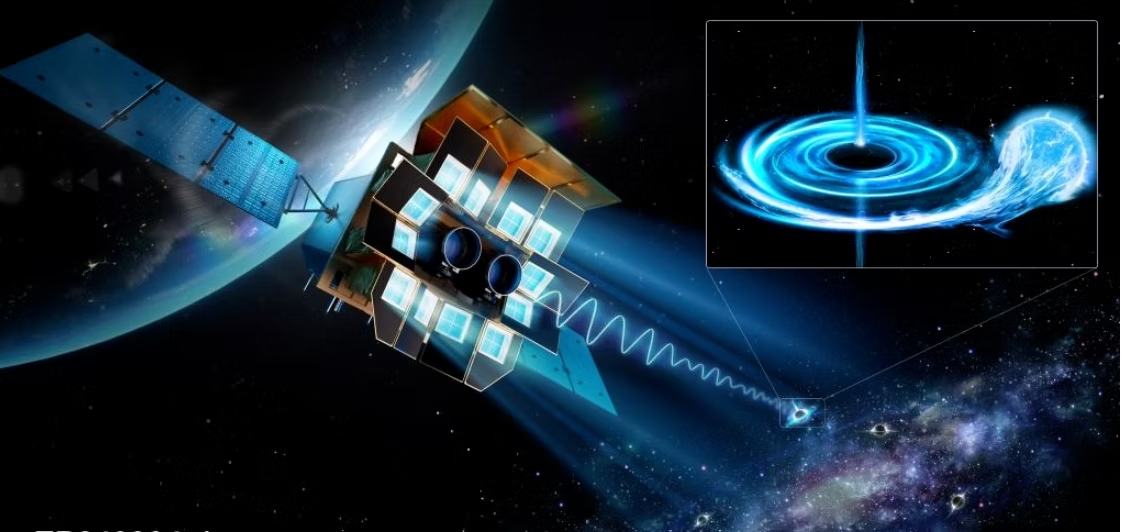
Credit: Chinese Academy of Sciences/ Xinhua
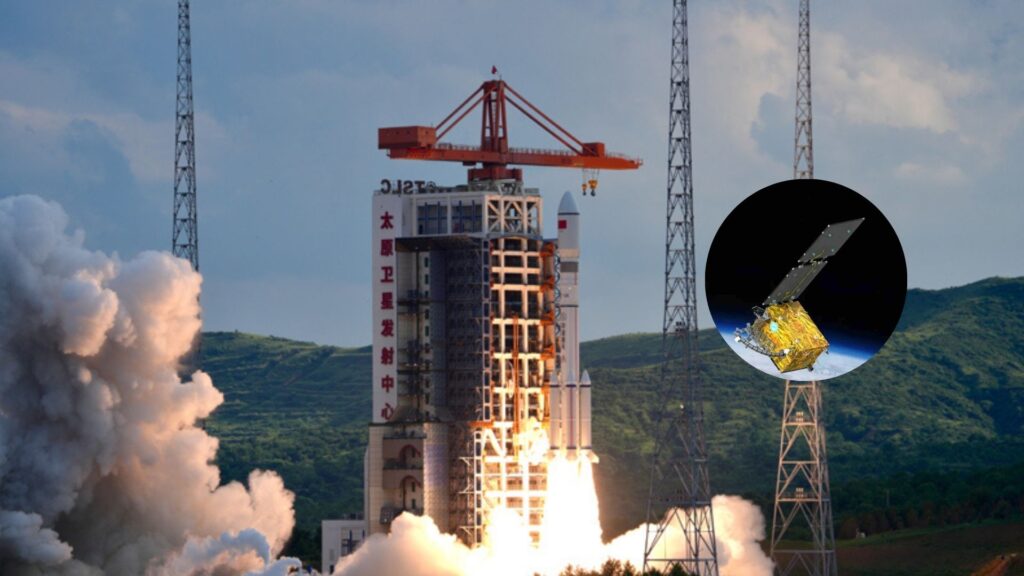
Nearly two years after China launched its astronomical satellite Einstein Probe (EP), the mission has unveiled a breathtaking series of transient cosmic events—brief, radiant flashes that light up the universe like celestial fireworks. These discoveries are helping reshape our understanding of some of the most extreme and mysterious physical processes in the cosmos.
“Since its launch in January 2024, the Einstein Probe has fundamentally transformed our view of the dynamic X-ray universe,” said Yuan Weimin, principal investigator of the mission and a researcher at the National Astronomical Observatories of the Chinese Academy of Sciences (NAOC). “This pioneering mission, led by the Chinese Academy of Sciences, is now delivering a steady stream of breakthrough discoveries—capturing rare, explosive events that were previously too faint or too fleeting to detect.”
The Einstein Probe is part of a series of major space science missions initiated by the Chinese Academy of Sciences (CAS) and is also a shining example of international scientific collaboration. The European Space Agency, Germany’s Max Planck Institute for Extraterrestrial Physics, and the French space agency CNES all contributed to its development.
At the heart of the mission are two powerful and complementary X-ray instruments. The Wide-field X-ray Telescope (WXT) uses advanced lobster-eye optics to monitor a vast portion of the sky—roughly one-tenth of the entire celestial sphere—in a single exposure. This gives EP unparalleled sensitivity to faint and rapidly changing events. For detailed investigation, the Follow-up X-ray Telescope (FXT) provides larger effective area and sharper resolution, enabling scientists to zoom in on newly detected phenomena.
READ ALSO: https://www.modernmechanics24.com/post/snake-inspired-4k-infrared-vision
“The Einstein Probe can capture momentary flashes lasting mere seconds, track changes unfolding over days or years, and detect faint signals hidden deep in cosmic darkness,” Yuan noted. “These capabilities firmly establish EP at the forefront of global research in time-domain, high-energy astrophysics.”
A Slow-Blooming Cosmic Firework
Among EP’s most striking discoveries is EP241021a, a new X-ray transient that glowed for more than 40 days—an unusually long and brilliant eruption resembling a cosmic firework in slow motion. The event was also accompanied by a relativistic jet, making it even more extraordinary. The findings, published in Astrophysical Journal Letters, suggest that this eruption may result from a star being torn apart by a rare intermediate-mass black hole or from an atypical massive star explosion.
“This discovery sheds new light on catastrophic cosmic explosions and how relativistic jets are launched,” said Shu Xinwen, professor at Anhui Normal University and lead author of the study. “It may also offer important clues about the elusive class of intermediate-mass black holes.”
WATCH ALSO: https://www.modernmechanics24.com/post/drdo-rocket-sled-escape-test-success
Revealing Hidden Black Holes in the Milky Way
In September 2024, EP detected another intriguing event: EP240904a, an extremely faint X-ray burst within our own Milky Way. Its distinctive X-ray rhythm, spectral evolution, and accompanying radio and infrared signals identified it as a new black hole candidate. Remarkably, the outburst was 100 times dimmer than typical black hole eruptions—explaining why it had escaped detection by previous telescopes.
“The discovery of EP240904a opens a new window into the hidden population of black holes in our galaxy,” said Cheng Huaqing of NAOC, first author of the study. “With the Einstein Probe, we finally have the capability to systematically uncover these ‘silent’ black holes,” added Tao Lian, researcher at the Institute of High Energy Physics of CAS.
READ ALSO: https://www.modernmechanics24.com/post/lithium-waste-into-super-strong-concrete
A Rare and Soft X-ray Flash
The mission’s intelligence and autonomy were demonstrated vividly in the discovery of EP240801a. As soon as the satellite detected this transient, it automatically activated the FXT telescope for detailed follow-up observations. A joint study with NASA’s Fermi satellite revealed the event to be an extremely soft X-ray flash, dominated by low-energy X-rays—one of the rarest types of cosmic explosions.
“These extremes in energy and behavior offer new insights into the diversity of gamma-ray bursts and stellar core-collapse events,” said Xu Dong of NAOC. “This event highlights the Einstein Probe’s exceptional capabilities—from detection to localization—making it a remarkably efficient platform for monitoring a dynamic universe.”
WATCH ALSO: https://www.modernmechanics24.com/post/chinese-company-s-humanoid-robot-dodges-arrow-with-side-flip