Home » Premium » China Maps Robotic Fortress Defence: AI Drone Network to Guard South China Sea Islands

China Maps Robotic Fortress Defence: AI Drone Network to Guard South China Sea Islands

China Maps Robotic Defence for South China Sea Islands
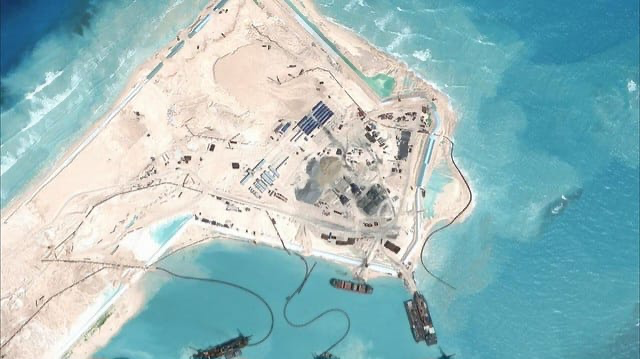
China's coastguard researchers propose a multi-domain defence network using air, surface and underwater drones to protect contested South China Sea islands. Credit: Earth Island Institute

Chinese coastguard researchers have outlined a proposed autonomous defence system that would use aerial, surface and underwater drones to protect islands and reefs in the contested South China Sea.

The concept replaces parts of a traditional human-led defence network with interconnected uncrewed platforms that can detect, assess and respond to threats. The proposal reflects growing military attention to drone swarms and their ability to challenge conventional ships and fixed positions.

A Network Built Around Drones

The proposal was developed by researchers from the China Coast Guard Academy’s ship command department and Dalian Maritime University’s Marine Electrical Engineering College.

Their study appeared in July in Command Control & Simulation, a Chinese weapons and military technology journal supervised by the state-run China Shipbuilding Industry Corporation. The researchers described the system as a possible approach to defending islands and reefs against attacks involving large numbers of low-cost unmanned platforms.

The proposed network would combine drones operating in three environments: air, sea and underwater. Fixed positions on islands and reefs would form additional nodes within the network, allowing mobile platforms to work with permanent infrastructure. According to the researchers, this arrangement would improve detection, coordination and the ability to continue operating even after individual parts of the system are damaged.

The idea is based partly on lessons from recent conflicts, particularly the extensive use of uncrewed systems in the war in Ukraine. The researchers pointed to Ukraine’s Magura V5 maritime strike drones as an example of relatively inexpensive unmanned vessels being used against much larger and more expensive naval assets. They argued that such attacks have highlighted weaknesses in conventional defence systems when they face coordinated swarms.

READ ALSO: https://modernmechanics24.com/post/taiwans-first-live-fire-drone-rehearsal/

Moving Beyond Linear Defences

The researchers said traditional defence systems often depend on a linear sequence in which sensors detect a threat, commanders assess it, decisions are made and weapons are deployed. In a large-scale swarm attack, this process can become slower and more vulnerable if a key communication or command point is disabled. The proposed system instead uses multiple connected platforms so that other units can continue functioning when individual nodes are lost.

The framework draws on US Air Force Colonel John Boyd’s well-known observe, orient, decide, and act decision-making model. The researchers adapted this model into what they described as a closed-loop defence system for islands and reefs. In simple terms, the network would continuously gather information, interpret it, select a response and deploy available assets before feeding new information back into the system.

Artificial intelligence would support this process at the platform level. AI chips installed on individual drones would allow them to analyse local conditions and make operational assessments even when communications with other parts of the network were disrupted. This feature is intended to reduce dependence on a single central command point during an attack.

WATCH ALSO: https://modernmechanics24.com/post/chinese-calligraphy-3d-ground-illusion/

Three Rings Of Defence

The proposed system would divide the area around an island or reef into three defensive rings based on local geography. In the outer ring, reconnaissance and strike drones would search for approaching threats, while high-speed uncrewed surface vessels would provide additional surveillance and attack capabilities. The paper says these platforms could be equipped to launch missiles or torpedoes against identified targets.

The middle ring would focus primarily on electronic warfare. Aerial drones and uncrewed surface vessels would be used to interfere with an opponent’s communications, sensors or decision-making processes. The aim would be to disrupt an incoming force before it reaches the most closely protected part of the island or reef.

The inner ring would provide close-range protection against threats that passed through the outer layers. The researchers listed close-in defence surface vessels, expendable attack drones and underwater vehicles among the systems that could operate in this zone. The three layers are intended to create overlapping protection rather than relying on one type of weapon or platform.

READ ALSO: https://modernmechanics24.com/post/nvidia-launches-nemotron-3-5-lightning-ai-agents/

Why The Proposal Matters

The geography of small islands and reefs presents specific challenges for defence planners. Narrow passages, shallow waters and uneven terrain can restrict the movement and deployment of personnel while also creating gaps in conventional surveillance coverage. A distributed network of drones could provide more persistent monitoring across these difficult areas while reducing the number of personnel required for some defensive tasks.

The proposal also reflects the changing economics of modern warfare. A relatively inexpensive unmanned platform can potentially force an adversary to use much more costly weapons or defensive systems in response. For fixed installations and naval forces, the challenge is, therefore, not only detecting individual drones but also maintaining enough defensive capacity when attacks arrive in large numbers.

China has already tested combinations of aerial, surface, and underwater unmanned systems in the northern South China Sea. The researchers cited those tests as evidence that the technologies required for their proposed system are being actively explored. However, the publication of the paper does not mean that the entire concept has been deployed or that the contested islands have been converted into autonomous military positions.

The proposal comes as countries examine how artificial intelligence, autonomous vehicles, and coordinated drone networks can change maritime security. If such systems become reliable enough for sustained operations, future island defence may depend less on a small number of manned platforms and more on networks of interconnected machines.

For the South China Sea, where territorial claims and military activity already overlap, the development of such autonomous capabilities could become an important factor in how future maritime defences are designed.

Share this article

One Response

Leave a Reply

Your email address will not be published. Required fields are marked *