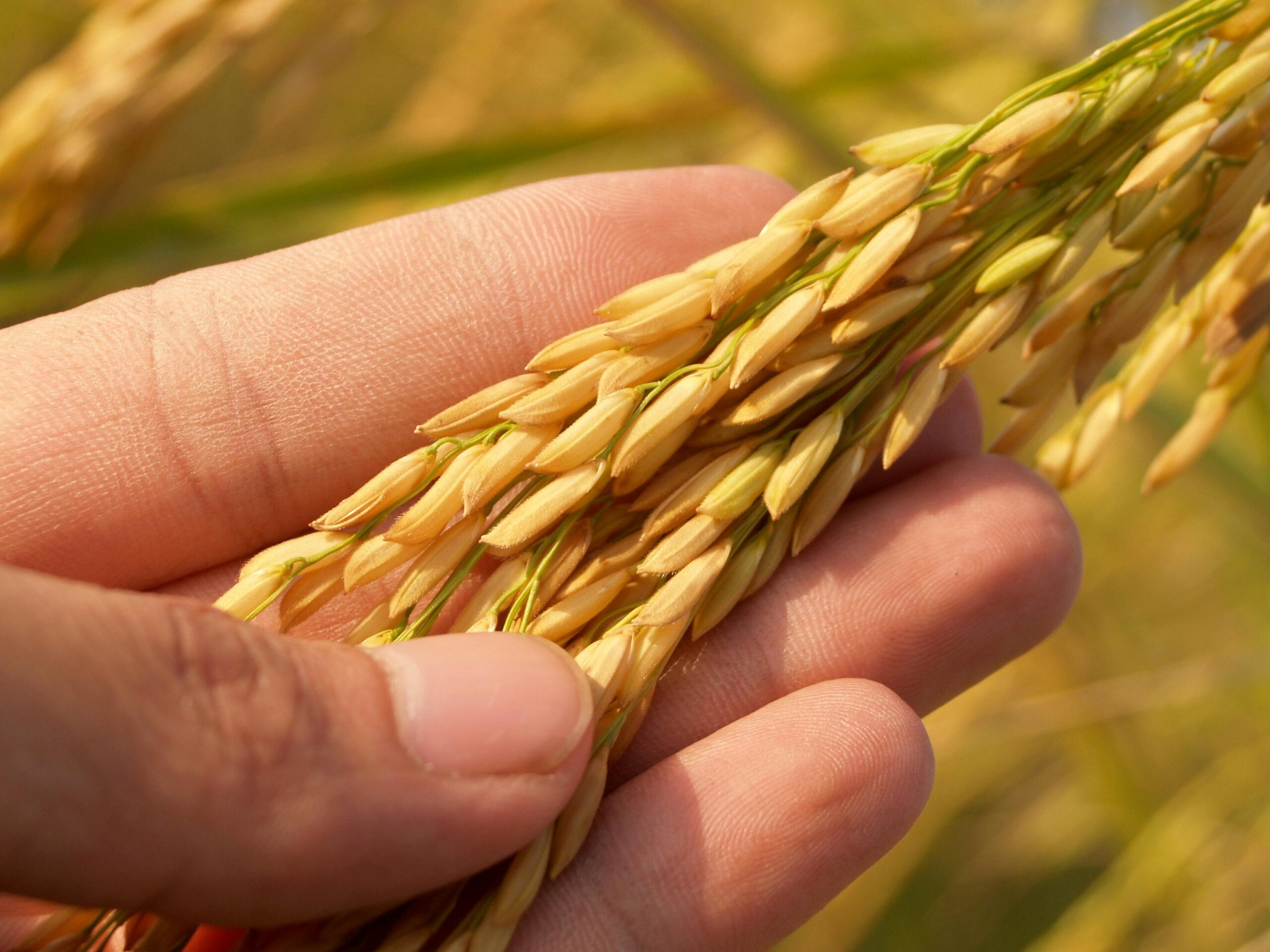
Researchers at the China National Rice Research Institute have developed the world’s first commercially viable apomictic hybrid rice, a “one-line” system that clones itself through seeds with over 99.7% efficiency. Led by Chief Scientist Wang Kejian, the breakthrough could cut hybrid seed costs by up to 99% and potentially double global rice output, transforming food security for hundreds of millions.
For decades, the “holy grail” of agricultural science has been apomixis—a plant’s ability to produce clonal seeds, passing down its superior genetic traits perfectly to the next generation. Now, a Chinese team has achieved it in rice. This means farmers could, for the first time, save and replant seeds from high-yield hybrid varieties without losing their vigor, breaking a cycle that forces them to buy expensive new seeds every season. “This was the first introduction of the apomixis trait into hybrid rice, a breakthrough from ‘0 to 1’,” Wang Kejian told China Science Daily.
The economic impact is staggering. In China, hybrid rice seeds can cost farmers between 20 to 100 yuan per jin (500 grams), up to 100 times more than conventional rice seeds. The team’s new Fix8 series of rice could reduce that price to just 2 to 5 yuan per jin, according to the researchers. This price collapse would place the most productive seeds within reach of the world’s smallest farmers, reported the South China Morning Post, which first detailed the innovation.
READ ALSO: https://modernmechanics24.com/post/hyundai-mobed-droid-ces-2026-award/
The journey to this point has been iterative. Back in 2019, Wang’s team published a landmark paper in Nature Biotechnology, announcing the first successful creation of clonal hybrid rice seeds. The late Yuan Longping, China’s revered “father of hybrid rice,” celebrated that work but noted practical hurdles remained, chiefly low seed-setting rates. The latest preprint, published on bioRxiv in October, confirms those hurdles are now cleared. The team identified a key gene, naming it Huaxu after a Chinese myth symbolizing “birth without father.” By transferring this gene and combining it with a “clonal gamete” technique, they created a system with near-perfect cloning efficiency and normal yields.
The results from multi-generation field tests in Hainan and Zhejiang provinces are promising. The Fix8#3 line achieved a seed-setting rate of 74.3%, directly comparable to conventional hybrid rice at 74.9%. “We have established an apomixis system with a normal fruit set rate, currently near 80 per cent, which meets commercial standards,” Wang stated. This solves the critical problem of creating clones that are both genetically pure and high-yielding.
WATCH ALSO: https://modernmechanics24.com/post/india-drdo-akhash-ng-missile-success/
The global implications are profound. With hundreds of millions facing food insecurity, hybrid rice has promised dramatically higher yields—in some parts of Africa, nearly four times the output of traditional varieties. The barrier has always been cost and seed renewal. This technology dismantles that barrier. If adopted worldwide, some industry estimates suggest global rice production could double, a vital buffer against population growth and climate instability.
The team has already developed six apomictic rice varieties now undergoing rigorous testing. While the published study doesn’t focus on specific disease resistance, the Fix8 technology is designed to lock any superior trait—be it yield, drought tolerance, or pest resistance—into a permanent, heritable package. The dream that Yuan Longping encouraged the team to pursue—the “early application of one-line hybrid rice in production”—now appears firmly on the horizon, poised to write a new chapter in the history of one of the world’s most vital crops.
READ ALSO: https://modernmechanics24.com/post/orano-selected-doe-900m-uranium-project/