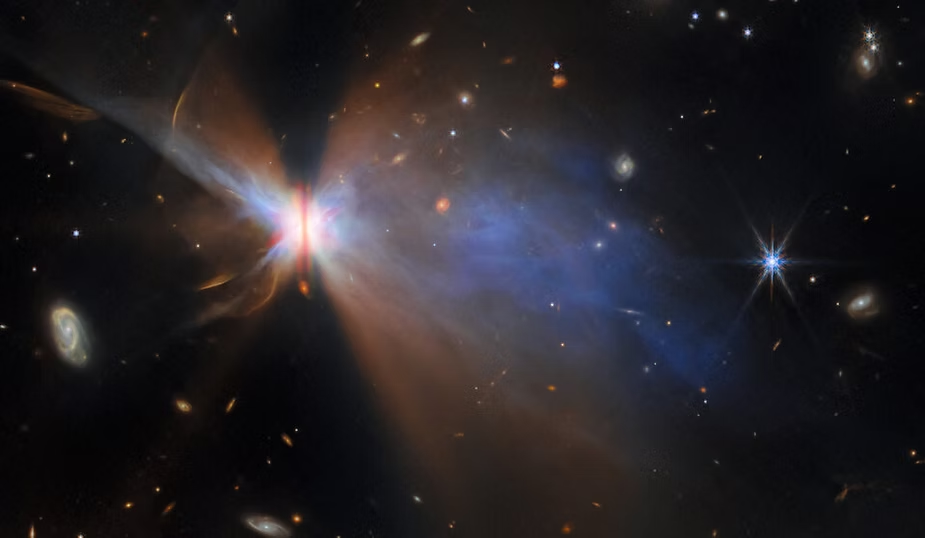
The NASA/ESA/CSA James Webb Space Telescope (Webb) has delivered a striking new view of IRAS 04302+2247, a young protostar surrounded by a massive disc of dust and gas. Located about 525 light-years away in the Taurus star-forming region, this object represents one of the earliest stages of planetary evolution. Webb’s ability to observe fine details within dusty environments allows astronomers to investigate how planets begin to take shape around infant stars.
Birthplaces of Planets
Across the Milky Way, stellar nurseries are scattered within giant, cold clouds of gas and dust. Within these regions, gravity causes clumps of material to collapse, giving rise to newborn stars. As they form, young stars pull in surrounding material, which flattens into a protoplanetary disc. These discs serve as the raw material for planet formation, much like the disc of dust and gas that surrounded our own Sun about 4.5 billion years ago.
By studying distant protoplanetary discs, researchers gain valuable insight into how Earth, the other planets, and the Solar System itself came into being.
IRAS 04302: A Protoplanet in the Making
IRAS 04302+2247—often shortened to IRAS 04302—is a classic example of a protostar still gathering mass from its surroundings. Webb’s measurements reveal that its surrounding disc stretches 65 billion kilometers across, several times wider than our Solar System.
From Webb’s vantage point, the disc is oriented edge-on, creating a striking visual: a thin, dark band of dust blocking much of the star’s light. This obscuring dust is not wasted—it provides the fuel for planet formation, offering an environment where young planets can accumulate mass.
When observed face-on, protoplanetary discs sometimes display rings, spirals, or gaps, features that may signal the presence of newborn planets carving paths through the dust. In contrast, Webb’s edge-on perspective of IRAS 04302 offers a detailed look at the vertical structure of the disc. This structure reveals how dust grains settle toward the midplane, gradually forming a dense, thin layer where planet formation is most efficient. The thickness of this disc is a key indicator of how far along the process has progressed.
The Butterfly Star
The dust lane of IRAS 04302 not only conceals the protostar’s glare but also allows Webb to capture the delicate nebulas above and below the disc. These reflection nebulas glow as starlight scatters off surrounding material, creating a symmetrical, wing-like appearance.
This resemblance has earned IRAS 04302 the nickname “The Butterfly Star.” The two glowing lobes on either side of the dark dust band highlight the dramatic interplay between starlight and interstellar matter, offering a glimpse into the dynamic environment where new planetary systems take shape.
READ ALSO: https://www.modernmechanics24.com/post/ga-asi-yfq42a-collaborative-combat-aircraft-flight
READ ALSO: https://www.modernmechanics24.com/post/succulents-that-glow-after-sunlight
A Multiwavelength Portrait
Webb’s view combines data from two of its instruments—the Near-InfraRed Camera (NIRCam) and the Mid-InfraRed Instrument (MIRI)—with optical observations from the NASA/ESA Hubble Space Telescope.
- Webb’s infrared capabilities reveal the distribution of tiny dust grains and show how near-infrared light scatters across material extending far beyond the disc.
- Hubble’s optical data complement this view, highlighting the dark dust lane, as well as clumps and streaks of matter still falling toward the young star. These features suggest that IRAS 04302 is not only feeding on its surroundings but also producing jets and outflows, hallmark signs of an active protostar.
Together, these observations form a multiwavelength portrait of a planetary nursery, offering astronomers an unparalleled chance to study how dust evolves and organizes itself during the birth of planets.
Unlocking the Secrets of Planet Formation
The study of systems like IRAS 04302 is more than just a cosmic portrait—it is a window into our own origins. Webb allows astronomers to measure grain growth within the disc, track the distribution of material, and determine how efficiently dust is settling into the midplane. These processes are fundamental to the formation of planets, moons, and other celestial bodies.
By observing IRAS 04302 and similar targets, scientists are piecing together the steps that transformed a dusty disc around the Sun into the diverse family of planets we see today. Each image offers fresh evidence about the timing, structure, and mechanics of this transformation.
READ ALSO: https://www.modernmechanics24.com/post/firehawk-3d-printed-hybrid-rocket-us-army
READ ALSO: https://www.modernmechanics24.com/post/autonomous-flight-air-force-reliable-robotics
Conclusion
The Webb Telescope’s image of IRAS 04302+2247 is not only visually stunning but also scientifically profound. By capturing the protostar and its massive planet-forming disc, Webb provides researchers with the tools to unravel the mysteries of planetary birth. The “Butterfly Star” serves as both a symbol of cosmic beauty and a vital laboratory for exploring the earliest stages of solar system formation.
As Webb continues to peer into stellar nurseries across the galaxy, its discoveries will bring us ever closer to understanding how our own world—and countless others—came to be.