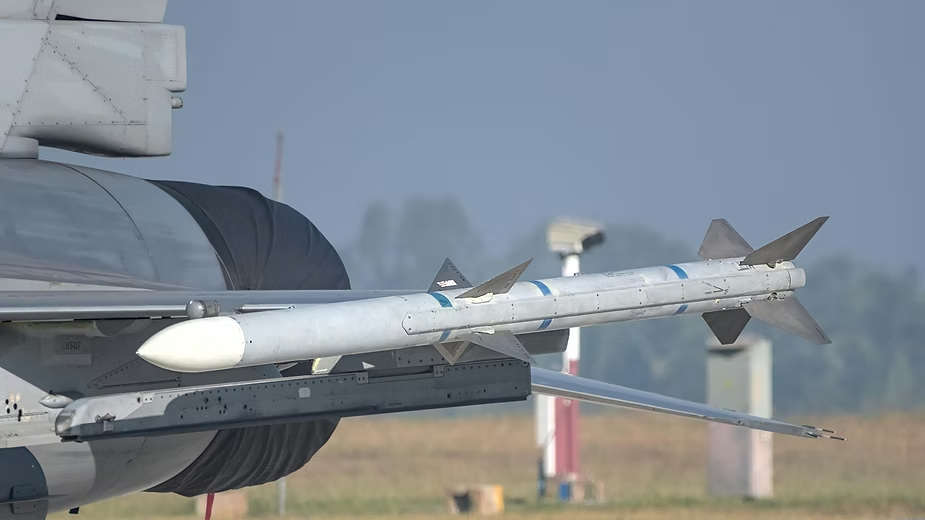
Estonian firm Frankenburg Technologies has developed the “Mark 1,” a less-than-metre-long rocket designed to be Europe’s cost-effective defense against Russian drone incursions. Priced at roughly $50,000 per unit—a tenth of some existing missile costs—the weapon is engineered for mass production to counter the threat of inexpensive Iranian-made Shahed drones that have plagued Ukrainian skies.
In the evolving arithmetic of modern warfare, using a $500,000 missile to shoot down a $50,000 drone is a losing equation. This unsustainable exchange rate has driven Estonian defense company Frankenburg Technologies to develop a pragmatic solution: the “Mark 1,” a pocket-sized rocket small enough to be carried by one person but designed to fundamentally shift Europe’s defensive capabilities. As Russian drone incursions become more frequent, this tiny munition is being heralded as a game-changing tool for NATO’s eastern flank.
The Mark 1’s specifications read like something from a science fiction novel. Measuring just 65 centimeters—shorter than a standard keyboard—the weapon utilizes solid rocket propellant and autonomous guidance to hunt its prey. Kusti Salm, CEO of Frankenburg Technologies and former chief civil servant in Estonia’s defense ministry, is unapologetic about its purpose. “We are not apologetic about the fact we manufacture weapons,” Salm stated in an interview with The Sun. “We are not afraid to say we are manufacturing them to take down Russian long-range drones.”
The current accuracy rate stands at approximately 56 percent, with the company aiming to improve this to 90 percent as production refines. The rocket operates within a range of about two kilometers and detonates its warhead within one to two meters of the target, making it ideal for engaging slow-flying, low-altitude drones like the Shahed models that have become staples of Russian attacks.
The core innovation lies in the manufacturing philosophy. While traditional defense contractors operate what Salm calls a “c,” Frankenburg Technologies is focused on scalability and affordability. Factories in two NATO countries are being prepared to produce hundreds of missiles daily, creating a defensive wall that can be deployed widely across critical infrastructure. “We want to bring affordability and scalability to an industry that has traditionally been like a designer bag industry,” Salm explained, according to The Sun’s reporting.
Military experts see the approach as addressing a critical gap in European defense. Colonel Hamish de Bretton-Gordon, a former British Army officer, applauded the development, noting that “drones now are sort of the ubiquitous currency of modern warfare.” He emphasized to The Sun that “the person who wins the drone war, if you like, is going to have a significant advantage. So we’ve now seen that Europe has woken up.”
The Mark 1’s AI guidance system represents a crucial advancement, reducing vulnerability to electronic warfare and eliminating the need for thousands of trained operators that Western nations currently lack. This autonomy allows the system to function effectively even in contested electromagnetic environments, where jamming has become a significant threat. The engineering challenge of packing a warhead, sensor, guidance system, and fuel into such a small frame required innovative solutions, from recalculating wing shapes to adjusting for shifting centers of gravity as fuel burns.
WATCH ALSO: https://www.modernmechanics24.com/post/worlds-first-motorbike-backflip-between-moving-trucks
While the system has limitations—it may struggle in extreme desert heat or Arctic cold, and is designed specifically for short-range, low-altitude threats—its proponents argue the economic case is compelling. When a $50,000 missile can protect infrastructure worth millions, the investment becomes not just plausible but essential. As Europe moves to establish its promised “drone wall” along NATO’s eastern border, the Mark 1 appears positioned to become a fundamental building block in continental defense.