Astronomers have uncovered one of the most unusual stellar explosions ever recorded — a massive star apparently detonating while trying to swallow a black hole companion. The discovery not only provides a possible explanation for a puzzling cosmic event but also highlights how artificial intelligence is transforming astronomy.
The event, designated SN 2023zkd, was spotted in July 2023 by the Zwicky Transient Facility, a California-based sky survey project. What set this discovery apart was the involvement of a new AI-powered algorithm designed to scan the sky in real time for strange explosions. The system flagged SN 2023zkd as unusual within hours of its appearance, allowing astronomers to mobilize telescopes across the globe and in space for immediate follow-up observations. That rapid response proved crucial in piecing together the story behind the explosion.
A Deadly Dance Between Star and Black Hole
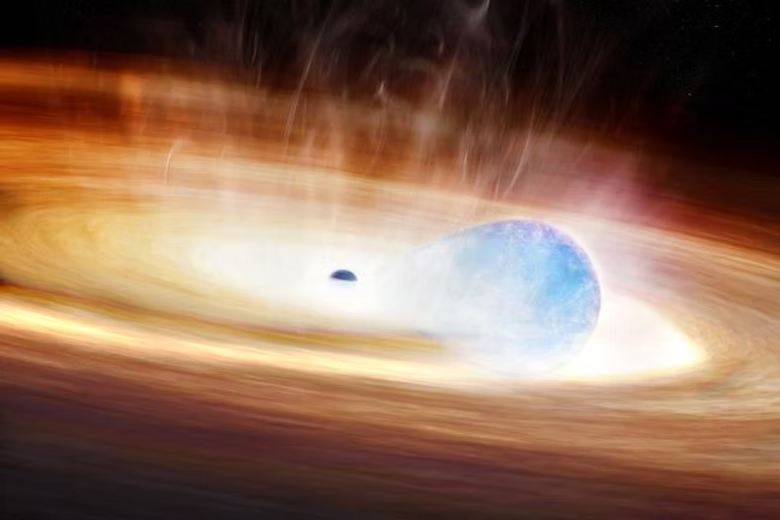
Researchers from the Center for Astrophysics | Harvard & Smithsonian (CfA) and the Massachusetts Institute of Technology (MIT), leading the effort as part of the Young Supernova Experiment, believe the most likely scenario involves a doomed binary system. In this cosmic partnership, a massive star orbited dangerously close to a black hole. Over time, the system lost energy, drawing the two objects ever closer until the black hole’s immense gravity destabilized its companion.
That stress appears to have triggered the supernova, either by collapsing the star’s core as it tried to engulf the black hole or by tearing it apart entirely. In both cases, the aftermath would leave behind a single, heavier black hole.
READ ALSO: Heat-Free Technology Revolutionizes Fruit Dehydration
READ ALSO: MSU research: How race, socioeconomic status contribute to math education inequalities
“This is the strongest evidence to date that such close interactions can actually detonate a star,” explained Alexander Gagliano, lead author of the study and a fellow at the NSF Institute for Artificial Intelligence and Fundamental Interactions. “Our machine learning system flagged SN 2023zkd months before its most unusual behavior, giving us time to capture critical observations.”
A Supernova with a Twist
At first glance, SN 2023zkd looked like a typical stellar explosion, producing a single, bright flash of light. But as astronomers tracked it over several months, something unexpected happened — it brightened again after initially fading.
Archival data provided more surprises. For over four years before the explosion, the system had been gradually increasing in brightness — a phenomenon rarely seen in supernovae. The team concluded that the star had been shedding material in its final years, creating a disk-like cloud around it. When the supernova erupted, its shockwave first lit up low-density gas, creating the initial flash. Later, as debris slammed into the denser surrounding disk, it produced the delayed second peak in brightness.
“This is one of the clearest signs we’ve seen of a massive star interacting with a companion before it exploded,” said V. Ashley Villar, assistant professor of astronomy at Harvard and co-author of the study. “We think this could represent an entire hidden class of stellar deaths — and AI will be key to finding them.”
READ ALSO: Thales and KNDS France Unveil RAPIDFire Land: New Ground-Based Variant of 40mm Naval Defence System
READ ALSO: US Army could soon get next high energy laser weapon system
The Future of Catching Cosmic Catastrophes
Located about 730 million light-years away, SN 2023zkd serves as a preview of discoveries to come. With the Vera C. Rubin Observatory preparing to scan the sky every few nights, astronomers expect a flood of new supernova detections. Real-time AI systems like the one that spotted SN 2023zkd will be essential in identifying the rarest and most exotic events.
Gagliano noted that most massive stars exist in binary systems, but observing one in the act of interacting with a black hole companion just before its destruction is “incredibly rare.” The ability to capture such events live, rather than reconstructing them after the fact, represents a major step forward.
The Young Supernova Experiment will continue its role by using the Pan-STARRS1 and Pan-STARRS2 telescopes to track stellar explosions shortly after they begin. This cost-effective strategy complements Rubin’s wide-field survey, creating a powerful network for exploring the dynamic universe.
“We’re entering an era where we can catch these cosmic events in real time,” Gagliano said. “For the first time, we can directly connect how a star lives with how it dies — and that’s an incredibly exciting frontier.”