Researchers at the University of California, Irvine, discovered a security flaw that allows attackers to control AI-powered drones with just an umbrella featuring a specific visual pattern.
The discovery raises serious concerns about the safety of drones used for surveillance, border patrol, and law enforcement operations.
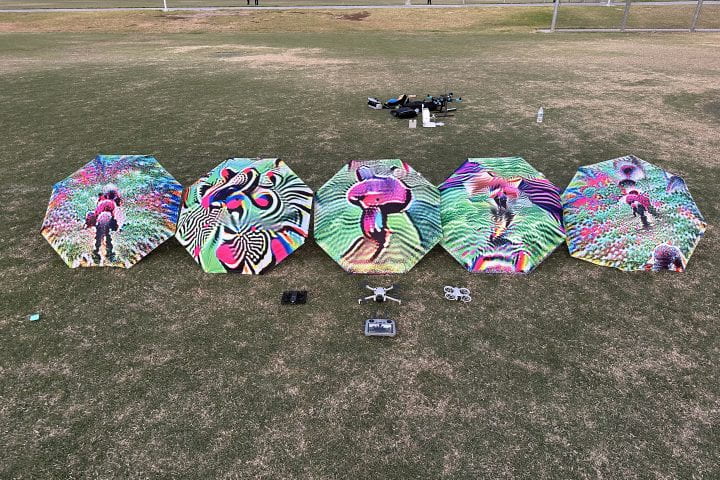
The research team created a new physical attack technique called ‘FlyTrap.’ The method exploits weaknesses in camera-based tracking systems used in many autonomous drones. These systems allow drones to automatically follow a person or object without direct human control.
Such features are often marketed as active track or dynamic tracking in consumer drones.
According to the researchers, the FlyTrap attack can trick a drone into moving closer to a target until it is captured or crashes.
How FlyTrap Umbrella Trick Works
The FlyTrap system relies on a specially designed visual pattern placed on an umbrella. When the umbrella is opened, the pattern confuses the drone’s AI tracking system.
The drone’s camera and neural network interpret the pattern as a person moving away from the drone, even though the person holding the umbrella remains stationary. Because the drone believes its target is moving farther away, it automatically flies forward to maintain its tracking distance. As a result, the drone continues to approach the umbrella holder.
READ ALSO: North Korea Tests Cruise Missiles From Choe Hyon Destroyer Amid Regional Tensions
Eventually, the drone moves close enough to be caught with a net or forced into a collision.
Unlike other hacking techniques that only disrupt a drone’s tracking ability, this attack allows the attacker to completely disable the drone by physically capturing or crashing it.
The UC Irvine team tested the FlyTrap technique on several commercial drones to evaluate its effectiveness.
In their experiments, the researchers successfully demonstrated the FlyTrap attack on three popular commercial drones: the DJI Mini 4 Pro, DJI Neo, and HoverAir X1. During testing, the specially patterned umbrella confused the drones’ AI tracking systems, causing them to gradually move closer to the attacker.
In several cases, the drones approached close enough to be captured with a net gun or forced into a crash, proving that the vulnerability can work against real-world consumer drone models. In multiple tests, the drones moved toward the umbrella until they were close enough to be captured with a net gun or forced into a crash.
READ ALSO: Mars’ Water Mystery: Dust Storms Reveal Clues to Red Planet’s Ancient Water
The researchers said the attack works without any wireless hacking or electronic signals. It relies only on visual deception in the physical world. Because of this, the attack can operate in many environments and does not require internet access or advanced equipment.
The vulnerability could create serious risks if exploited by criminals. Autonomous drones are widely used by governments and security agencies for tasks such as border monitoring, surveillance, and search operations. If attackers can easily manipulate these drones, they could avoid detection or disrupt security operations.
Alfred Chen, an assistant professor of computer science at UC Irvine and co-author of the research paper, highlighted both the promise and the danger of the technology.
“Autonomous target tracking offers great potential, but it also creates significant risks,” Chen said. “Law enforcement agencies use this technology for public safety and border patrol, but criminals may misuse it for stalking or other malicious activities.”
WATCH ALSO: Hyundai’s Atlas humanoid robot wins top honor for its advanced design and capabilities
Chen added that the team’s research represents the first comprehensive security analysis of this widely used drone technology.
The researchers noted that the same technique could also help people protect themselves from intrusive drones. In cases where someone is being harassed or stalked by a drone, the FlyTrap method could potentially allow a person to force the drone to land or crash.
However, experts say broader safeguards are necessary to prevent misuse of drone technology.
Lead author Shaoyuan Xie, a graduate student researcher at UC Irvine, stressed that the findings show an urgent need to improve drone security systems.
“Our findings highlight the need for stronger security protections in autonomous tracking systems,” Xie said. “If it is this easy to manipulate an autonomous drone, we should reconsider using them in sensitive environments like public safety or critical infrastructure.”
READ ALSO: This Superhot Rock Deep Underground Could Power the Planet With Clean Energy
The research team has already shared its findings with drone manufacturers DJI and HoverAir through responsible disclosure. The researchers presented their work this week at the Network and Distributed System Security Symposium in San Diego, a major international cybersecurity conference.
Research Supported by NASA and NSF
The FlyTrap project was supported by funding from NASA and the US National Science Foundation (NSF).
The research team has also released detailed documentation, datasets, demonstration videos, and technical papers to help improve drone security going forward. All experiments and drone data used in the study were completed before December 22, 2025.
As autonomous drones become more common in everyday life, the researchers say addressing these vulnerabilities is essential. Without stronger protections, even a simple object like an umbrella could become a powerful tool for manipulating advanced AI technology.