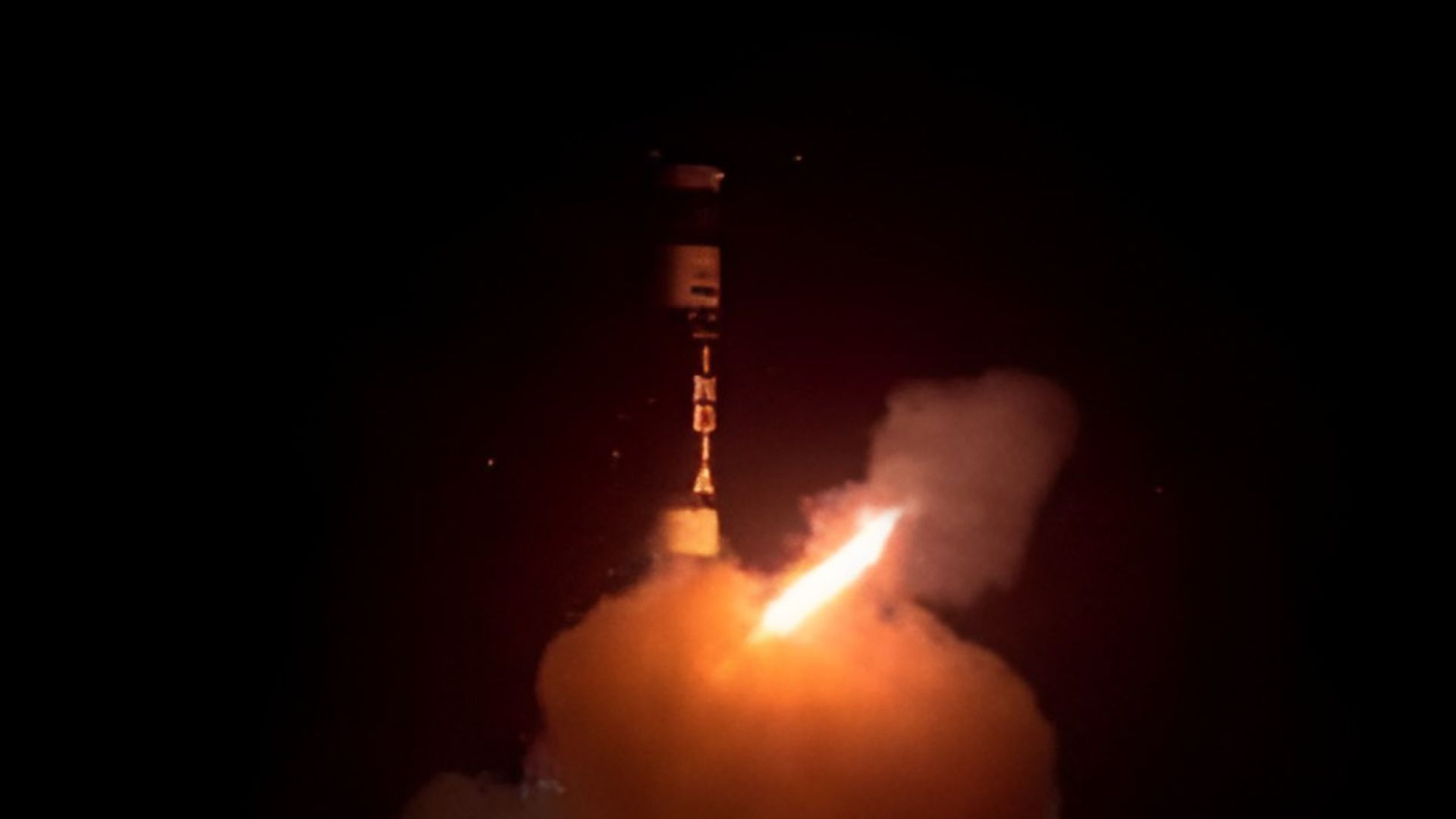
India on Thursday successfully conducted a test firing of the Intermediate Range Ballistic Missile (IRBM) Agni-III from the Integrated Test Range (ITR) at Chandipur in Odisha.
This test reaffirmed the country’s robust strategic deterrence capability and high level of operational preparedness. The launch was executed under the aegis of the Strategic Forces Command (SFC) as part of a routine training and validation exercise.
According to Defense officials, the test achieved all its stated objectives, with every operational and technical parameter performing as expected. The successful flight further validates the reliability, accuracy, and readiness of the Agni-III weapon system. It will work as a key pillar of India’s nuclear deterrence architecture.
Developed indigenously by the Defence Research and Development Organisation (DRDO), the Agni-III is a two-stage, solid-fuelled surface-to-surface ballistic missile with a strike range exceeding 3,000 kilometres.
READ ALSO: https://modernmechanics24.com/post/trash-to-sustainable-jet-fuel-daily/
Designed to deliver both conventional and nuclear warheads, the missile provides India with credible reach and assured retaliatory capability against distant targets. With a payload capacity of up to 1.5 tonnes and an estimated yield of 200 to 300 kilotons, Agni-III is optimised for strategic missions under India’s doctrine of credible minimum deterrence.
The missile is capable of being deployed from both road- and rail-mobile launchers. It significantly enhances its survivability and operational flexibility. As mobility is a critical factor in modern strategic forces, it ensures that missile systems remain effective even in highly contested environments. The Agni-III allows for rapid deployment, dispersal, and launch, boosting India’s second-strike credibility.
The Strategic Forces Command, which oversees India’s nuclear forces, supervised the launch to validate the missile’s performance under operational conditions. Officials stressed that the test was not directed against any specific adversary, but was conducted as part of India’s ongoing effort to maintain a safe, secure, and effective strategic arsenal.
WATCH ALSO: https://modernmechanics24.com/post/buildroid-ai-expands-robotics-platform/
Inducted into the Strategic Forces Command in 2011, the Agni-III has since formed a crucial component of India’s land-based nuclear deterrent. Regular training launches and validation exercises ensure that systems remain fully mission-ready and aligned with evolving technological and strategic requirements.
The Agni-III test also highlights the broader maturity of India’s Agni missile series, which constitutes the backbone of the country’s nuclear deterrence capability.
India and Agni Series
Conceptualised in the 1980s under the Integrated Guided Missile Development Programme (IGMDP), the Agni programme marked a major milestone in India’s quest for strategic self-reliance.
Beginning with a two-stage technology demonstrator tested in 1989, the programme steadily evolved into operational missile systems.
READ ALSO: https://modernmechanics24.com/post/china-20mw-offshore-wind-turbine-grid/
Agni-I, with a range of 700 to 1,250 kilometres, and Agni-II, capable of striking targets up to 2,500 kilometres away, were subsequently inducted into the Indian Army. Agni-III extended its range to 3,000–3,500 kilometres, addressing strategic requirements across a wider geographical spectrum.
India later developed and tested Agni-IV, an advanced two-stage IRBM with a range of 3,000 to 4,000 kilometres, incorporating improved guidance, navigation, and control systems. The missile is currently undergoing field trials and is expected to further enhance the precision and reliability of India’s strategic forces.
At the higher end of the spectrum, Agni-V represents a significant leap in capability. Classified as an intercontinental ballistic missile (ICBM)-class system, Agni-V has a range exceeding 5,000 kilometres and features canisterised, road-mobile launch capability. This configuration enables faster launch times and improved survivability, reinforcing India’s assured retaliation posture.
WATCH ALSO: https://modernmechanics24.com/post/buildroid-ai-expands-robotics-platform/
Apart from this, Agni-VI is under development and is expected to further transform India’s strategic capabilities. With a projected range of 8,000 to 10,000 kilometres and potential land and sea-based launch options, Agni-VI is envisaged to significantly strengthen India’s second-strike capability and overall deterrence posture.
Simultaneously, India is also advancing Agni Prime, a new-generation, nuclear-capable missile designed to replace older systems. Lighter and more agile than previous variants, Agni Prime is a two-stage, canisterised missile with a range of 1,000 to 2,000 kilometres, offering improved accuracy and operational flexibility.
The successful Agni-III test from Odisha underscores India’s sustained focus on indigenous defense development, operational readiness, and strategic stability. Such demonstrations of capabilities showcase India’s commitment to maintaining a credible, reliable, and restrained nuclear deterrent in line with its declared doctrine.