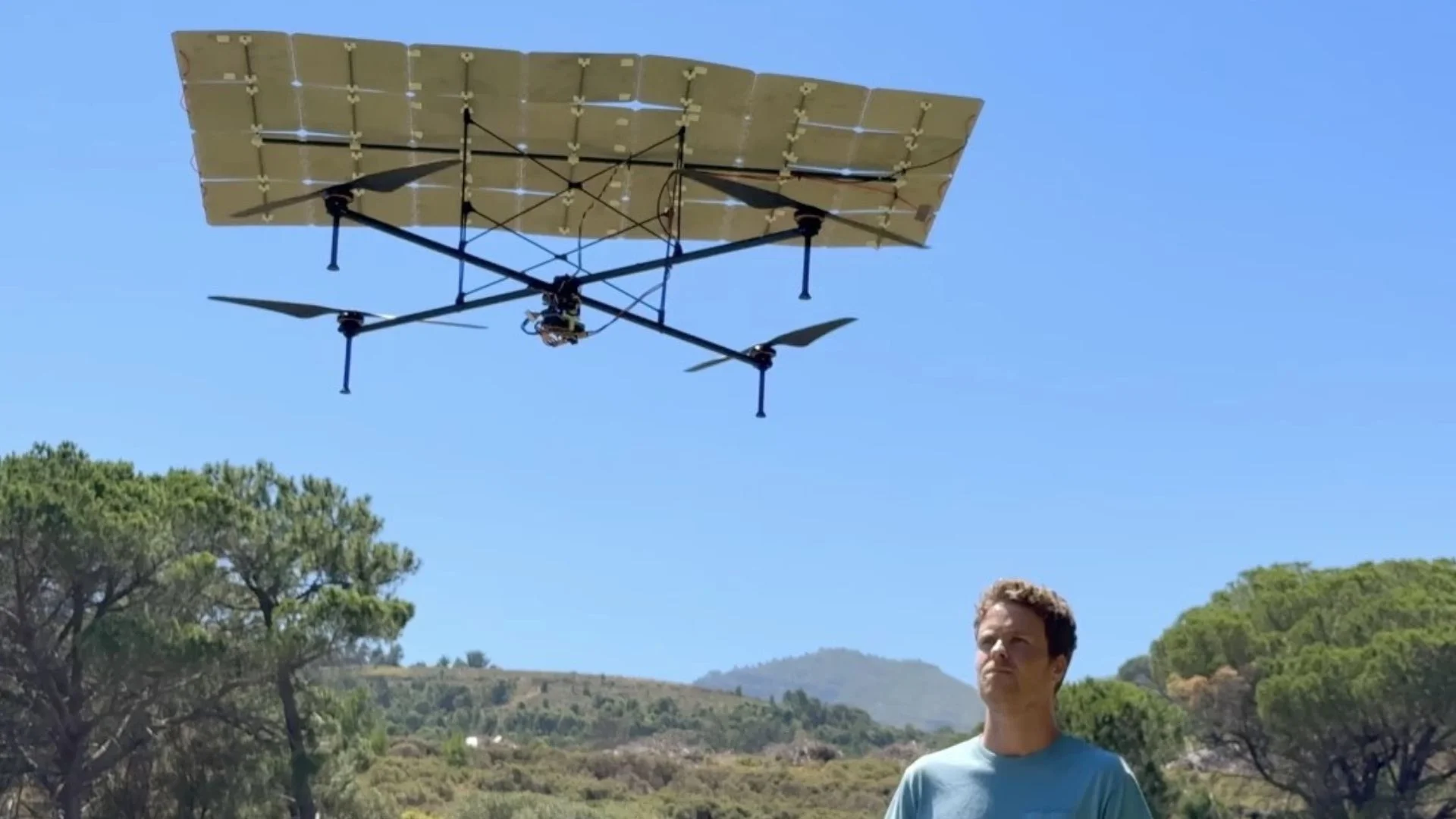
A homemade solar-powered drone built by Luke and Mike Bell stayed airborne for over five hours, setting an unofficial endurance record before the pilot chose to land it.
Unlike traditional drones that rely fully on batteries, this one runs mainly on sunlight. That makes it a unique step forward in drone technology.
The Bells are not new to building record-breaking machines. They are widely known for their Peregreen series of racing drones. These drones have repeatedly set and broken speed records over the years.
In 2023, they hit 247 mph. A year later, they crossed 300 mph (483 km/h). Their Peregreen 3 reached 363 mph (584 km/h) in Dubai. Most recently, the Peregreen 4 touched 408 mph (657.59 km/h) in January 2026.
That speed record still officially stands. However, aerospace engineer Benjamin Biggs has reportedly surpassed it with his BlackBird drone. The competition in high-performance drones remains intense.
READ ALSO: When AI Chooses Who Suffers: MIT’s SEED-SET Flags Ethical Blind Spots Inside AI Decisions
Luke Bell also holds another impressive record. He set an unofficial hover endurance record of 3 hours, 31 minutes, and 6 seconds using a specially designed drone. That machine used large 101-cm propellers and high-density lithium batteries. But the new solar drone is very different in design and purpose.
Luke explained the idea clearly. “A solar-powered drone that can fly for up to 12 hours a day opens up many possibilities,” he said. He added that such drones do not require constant recharging and can travel long distances each day. He compared this with current drones, which are often limited by battery life.
He pointed out how this technology can help industries. Agriculture, mining, mapping, and surveillance could benefit the most. These sectors often need long flight times, which current drones struggle to provide.
The team’s first solar drone was extremely simple. It had no battery and no backup system. It depended entirely on sunlight in real time. The drone used 27 solar panels connected in series. On the ground, they produced around 150 watts of power.
The design worked, but only briefly. A strong gust of wind disrupted the drone’s balance, and it crashed after just three minutes in the air.
WATCH ALSO: China’s new massive battle tank takes part in live-fire test
Learning from that failure, the Bells redesigned the drone. They reduced its weight by about 70 grams. This small reduction helped save around 4 watts of power during flight. They also improved the frame by lowering rotational inertia, making the drone more stable.
To better secure the solar panels, they added TPU sleeves over the carbon fiber arms. This material, often used in 3D printing, is flexible and strong. It helped keep the panels in place during flight.
The biggest improvement came with the addition of a backup system. The new design includes diodes and an auxiliary battery. Diodes act like one-way gates. They stop electricity from flowing back into the solar panels.
When sunlight drops due to clouds or sudden wind, the battery automatically steps in. It fills the gap and keeps the drone stable. This small change made a huge difference in performance.
The final version of the drone uses 28 solar panels. These panels generate over 110 watts of power under full sunlight. The drone needs about 70 watts to stay in the air. The extra energy charges the backup battery during flight.
WATCH ALSO: United Launch Alliance’s Atlas V rocket delivers success for Amazon Leo
This smart balance between solar power and battery support allowed the drone to achieve its long flight time.
However, challenges remain. Wind is still a major problem. Because the drone is lightweight, it is more sensitive to air movement. Luke admitted this openly. “Wind is always a major issue with such a low wing-loading device,” he said. He added that the next version will focus on improving wind resistance while keeping the drone light.
Keeping a multirotor drone in the air for extended periods is much harder than with a fixed-wing aircraft. Fixed-wing drones can glide and use less energy. Multirotors must constantly use power to stay airborne.
Some industrial drones have already shown extreme endurance. The Airbus Zephyr S holds the record for the longest continuous flight, at 64 days. Another platform, PHASA-35, has flown for 24 days. But even these advanced systems are not designed for endless flight.
They face limits such as battery wear, mechanical stress, and long nights without sunlight.
READ ALSO: Tiny 9-Spin Quantum System Beats Massive AI in Real Weather Forecast Test
Luke believes that truly continuous flight is still possible in theory. He suggested a hybrid design. “A simple way is to turn it into an eVTOL,” he said. In such a design, the solar panels would act as wings. This would reduce the power needed for flight to just 10% of what hovering requires.
That means the drone could rely on a small battery at night and recharge again during the day.
He also pointed out another limitation. Current solar panels only convert about 20–25% of sunlight into energy. If this efficiency improves, solar drones could become far more powerful and reliable.
The Bells have taken a strong step forward. Their solar drone shows that simple ideas, when carefully refined, can lead to big results. The next version is already in the works. And if their track record is anything to go by, it may fly even longer and smarter.