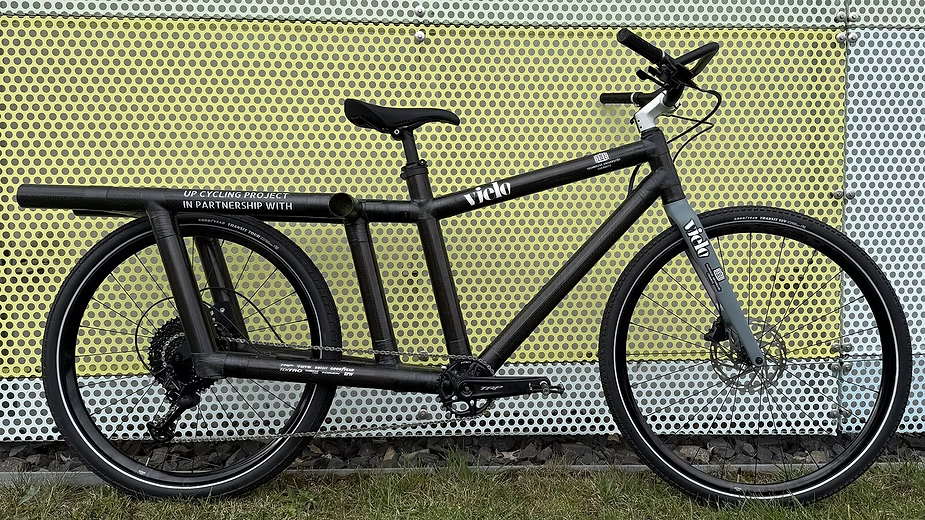
Students at Chemnitz University of Technology have engineered a remarkable fusion of sustainability and social aid, constructing four cargo bikes from upcycled carbon fiber tubes sourced from Airbus passenger aircraft. Weighing just 13 kilograms yet capable of carrying over 70 kilograms, these unique bikes were delivered to flood-devastated communities in Spain’s Valencia region to restore crucial mobility.
In the wake of the devastating floods that struck Spain’s Valencia region in October 2024, a unique international collaboration was sparked, leading to an innovative aid project. Students from the Chair of Sports Equipment Technology at Chemnitz University of Technology, in partnership with British bicycle manufacturer Vielo and Elbe Flugzeugwerke GmbH (EFW), have designed and built four special cargo bikes. The frames are crafted from 55-millimeter diameter carbon fiber tubes that were originally load-bearing structures inside Airbus passenger aircraft, giving high-quality aerospace material a impactful second life.
“For our students in the Sports Engineering program, this project was a unique opportunity to combine sustainable material use, lightweight construction, and social commitment,” explained Jens Buder, a research associate at the Chair of Sports Equipment Technology. The project allowed students to navigate the entire prototype development process, from CAD design to the hands-on work of cutting, bonding, and applying multi-layer carbon fiber wrapping to create exceptionally strong joints. “This resulted in a highly stable frame with an exceptionally good weight-to-stiffness ratio,” Buder added. The final bikes are a feat of lightweight engineering, weighing approximately 13 kilograms while being able to transport a payload of more than 70 kilograms.
READ ALSO: https://www.modernmechanics24.com/post/china-5g-remote-robotic-eye-surgery-4000km-away
The initiative was driven by social need. The aid project was initiated by Juan Dual, a Valencian cyclist and Vielo athlete known as “Empty Juan.” Following the floods, Dual led a team of 100 volunteer cyclists to deliver aid to inaccessible areas. With support from Vielo and Chemnitz University of Technology, his vision to provide durable cargo bikes to the hardest-hit communities became a reality. Vielo co-founder Trevor Hughes personally collected the bikes from the university and embarked on a 2,600-kilometer journey to deliver them to Valencia in October 2025.
The students involved faced and overcame significant technical challenges, turning the theory of their studies into practical reality. “At the beginning, it was a real challenge – but after the first bike, the assembly went surprisingly smoothly,” said student Louis Ladewig. His fellow student, Sebastian Marx, highlighted the unique learning experience: “We all work on our own bikes, but building a bicycle from scratch is something completely different.” Another participant, Thorben Tittel, found value in the design constraints, noting that forgoing suspension kept the concept streamlined and efficient.
The collaboration showcased a successful model for the circular economy in advanced manufacturing. “The direct line to Elbe Flugzeugwerke GmbH was key to finding a meaningful way to reuse certified aerospace carbon structures,” emphasized Prof. Dr. Stephan Odenwald, Chair of Sports Equipment Technology, who established the corporate connection.
WATCH ALSO: https://www.modernmechanics24.com/post/lucid-bots-sherpa-drone-painting-module
“This collaboration demonstrates how the circular economy can work in lightweight construction: We are giving high-quality fiber composites from the aerospace industry a second life.” The project, supported by partners like Goodyear/Cambrian Tyres and Ineos Automotive, stands as a powerful example of how academic institutions, industry, and social commitment can converge to create tangible, hopeful solutions from what was once considered waste.