Credit: NASA
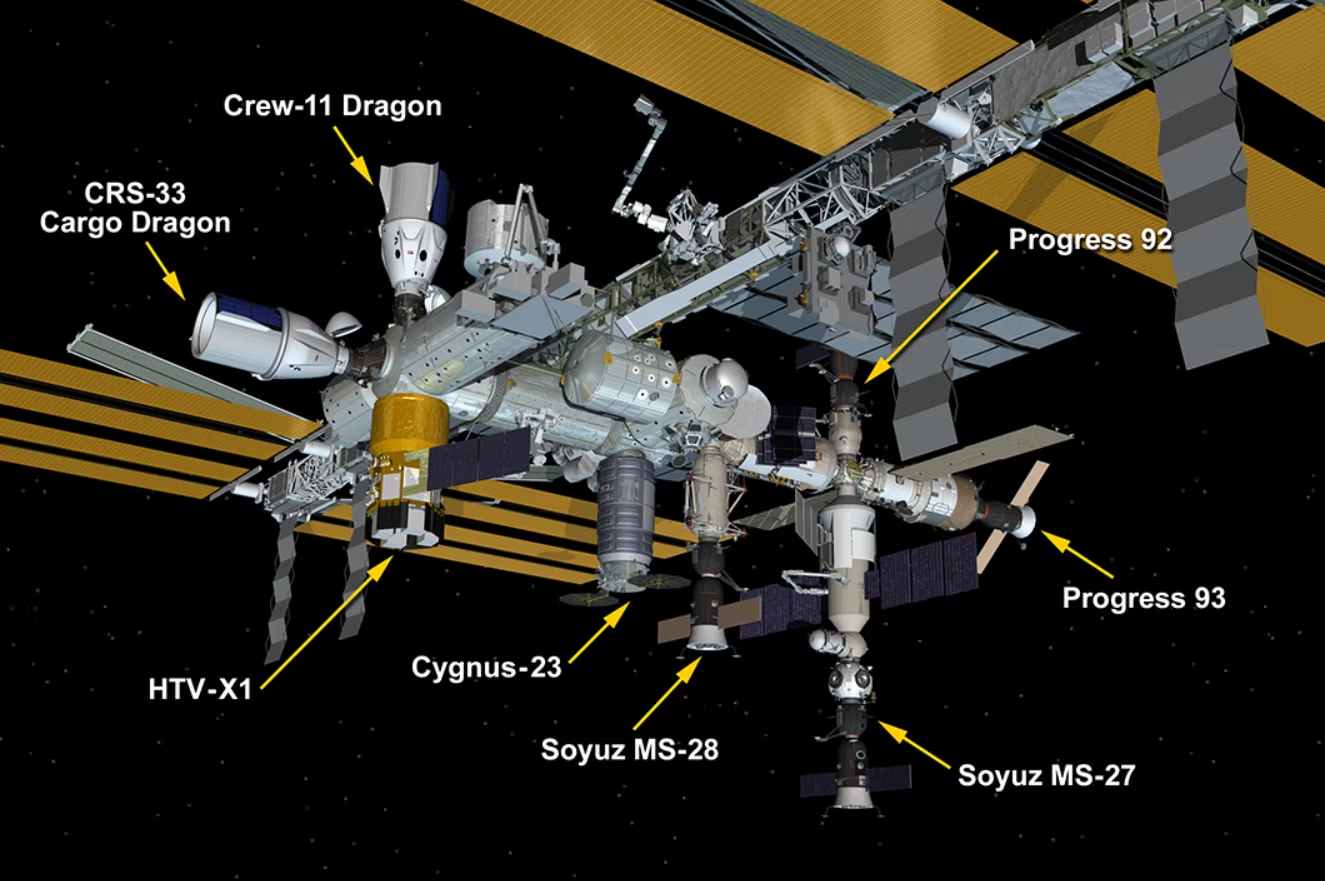
In a historic first for the International Space Station (ISS), all eight of its docking ports are now fully occupied. This milestone was reached after Northrop Grumman’s Cygnus XL cargo spacecraft was reinstalled at the Earth-facing port of the Unity module. With this addition, the station is currently hosting an impressive lineup of visiting vehicles: two SpaceX Dragon spacecraft, the Cygnus XL, JAXA’s HTV-X1, two Russian Soyuz crew vehicles, and two Progress cargo ships.
The achievement comes after the careful reattachment of Cygnus XL as part of the Northrop Grumman-23 commercial resupply mission for NASA. The spacecraft had been temporarily removed the previous week using the ISS’s Canadarm2 robotic arm, operated remotely by the robotics officer at NASA’s Mission Control Center in Houston.
NASA, Northrop Grumman, and Roscosmos jointly coordinated the maneuver to ensure safe clearance for the arrival of the crewed Soyuz MS-28 spacecraft on November 27.
Cygnus XL will remain docked until at least March 2026. When its mission is complete, it will depart the station loaded with up to 11,000 pounds of waste and excess equipment, eventually burning up safely in Earth’s atmosphere.
Meanwhile, the Expedition 73 crew—now consisting of 10 members—spent the day conducting a variety of physics and biology experiments while preparing for upcoming crew rotations. The station welcomed three new residents following the arrival of Soyuz MS-28 on November 27, 2025: NASA astronaut Chris Williams and Roscosmos cosmonauts Sergey Kud-Sverchkov and Sergei Mikaev.
READ ALSO: https://www.modernmechanics24.com/post/china-star-eye-satellite-tracking-network
Their long-duration mission, lasting until July 2026, will include critical studies on human health in microgravity. Kud-Sverchkov and Mikaev have already begun researching how spaceflight affects blood circulation in extremities, while Williams supported his teammates with ongoing cargo operations.
Looking ahead, the ISS crew will transition back to seven members on December 8 when NASA astronaut Jonny Kim and Roscosmos cosmonauts Sergey Ryzhikov and Alexey Zubritsky board Soyuz MS-27 for their return to Earth. The trio completed checks on their Sokol suits and continued preparations for their landing in Kazakhstan. With their departure, they will conclude an eight-month scientific mission that began on April 8, 2025.
Following Cygnus XL’s reinstallation, Kim joined Williams and NASA Flight Engineer Zena Cardman to open the hatch and begin offloading the several tons of scientific equipment and supplies delivered on September 18.
WATCH ALSO: https://www.modernmechanics24.com/post/tron1-hyper-real-dinosaur-robot
Elsewhere on the station, NASA’s Mike Fincke and JAXA astronaut Kimiya Yui dedicated their day to microgravity research. Fincke upgraded hardware for an experiment focused on preserving cryogenic fuels for spacecraft, then set up the newly arrived NanoRacks Thailand Liquid Crystals experiment to study the behavior of thin liquid crystal films in weightlessness. Yui conducted medical research, measuring blood flow and blood pressure to help scientists better understand the effects of space on the human brain.
In the Russian segment, Roscosmos Flight Engineer Oleg Platonov collected and documented microbial samples for analysis and downloaded data tracking the vibration patterns experienced by the station as it orbits Earth.
READ ALSO: https://www.modernmechanics24.com/post/uk-stops-ajax-vehicles-after-troops-sick