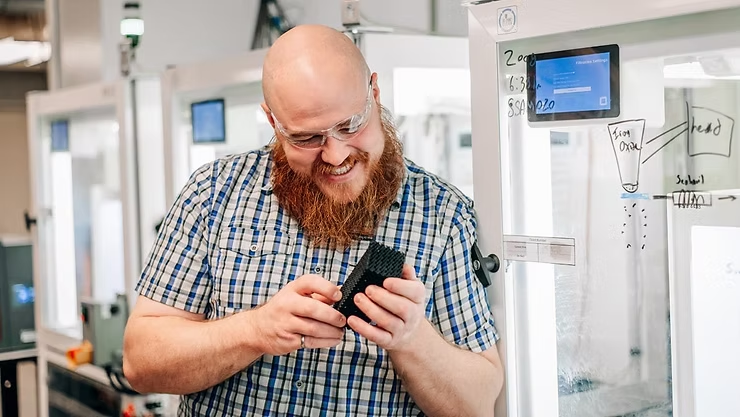
Engineers at the University of Maine have introduced a promising new approach to more accurately predict the strength of lightweight 3D-printed parts. The work, carried out at the university’s Advanced Structures and Composites Center (ASCC), is expected to advance the design and reliability of 3D-printed components used across multiple industries. By offering a more precise way to control strength while reducing weight, the method opens doors for creating robust yet lightweight plastic parts tailored for modern applications.
Bridging Computer Models and Real-World Testing
The study integrates advanced computational modeling with hands-on experiments to provide a clearer picture of how 3D-printed parts behave when subjected to stress. Unlike traditional methods that often rely solely on simplified calculations or trial-and-error testing, this combined approach allows researchers to anticipate performance with greater accuracy before a part is even manufactured.
The research team was led by Philip Bean, research engineer at the ASCC, in collaboration with Senthil Vel, professor of mechanical engineering, and Roberto Lopez-Anido, professor of civil engineering. Their findings, recently published in Progressive Additive Manufacturing, represent a significant step forward in predictive design for additive manufacturing.
READ ALSO: Next-Gen Shape Memory Alloy Designed to Withstand Space’s Harsh Cold
Why Gyroid Infill Matters
A major focus of the project was the use of gyroid infill, a complex, repeating lattice-like structure widely adopted in 3D printing. Gyroid patterns are known for their ability to reduce material usage without sacrificing too much strength. Their curved, three-dimensional geometry distributes loads efficiently, making them popular in applications where weight reduction is critical.
However, despite their popularity, predicting how gyroid structures respond under different conditions has been difficult. Conventional analytical methods struggle to account for the complexity of these internal patterns. The UMaine team addressed this challenge by using computer simulations to model gyroid structures under various loads and then validating these results through physical experiments on 3D-printed prototypes.
The combination of theory and testing allowed the researchers to see how gyroid infill contributes to a part’s overall performance, providing insights that were previously hard to obtain.
A Step Toward Smarter 3D-Printed Design
“This work allows us to design 3D-printed parts with greater confidence and efficiency,” said Philip Bean, one of the lead researchers. “By understanding the precise strength of these gyroid-infilled structures, we can reduce material use and improve performance across industries.”
In other words, manufacturers will be able to make smarter choices—knowing exactly how much material to save without risking part failure. This not only improves safety and reliability but also makes the 3D printing process more sustainable by cutting down on waste.
READ ALSO: General Dynamics to upgrade Virginia-class submarines with new contract
READ ALSO: 3rd MLR Deploys NMESIS to the Philippines for Balikatan 25 Exercise
Industry Impacts and Future Potential
The implications of this research extend well beyond the lab. Many industries increasingly depend on lightweight yet strong materials, and the ability to predict and fine-tune strength could be transformative.
- Aerospace: Aircraft manufacturers are constantly searching for lighter components to improve fuel efficiency. Predictive modeling of gyroid structures could lead to safer, lighter parts for interiors and even structural applications.
- Automotive: Car makers striving for electric vehicle efficiency could benefit from parts that are both durable and weight-optimized, improving performance and battery life.
- Medical devices: From prosthetics to surgical tools, the ability to predict strength in customized, lightweight 3D-printed parts could enhance patient outcomes while lowering production costs.
The method could also inspire innovations in sports equipment, robotics, and consumer products, where designers balance performance, durability, and weight.
Looking Ahead
As industries adopt 3D printing more widely, the demand for accurate predictive tools will only grow. The University of Maine’s work demonstrates how combining computational and experimental approaches can unlock new capabilities in design and manufacturing.
By refining these methods further, researchers hope to create a framework that designers and engineers can apply across a variety of materials and structures, not just gyroid infill. The ultimate vision is a future where lightweight 3D-printed parts can be designed with precision confidence—before they’re even produced.
With this breakthrough, UMaine engineers have not only enhanced the science of additive manufacturing but also contributed a practical tool that could reshape how industries design, test, and deploy the next generation of strong, lightweight components.