When solving an engineering challenge, NASA follows the same principle detectives use to crack a mystery: gather evidence, analyze the clues, and build a clear case. That’s exactly the approach researchers are taking with a new series of experimental flights designed to refine a sensor system for supersonic parachutes. The goal is to enhance reliability and safety for delivering scientific instruments and payloads to destinations like Mars.
The EPIC Initiative
The research is led by the Enhancing Parachutes by Instrumenting the Canopy (EPIC) team at NASA’s Armstrong Flight Research Center in Edwards, California. The project focuses on integrating flexible strain-measuring sensors into parachute canopies to capture critical performance data without compromising the parachute’s function.
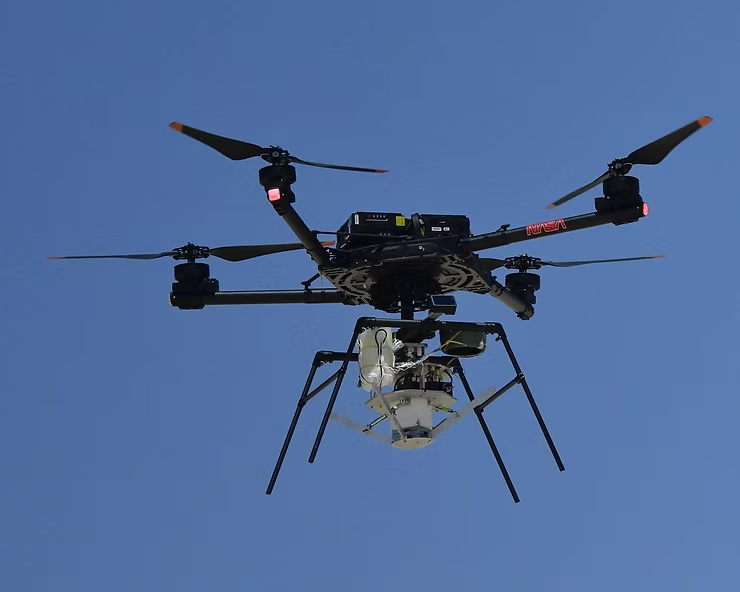
In June, the EPIC team conducted a key test flight. Using a quadrotor aircraft (drone), researchers air-launched a capsule equipped with a specially instrumented parachute. The parachute featured the new sensor technology, which successfully recorded strain measurements while remaining unobtrusive to the canopy material—just as predicted during the design phase.
Successful First Results
The outcome provided more than just proof of compatibility. The sensors also captured valuable performance data that will inform the design of upcoming trials.
“Reviewing the research flights will help inform our next steps,” explained Matt Kearns, EPIC project manager at NASA Armstrong. “We are engaging with potential partners to identify the data they’re most interested in. Our team is also refining methods for temperature testing the sensors, improving data analysis, and investigating additional instrumentation for future experiments.”
READ ALSO: General Atomics Sets Global Strategy for Swift Development of Uncrewed Combat Jets
READ ALSO: 3rd MLR Deploys NMESIS to the Philippines for Balikatan 25 Exercise
Bridging the Data Gap
This initial testing marks an important step toward filling critical gaps in computer models that predict parachute behavior under supersonic conditions. Better modeling will lead to improved designs, reducing risk during high-speed atmospheric entries on Earth, Mars, or other planetary bodies.
The technology also has potential applications beyond space exploration. The aerospace and even auto racing industries, where high-speed aerodynamic performance is essential, could benefit from the insights gained through this research.
Collaborative Effort
The EPIC project is funded by NASA’s Space Technology Mission Directorate (STMD) through its Entry Systems Modeling project at NASA’s Ames Research Center in California’s Silicon Valley. The capsule and parachute system originated at NASA’s Langley Research Center in Hampton, Virginia.
To support the tests at Armstrong, NASA interns collaborated with Langley engineers to build and integrate a similar capsule-parachute system. This hands-on involvement not only expanded testing capacity but also provided valuable training for the next generation of aerospace engineers.
The work builds on an earlier phase funded under STMD’s Early Career Initiative, which focused on sourcing commercially available flexible strain sensors and developing a durable bonding method for canopy integration.
READ ALSO: The Hutchinson site in Château-Gontier has earned the AeroExcellence Bronze certification.
READ ALSO: Artificial biosensor enables more precise detection of the body’s primary stress hormone
Looking Ahead
With successful initial tests completed, the EPIC team is preparing for more complex experiments. The data gathered will guide the next generation of supersonic parachutes, improving their resilience and performance in extreme environments. In the long term, this technology could play a pivotal role in ensuring the safe delivery of payloads—whether landing on Mars, returning samples to Earth, or enabling other high-speed deployment missions.
By methodically collecting and analyzing each piece of data, NASA is bringing the vision of safer, more advanced parachute systems closer to reality.