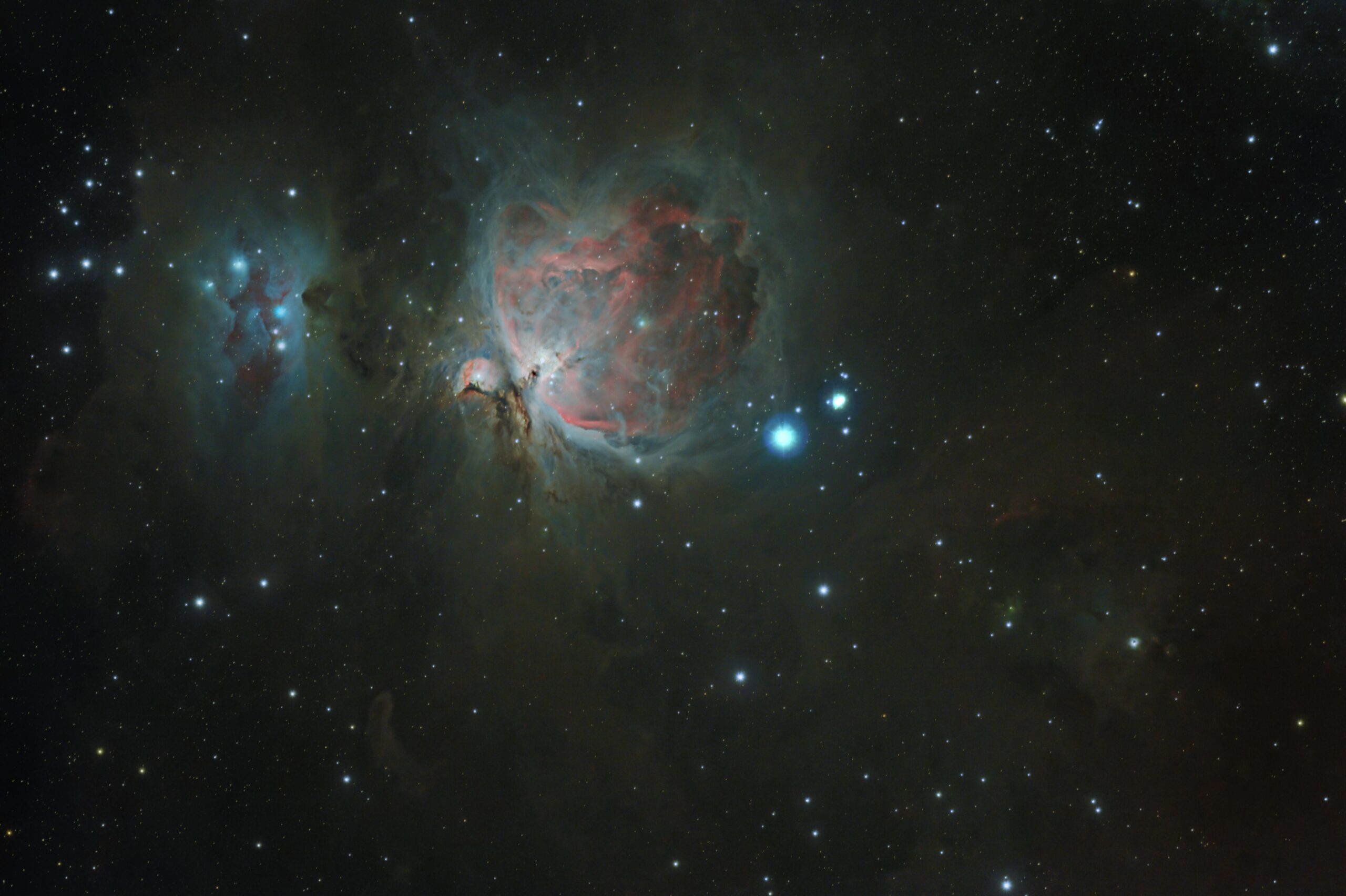
For the first time, astronomers have witnessed three supermassive black holes, all simultaneously emitting powerful radio jets, on a collision course within a single merging galaxy system. Located 1.2 billion light-years away, this rare triple-act reveals a chaotic, three-way cosmic dance that could explain how the universe’s most massive black holes grow to gargantuan sizes.
Imagine the chaos of three galactic cores, each harboring a ravenous gravitational monster, spiraling toward an eventual merger. That’s the unprecedented scene captured by a team using the US National Science Foundation’s Very Large Array (VLA) and Very Long Baseline Array (VLBA). The system, cataloged as J1218/1219+1035, shows three active galactic nuclei separated by 22,000 and 97,000 light-years—cosmically close, but still taking millions of years to finally unite. What makes it a landmark discovery is that all three central black holes are “radio-bright,” actively feeding and shooting out jets of material, a phenomenon never before confirmed in a triple merger.
“Triple active galaxies like this are incredibly rare, and catching one in the middle of a merger gives us a front-row seat to how massive galaxies and their black holes grow together,” said the study’s lead author, Dr. Emma Schwartzman of the US Naval Research Laboratory, as reported in the team’s statement. She emphasized the breakthrough: “By observing that all three black holes in this system are radio-bright and actively launching jets, we’ve moved triple radio AGN from theory into reality.”
READ ALSO: https://modernmechanics24.com/post/naval-laser-weapon-jv-rheinmetall-mbda/
The discovery, detailed by NASA and the research team, began with intriguing infrared data hinting at a complex merger. However, optical and X-ray observations can be obscured by dust and gas swirling around active black holes. Radio observations cut through that cosmic fog. The powerful radio telescopes provided the clear, high-resolution evidence needed to distinguish three distinct, powerful sources, confirming the historic find.
Why is a triple merger so special? Galaxy mergers are common—our own Milky Way will eventually collide with Andromeda—but spotting three large galaxies intertwining is far less frequent. Having all three central black holes actively “turned on” and detectable in radio waves is rarer still. It’s a perfect storm of conditions that offers a unique laboratory. According to the researchers, this system provides critical clues about the trigger mechanism for black hole activity during mergers, as fresh supplies of gas are funneled toward the galactic cores, igniting feeding frenzies.
The detection is more than a cosmic curiosity; it’s a key to unlocking a major astronomical mystery. Supermassive black holes can weigh billions of times the mass of our Sun, but how they accumulate such staggering mass isn’t fully understood. Hierarchical mergers—black holes crashing together and combining—are a leading theory. Observing a system where three are destined to become one provides a direct test of this growth pathway.
WATCH ALSO: https://modernmechanics24.com/post/us-supersonic-jet-cuts-flight-time-silences-sonic-boom/
The team plans extensive follow-up observations across multiple wavelengths to probe the system’s physics further. They aim to measure the black holes’ masses, map the complex gas dynamics fueling them, and model the eventual gravitational wave signal this triplet will produce. Each observation will refine our understanding of galaxy evolution and the life cycle of the universe’s most enigmatic objects.
For astronomers, J1218/1219+1035 is a gift. It transforms theoretical models of chaotic triple mergers into observable reality, offering a direct glimpse into the turbulent processes that shaped the largest structures in our cosmos. As Dr. Schwartzman and her colleagues continue their watch, they’ll be documenting a billion-year-long collision in ultra-slow motion, revealing secrets of growth built from cosmic chaos.
READ ALSO: https://modernmechanics24.com/post/wisk-gen6-autonomous-evtol-first-flight/