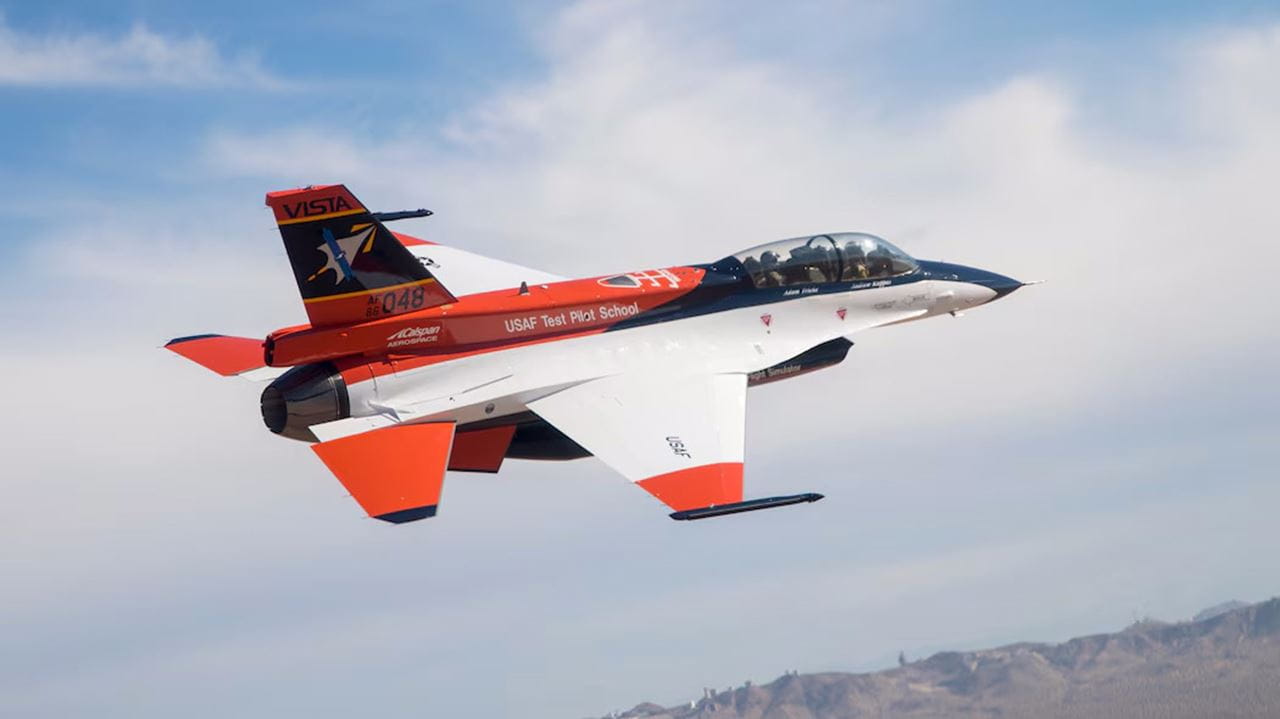
RTX business Raytheon has secured a U.S. Air Force contract to install its new PhantomStrike radar on the experimental X-62A VISTA autonomous fighter jet, aiming to provide the AI-piloted aircraft with superior situational awareness at nearly half the cost of typical systems.
The contract marks a significant step in the Air Force’s push toward autonomous air combat. The X-62A Variable In-flight Simulation Test Aircraft (VISTA), a heavily modified F-16D serving as a premier testbed for machine learning and autonomous software, will be equipped with the revolutionary sensor. According to the announcement, PhantomStrike is an air-cooled, compact fire-control radar designed to be smaller, lighter, and more power-efficient than modern Active Electronically Scanned Array (AESA) radars.
What makes this radar so pivotal for the future of unmanned combat? The PhantomStrike leverages Gallium Nitride (GaN) technology and a completely air-cooled design to deliver advanced capabilities without the liquid cooling systems of larger radars. This makes it ideal for integration on a wider range of platforms, including unmanned aerial vehicles and light-attack aircraft. Dan Theisen, president of Advanced Products & Solutions at Raytheon, underscored its strategic importance: “This radar is revolutionary in its use of GaN, completely air-cooled technology, and innovation in how we manufacture it – at a lower cost than other modern-day radars,” he said.
READ ALSO: https://modernmechanics24.com/post/rolls-royce-test-methanol-marine-engine/
The U.S. Air Force’s VISTA aircraft, operated by the Air Force Test Pilot School and DARPA, is at the forefront of testing AI agents in realistic dogfighting scenarios. Integrating the PhantomStrike radar will provide these AI pilots with a high-fidelity sensor capable of digital beam forming, multimode functionality, and interleaved ground and air targeting. This enhanced “sight” is critical for an autonomous system to perceive, understand, and dominate a complex battlespace. The Raytheon announcement emphasized that the radar delivers this superior capability at nearly half the cost of typical fire-control radars, a key factor for scalable future production.
This move is more than just an upgrade; it’s a foundational investment in the hardware that will enable trusted human-machine teaming. As Dan Theisen noted, autonomous aircraft are poised to play a key role in maintaining U.S. air superiority, acting as loyal wingmen to manned fighters like the F-35 or Next-Generation Air Dominance (NGAD) platform. A low-cost, high-performance radar is essential for making these autonomous assets viable and deployable in large numbers.
The contract signals a clear trajectory: the U.S. Air Force is not only developing the AI brains for its future fleet but is now specifically tailoring the sensory organs. By choosing the PhantomStrike for its flagship autonomous test jet, the service is validating a new class of affordable, capable sensors designed for the drone-centric battlefields of tomorrow. The successful integration and testing on the X-62A VISTA will likely set the standard for radars across a future family of collaborative combat aircraft.
WATCH ALSO: https://modernmechanics24.com/post/rolls-royce-test-methanol-marine-engine-2/