NASA, in partnership with The Aerospace Corporation, has successfully launched its innovative DiskSat technology demonstrator to low Earth orbit. The mission will test the performance of a flat, circular spacecraft design—one meter in diameter but only an inch thick—that could dramatically expand the capabilities and lower the cost of future small satellite missions.
Move over, CubeSats. There’s a new shape in town, and it’s as flat as a pancake. In the pre-dawn hours of Thursday, Dec. 18, a Rocket Lab Electron rocket lifted off from Wallops Island, Virginia, carrying a novel technology demonstrator for NASA. Its payload: four DiskSat spacecraft, a radical departure from the boxy satellites that have dominated the small satellite revolution.
This mission, a collaboration between NASA’s Small Spacecraft & Distributed Systems program and The Aerospace Corporation, aims to prove the viability of a unique, disk-shaped platform. Each DiskSat is 40 inches (one meter) in diameter but only one inch (2.5 cm) thick—imagine a small coffee table floating in space. This flat architecture, coupled with an onboard electric propulsion system for maneuvering, is designed to unlock new mission possibilities, particularly in Very Low Earth Orbit (VLEO) where advantages include sharper Earth imaging and faster communications.
READ ALSO: https://modernmechanics24.com/post/industrial-robotics-agile-one-launch/
“DiskSat boosts U.S. innovation and commercial space opportunities while providing mission designers new flexibility, enabling them to pursue and achieve NASA’s goals faster and more affordably,” stated NASA in its mission announcement. The design could broaden scientific opportunities and increase overall access to space, offering an alternative for NASA, commercial entities, and academia, reported The Aerospace Corporation.
The launch itself was a multi-agency effort. While NASA funded the technology’s development, the launch services were provided by the U.S. Space Force’s Rocket Systems Launch Program (RSLP), with in-orbit operations managed by the Department of War Space Test Program (STP). NASA’s Wallops Flight Facility provided critical range safety and tracking services.
A key component being tested is the specialized dispenser, engineered to hold and sequentially deploy the four fragile-looking disks in orbit. Once free, the mission will evaluate the satellites’ performance, stability, and propulsion capabilities. Their flat form factor is particularly conducive to operating in lower orbits that are often too demanding for traditional satellites due to atmospheric drag.
READ LAOS: https://modernmechanics24.com/post/icfo-shortest-light-pulse-record-icfo/
The implications are significant for future exploration. The DiskSat concept supports NASA’s long-term plans for sustained operations at the Moon and Mars, as well as advanced Earth science. By demonstrating a lower-cost, high-capability platform, it could enable new constellations for climate monitoring, communications, and technology demonstrations.
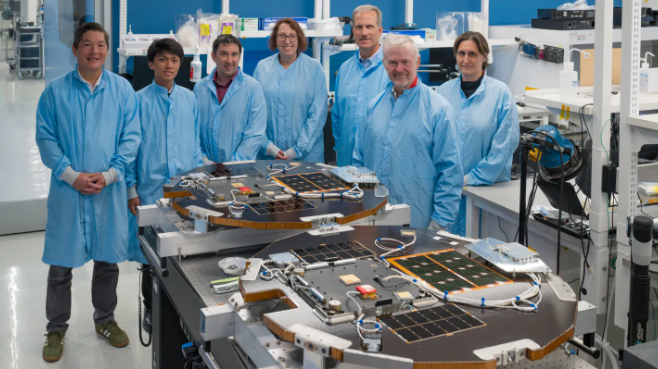
Led by Catherine Venturini, DiskSat principal investigator at The Aerospace Corporation, the engineering team conducted final checks in El Segundo, California, before the historic launch. If successful, this quiet midnight launch from Virginia could mark the beginning of a much flatter, and potentially more capable, future in small spacecraft design.