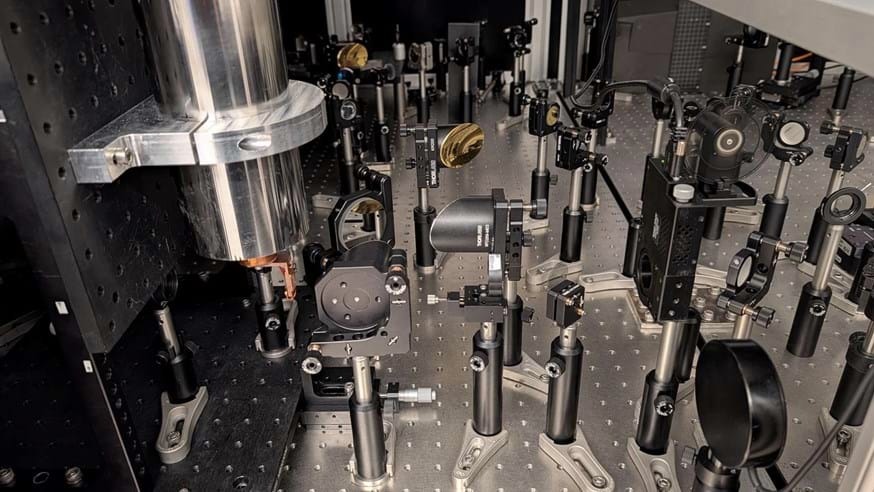
An international research team led by Lancaster University has uncovered a highly efficient method for controlling magnetization using ultra-short light pulses. Their discovery reveals that the interaction between electron orbits and spins can produce a spin deflection ten times larger than previously possible, a breakthrough for future ultrafast, energy-efficient data storage and quantum technologies.
What if you could flip the magnetic memory in your computer or a data server a thousand times faster, using far less energy? A new discovery in fundamental physics brings that future closer. Scientists, led by Dr. Rostislav Mikhaylovskiy at Lancaster University, have found a remarkably powerful way to “shake” and steer magnetization using light pulses shorter than a trillionth of a second. Their work, published in the prestigious journal Physical Review Letters, reveals a hidden mechanism that could turbocharge the development of next-generation computing.
The core of the breakthrough lies in the intricate dance between an electron’s orbit and its spin. In magnetic materials, each electron acts like a tiny compass needle. Traditionally, controlling magnetization—flipping these needles to encode data as 0s and 1s—relies on energy-intensive methods. The Lancaster-led team explored a more elegant approach: hitting a magnet with an extremely brief electromagnetic pulse and observing how its magnetic state changed.
READ ALSO: https://modernmechanics24.com/post/bmw-encory-launch-direct-battery-recycling/
They compared two similar magnetic materials with different electronic orbital structures. The critical finding was that the interaction between orbital motion and spinning unlocks a dramatically stronger response. After the light pulse shook the magnet, the resulting spin deflection was 10-fold larger in the presence of this spin-orbit coupling than without it. “We believe that this exciting discovery will stimulate further studies of the mechanisms governing the efficient and rapid control of magnetization,” stated Dr. Rostislav Mikhaylovskiy, the study’s lead author.
This isn’t just an academic curiosity. Magnetic materials are the backbone of modern data storage, from the hard drives in massive data centers to sensors in smartphones. Making the process of writing magnetic data faster and more efficient is a relentless pursuit. The ability to use a tiny pulse of light to induce a large magnetic change points toward a path for ultrafast, low-power magnetic memory devices. It represents a new fundamental property that device physicists can now exploit.
The research provides a deeper understanding of how to steer magnetization at its most fundamental level. By modifying the electron’s orbital state with light, researchers can indirectly, but very powerfully, torque its spin—the essence of magnetism. This efficient coupling mechanism could be crucial for future quantum technologies, where precise control over quantum states is paramount.
WATCH ALSO: https://modernmechanics24.com/post/chinese-company-new-humanlike-robot/
By illuminating the profound link between orbital and spin dynamics, the Lancaster University-led team has not only advanced basic science but has also handed engineers a potential key to unlocking the next revolution in information technology: devices that are unimaginably fast and sip rather than gulp power.