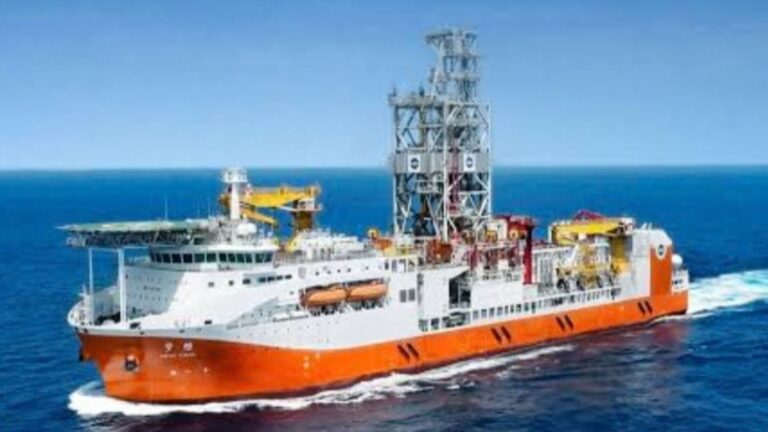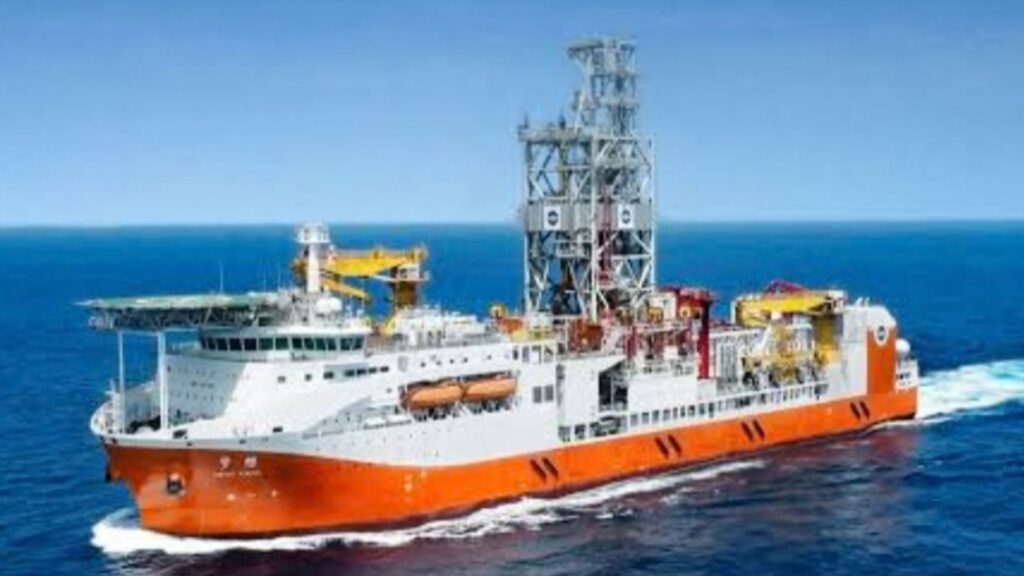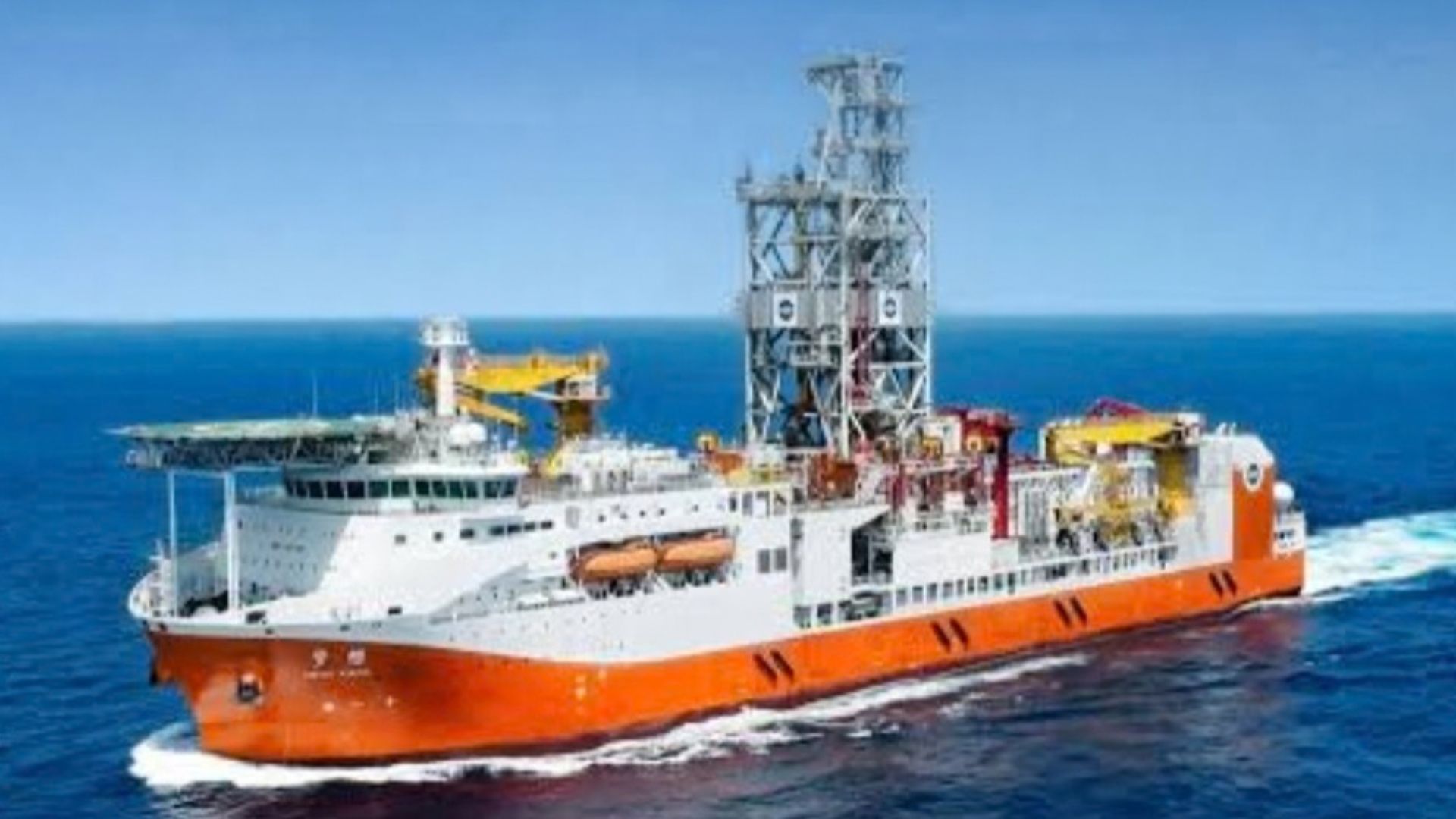
China has reached a new level in deep-sea scientific drilling after its ocean research vessel Mengxiang recovered hard basalt from the South China Sea basin.
The vessel reached a maximum total depth of 4,929.17 meters during a 30-day trial mission and drilled to a depth of 864.77 meters below the seabed. The operation gives China new experience in ultra-deep-water drilling and places it among the few countries able to recover hard-rock samples from deep ocean basins.
The Ministry of Natural Resources said the vessel recently returned to Guangzhou, Guangdong, after completing the trial scientific drilling mission.
The voyage took place in the South China Sea and focused on testing the vessel’s drilling and scientific research systems under demanding deep-water conditions. The results established a new national record for independently conducted ocean drilling in China.
One of the main achievements was recovering a 4.27-meter-long basalt sample from the seabed. Researchers obtained the sample using a domestically developed drilling system for the mission. The operation made China the third country, after the United States and Japan, to recover hard-rock samples from a deep ocean basin using a drilling vessel, according to the ministry.
Basalt is a common type of volcanic rock found beneath the world’s oceans. Ocean-floor basalt generally occurs in deep and ultra-deep waters, at depths ranging from about 1,000 to 7,000 meters. Its hardness and brittle structure make it difficult to drill, cut, and recover without damaging the core sample.
Sun Zhen, a researcher at the Guangzhou Marine Geological Survey, said the successful recovery of hard-rock material from the South China Sea was an important result of the mission.
He explained that drilling basalt places heavy demands on drill bits and other equipment because the rock is both extremely hard and prone to breaking. These characteristics make continuous core recovery particularly challenging at great water depths.
Deep Water Operations Tested
The trial also tested remotely operated vehicles (ROVs) during long-duration deep-sea operations. The research team deployed two ROVs at depths of around 4,000 meters for a combined operating time of more than 358 hours. One continuous operation lasted 103 hours, according to Sun.
READ ALSO: https://modernmechanics24.com/post/cape-canaveral-lasers-drone-threats/
ROVs are unmanned underwater vehicles connected to a surface vessel. They allow researchers to inspect the seabed, operate equipment and collect information in places that are too deep or difficult for divers to reach. Using them during the mission provided additional experience conducting extended scientific operations under extreme underwater pressure.
The team also followed International Ocean Discovery Program standards during the mission. Researchers carried out several stages of sample processing directly on the vessel, including cataloging, cutting, scanning, testing and storage. This gave the team experience with a complete workflow for handling material recovered from ultra-deep waters.
The drilling results are expected to support research into the geological development of the South China Sea. Basalt samples and associated data can help researchers examine how the basin expanded and how its seabed developed over geological time. The material may also contribute to studies of ancient marine environments and the assessment of resources located in ultra-deep waters.
Inside China’s Drilling Vessel
The Mengxiang, whose name means ‘dream,’ is China’s first domestically built ocean drilling vessel. It was officially commissioned in 2024 and was designed with a stated maximum drilling capability of 11,000 meters. The vessel has four drilling modes and three coring methods, allowing researchers to use different techniques depending on seabed conditions.
A major feature of the ship is its onboard laboratory. According to Chinese authorities, the vessel has what is described as the world’s largest and most comprehensive shipboard laboratory. The facility allows researchers to examine recovered material at sea instead of relying entirely on laboratories after the vessel returns to port.
The vessel’s capabilities are intended for scientific work at depths well beyond the range of many conventional research ships. Its systems are designed to support drilling, core recovery, sample analysis and other research tasks during a single expedition. This reduces the need to separate drilling and laboratory work between different platforms.
China has also compared the vessel with two major international ocean drilling ships. A February article on the State-owned Assets Supervision and Administration Commission website said Mengxiang’s overall performance surpasses that of Japan’s Chikyu and the retired US research vessel JOIDES Resolution. Those vessels have played major roles in international ocean drilling research.
Wider Maritime Industry Impact
The Mengxiang project extends beyond the scientific study of the seabed. Building and operating a vessel of this type requires specialized materials, drilling systems, precision equipment and deep-sea engineering technologies. These requirements have helped develop capabilities across several parts of China’s marine industrial supply chain.
Cao Heping, a professor at Peking University, described the vessel as an important part of China’s wider effort to develop maritime and scientific capabilities.
He said technologies developed for the project also provide a foundation for other parts of the national industrial system. The Global Times reported his comments.
The vessel has also supported industries producing marine-grade steel, deep-sea drill bits, precision instruments and large underwater equipment. Chinese officials and researchers have linked these capabilities to the development of wider industrial chains around deep-sea engineering. Cao also said these technologies may eventually support exporting integrated marine equipment to partner countries.
The development comes as China continues to expand its marine economy. Data from the Ministry of Natural Resources show that China’s marine economy reached 11.02 trillion yuan, or about $1.64 trillion, in 2025. The sector grew by 5.5 percent year on year and accounted for 7.9 percent of GDP growth during the year.
Marine engineering equipment manufacturing was among the areas showing strong growth. Its value-added output increased by 10.2 percent year on year in 2025, according to the ministry. Other emerging marine industries are also being developed alongside established sectors.
READ ALSO: https://modernmechanics24.com/post/trump-says-raf-fairford-suspects-damage/
Next Phase Of Exploration
The latest drilling mission is expected to serve as an early test of what the Mengxiang can accomplish during future scientific expeditions. Its stated 11,000-meter drilling capability gives researchers a platform for work in some of the deepest parts of the world’s oceans. Future missions can build on the drilling, ROV operations and onboard sample-processing procedures tested during the South China Sea voyage.
China’s marine development plans for 2026-2030 also identify areas such as marine energy resources, deep-sea and offshore aquaculture, marine equipment manufacturing and marine biomedicine for further development. Deep-sea research vessels can provide data and technical experience for some of these activities. The Mengxiang is therefore positioned to support both geological research and wider marine engineering work.
The South China Sea samples will now provide researchers with physical evidence for studying the basin’s geological history and ancient marine conditions.
At the same time, the drilling mission has demonstrated China’s ability to conduct extended operations and recover hard rock from nearly 5,000 meters of water. Further expeditions will determine how these capabilities contribute to China’s long-term ocean research and deep-sea resource programs.