

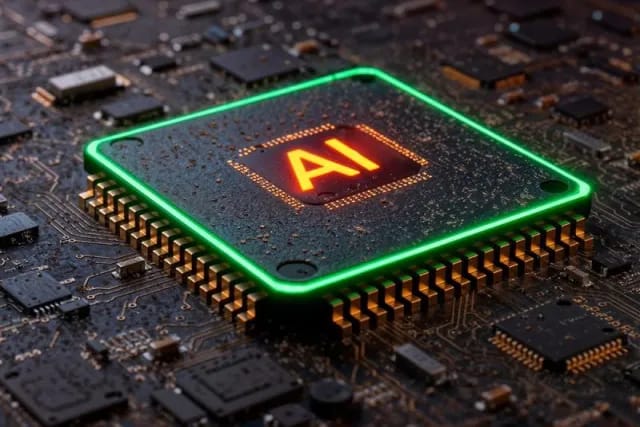
Alibaba has unveiled a new artificial intelligence chip and outlined plans for a Qwen model with as many as 10 trillion parameters.
The Chinese technology group announced the developments at its annual Apsara Conference in Hangzhou as it expands its AI models, computing hardware and cloud infrastructure.
The company also plans to increase its global data-centre capacity to more than 20 gigawatts by 2032.
Alibaba chairman Joe Tsai said the company is investing across the full AI technology chain. The approach covers AI models, chips and cloud computing rather than focusing on a single part of the technology stack.
Tsai said the aim is to move AI from research and technical development into commercial applications.
Chief executive Eddie Wu Yongming described AI models, AI chips and AI cloud services as three main areas for the company.
He said the growth of AI is increasing demand for computing resources across industries. Alibaba plans to build cloud infrastructure capable of supporting this expansion over the coming years.
The company said its Alibaba Cloud global data-centre capacity is expected to exceed 20 gigawatts by 2032. Data centres require large amounts of electricity because they operate powerful processors around the clock. The planned expansion is therefore closely linked to the growing computing requirements of large AI systems.
READ ALSO: https://modernmechanics24.com/post/kaist-mxene-coating-extends-ev-battery/
Qwen Targets Larger Models
Alibaba’s Qwen team is also preparing a major expansion of its model development programme. The company plans to train Qwen 5 with between 5 trillion and 10 trillion parameters. Parameters are values that an AI model learns during training, and larger models generally require substantially more computing resources.
Alibaba currently lists Qwen 3.8-Max as its flagship model. The system has 2.4 trillion parameters and ranks as the second-highest-scoring Chinese system on the Artificial Analysis Intelligence Index, according to the information provided by the company. Moonshot AI’s Kimi K3 has 2.8 trillion parameters and is described as China’s largest open-weight model.
Liu Dayiheng, who leads Alibaba’s Qwen large language model project at Alibaba Token Hub, presented the company’s model development plan. The roadmap includes Qwen 4, Qwen 4.5 and Qwen 5. Liu also discussed work on recursive self-improvement, where models use feedback from their own performance to improve future results.
The Qwen programme is also expanding beyond text-based systems. Alibaba is developing speech, vision and multimodal models that can process different types of information. The company says these developments are part of its longer-term effort to move towards artificial superintelligence, referring to systems that match or exceed human intelligence across a broad range of tasks.
New Chip Targets AI Demand
Alibaba introduced the Zhenwu V900 processor as part of its effort to strengthen its domestic AI hardware capabilities.
The company described it as China’s most powerful AI chip and said it delivers three times the performance of its predecessor, the Zhenwu M890. The chip is designed to support both AI model training and inference, which is the process of using a trained model to generate results.
A computing cluster based on the V900 can connect as many as 500,000 chips, according to Alibaba. Such large systems are intended to provide the computing capacity required by frontier AI models. Alibaba also expects annual shipments of its AI chips to increase significantly, although it did not provide a specific shipment target.
Alibaba’s semiconductor unit T-Head provided further details about the chip roadmap. The V900 is planned to have 216 gigabytes of high-bandwidth memory and inter-chip bandwidth of 1.2 terabytes per second. Mass production and commercial availability are scheduled for the first quarter of 2027.
T-Head also previewed the Zhenwu J900, which is scheduled for the third quarter of 2028. The company is also developing Yitian 720 and Yitian 730 processors for agent-based AI workloads, with both CPUs planned for 2027. The Yitian 730 will be T-Head’s first CPU based on an in-house microarchitecture.
WATCH ALSO: https://modernmechanics24.com/post/china-phl03-rocket-long-range-firepower/
Alibaba Expands AI Ecosystem
Alibaba is also moving its Qwen technology into consumer devices. The company launched Qwen Intelligence, a full-stack platform that gives smartphone manufacturers access to Qwen-powered tools. These tools are designed to support AI phones that can perform tasks across different applications.
Alibaba has previously confirmed that it is working with Apple on AI features for iPhones sold in China. The collaboration places Alibaba’s AI technology within the wider competition to bring more advanced AI functions to smartphones. The company is, therefore, developing products for both large-scale data-centre systems and consumer devices.
Alibaba faces competition from other Chinese technology companies as the country’s AI industry expands. Huawei recently introduced its Atlas 960 SuperPoD computing cluster, which uses its Ascend 960 AI chips. Huawei’s rotating chairman Eric Xu Zhijun said the company expects a major shift in China towards its AI computing infrastructure for model training next year.
US restrictions on advanced semiconductor exports remain another factor in China’s AI development. Reports have said that some of China’s leading AI developers continue to use Nvidia processors to train advanced models despite those controls. This has increased the importance of domestic chips and computing infrastructure for Chinese technology companies.
Alibaba’s infrastructure plans show the scale of computing capacity it expects to need. The company is expanding power-intensive data-centre operations while developing its own processors and AI models. Its next steps will depend on how quickly the new chips enter production and how its Qwen models perform as their size increases.
Alibaba shares listed in Hong Kong rose 3 per cent to HK$166 by midday on Tuesday. The company now faces the task of turning its model, chip and cloud investments into a larger AI ecosystem. Its planned 2027 and 2028 chip launches, alongside the Qwen 5 programme, will provide the next major stages of that strategy.







One Response