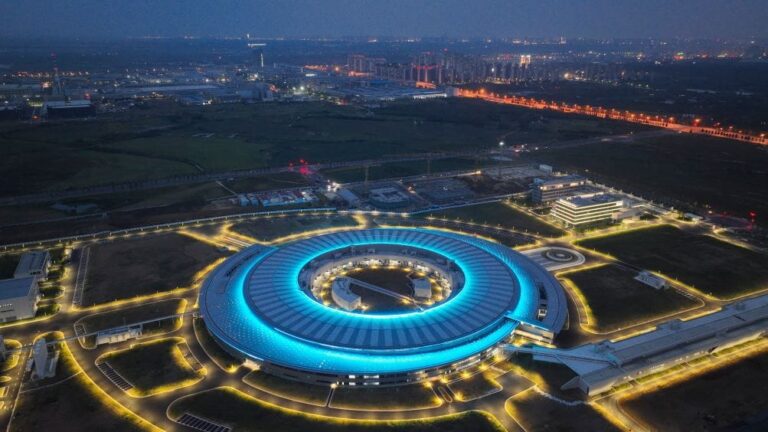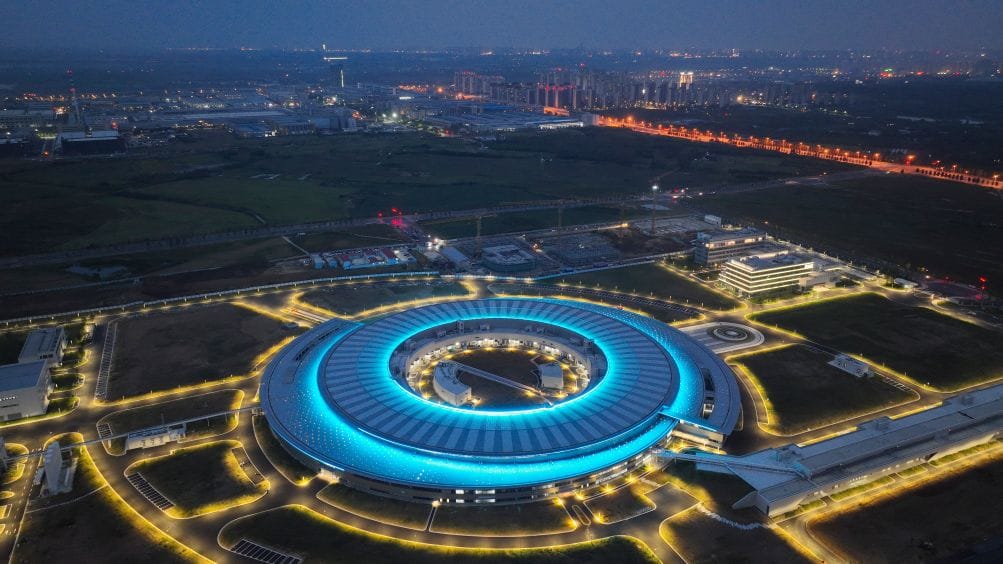
China’s Hefei Advanced Light Facility (HALF) has produced and delivered its first electron beam, marking a major construction milestone for the new synchrotron radiation facility.
The linear accelerator completed the operation on Sunday in Hefei, the capital of Anhui Province in eastern China. The result moves the project into a new phase of testing before the electron beam is injected into the facility’s storage ring.
HALF is being developed as a fourth-generation synchrotron radiation source for research in the low-energy range.
It has a designed operating energy of 2.2 gigaelectronvolts (GeV) and uses diffraction-limited storage ring technology. The project is also classified as a major national science and technology infrastructure project in China.
The first beam marks the point at which the linear accelerator begins performing one of its central functions. It generates an electron beam that will eventually circulate through the storage ring and produce synchrotron radiation. The quality and stability of that beam are important to the performance of the facility’s research systems.
READ ALSO: https://modernmechanics24.com/post/us-navy-sub-tsar-submarine-bottleneck/
How The Facility Works
Synchrotron facilities produce highly intense and tightly controlled light by accelerating electrons and guiding them through a storage ring.
Scientists then use the resulting radiation to examine materials and other forms of matter at extremely small scales. In simple terms, the facility works like a highly advanced microscope for studying structures that ordinary laboratory instruments cannot resolve.
HALF is designed to generate soft X-rays with more than 100 times the brightness and coherence of those from third-generation synchrotron sources.
Higher brightness means researchers can work with stronger signals, while greater coherence helps them obtain more precise information from experiments. These capabilities are intended to improve measurements across spatial, temporal and energy scales.
The facility will support studies of microscopic particle behaviour and the structure of light elements. Researchers will also be able to examine changes in the electronic, chemical and spin states of materials. Such measurements are useful for understanding how materials behave and how their properties change under different conditions.
Next Phase Involves Storage
The project will now move into a more demanding commissioning stage. During this phase, engineers will work to inject the electron beam from the linear accelerator into the storage ring and test how the systems operate together. Further testing will then prepare the facility for full-system commissioning and more stable operation.
He Zhigang, chief engineer of the injector system, said the successful generation and delivery of the beam represented an important step toward the project’s final objective.
He explained that the linear accelerator provides the electron beam that becomes the source of synchrotron radiation. He also said beam quality, stability and reliability directly influence the storage ring, beamlines and experiments that follow.
The commissioning process will involve more than the accelerator itself. Engineers must coordinate the injector, storage ring and downstream beamlines so that the electron beam can be transported and controlled reliably. Researchers will eventually use those beamlines to conduct experiments with the radiation generated by the circulating electrons.
WATCH ALSO: https://modernmechanics24.com/post/china-disputed-south-china-sea-patrols/
Research Reach Beyond China
Once completed, HALF is expected to complement China’s existing synchrotron radiation facilities by operating in a different energy range.
Its fourth-generation design will provide another research platform for scientists working with materials, biological systems and energy-related technologies. The facility is also intended to support research connected with high-temperature superconductivity, advanced batteries, aerospace applications, biomedicine and advanced materials.
The project has wider relevance because synchrotron radiation is used across many scientific disciplines. Researchers can use the intense radiation to study the composition, structure and behaviour of materials with high precision. The resulting data can support work ranging from fundamental studies of matter to the development and testing of new technologies.
HALF is also planned as an international research facility. According to He, scientists from China and other countries will be able to use the facility once it is completed and operational. Its planned research areas include quantum information, energy, environmental science and life sciences.
The first electron beam therefore marks the transition from construction toward integrated testing and commissioning. The next major task is to establish reliable electron circulation in the storage ring and prepare the beamlines for experiments. However, HALF is set to add a new fourth-generation synchrotron research platform to China’s scientific infrastructure.