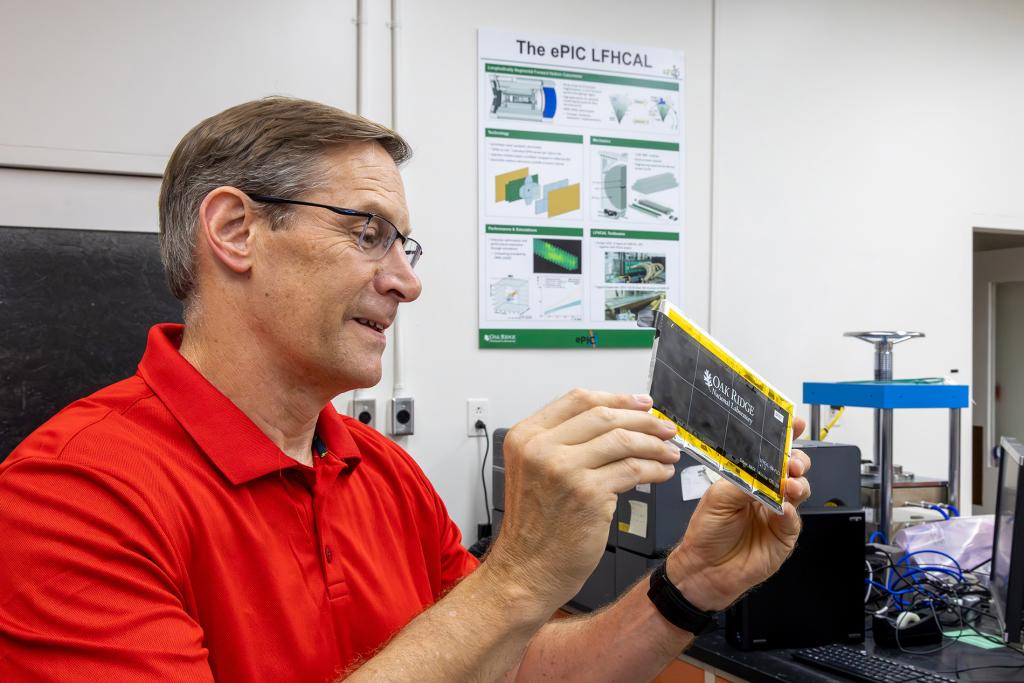
Oak Ridge National Laboratory (ORNL) physicist John Lajoie is developing advanced detector technologies to help scientists study the smallest building blocks of matter. His work includes the detector being built for the future Electron-Ion Collider, which could provide new information about quarks and gluons.
Lajoie leads the Relativistic Nuclear Physics Group at ORNL and is also spokesperson for the ePIC Collaboration. The collaboration includes hundreds of scientists and engineers from 183 institutions across 26 countries working on the first detector for the Electron-Ion Collider at Brookhaven National Laboratory.
Particle detectors help scientists turn invisible particle collisions into measurable information. They can track how particles move, measure their energy and identify what types of particles are produced after a collision.
READ ALSO: https://modernmechanics24.com/post/llnl-3d-print-ceramic-laser-high-power/
Lajoie focuses on building detectors that can collect this information more effectively. His research aims to understand how quarks and gluons make up protons and neutrons and how their interactions create the matter we see around us.
The future Electron-Ion Collider, or EIC, will use several types of detectors. Its ePIC detector will include three tracking systems, seven calorimeters and four particle-identification detectors, each designed to capture different information from particle collisions.
One major change in ePIC will be how it handles data. Instead of using traditional trigger systems that decide when to record an event, ePIC is being designed to continuously collect data and process it in real time. Artificial intelligence and machine learning could help identify the most useful signals as the data arrives.
The detector technology developed for particle physics can also find uses outside fundamental research. For example, Timepix4, a detector originally developed at CERN for particle experiments, is now being used at ORNL in microscopy work to study materials.
Lajoie says detector development also creates skills that can be useful in other areas. Students and researchers who learn to solve complex detector problems can take those skills into other scientific and technical fields, including national security and materials research.
The EIC is still under construction, so many of its scientific benefits are yet to be seen. Building its detectors also involves challenges involving cost, size, data processing and performance, making the project a long-term engineering effort.
WATCH ALSO: https://modernmechanics24.com/post/youtuber-bottles-lightning/
Lajoie previously spent more than 26 years working at Brookhaven’s Relativistic Heavy Ion Collider, where he contributed to the PHENIX experiment and helped manage detector construction for the sPHENIX upgrade. At ORNL, his work on ePIC represents another major effort to build tools that could reveal new details about quantum matter.