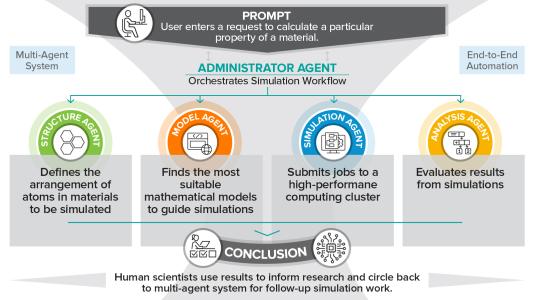
Researchers at Argonne National Laboratory have developed an AI system that automates complex materials simulations. The new system can reduce materials discovery from months or years to just days, helping scientists find new materials more quickly for batteries, electronics, and aerospace.
The project was led by Argonne National Laboratory in collaboration with the University of Illinois Chicago. The research also involved the Center for Nanoscale Materials (CNM) and the Argonne Leadership Computing Facility (ALCF). According to Argonne News, the team created a multi-agent AI framework that performs complex simulation tasks with limited human input.
The system addresses a major challenge in materials research. Atomistic simulations, which model how atoms interact inside materials, are powerful but difficult to use. Scientists often spend a long time setting up simulations, managing different software tools, and analyzing results. This slows the discovery of new materials.
READ ALSO: https://modernmechanics24.com/post/industrial-waste-turned-renewable-energy/
The AI framework works as a team of specialized AI agents. A researcher starts by entering a simple request, such as calculating the properties of a material. The AI agents then divide the work, search scientific databases, prepare simulation files, run calculations on high-performance computers, and analyze the results. The system can also ask follow-up questions if more information is needed.
The technology could help researchers develop better batteries, stronger aerospace materials, and more efficient electronic components. By automating routine tasks, scientists can spend more time designing new materials instead of managing complex software. According to Argonne News, the framework is also publicly available, allowing other researchers to adapt it for their own work.
The system is still in the early stages of adoption. While initial tests showed results that closely matched simulations performed by human experts, researchers must continue validating the framework across more materials and scientific applications. Human oversight also remains important for reviewing and confirming the results.
WATCH ALSO: https://modernmechanics24.com/post/hmnd-01-alpha-simulation-first-robotics/
The study shows how AI can improve scientific research beyond chatbots and data analysis. According to Argonne National Laboratory, the new framework could make advanced materials research faster, easier, and more accessible. If widely adopted, it may speed up discoveries that support cleaner energy, stronger industrial materials, and future electronic technologies.
According to Argonne News, the research was supported by the U.S. Department of Energy’s Office of Science, and the AI framework has been released as an open-source tool for the scientific community.