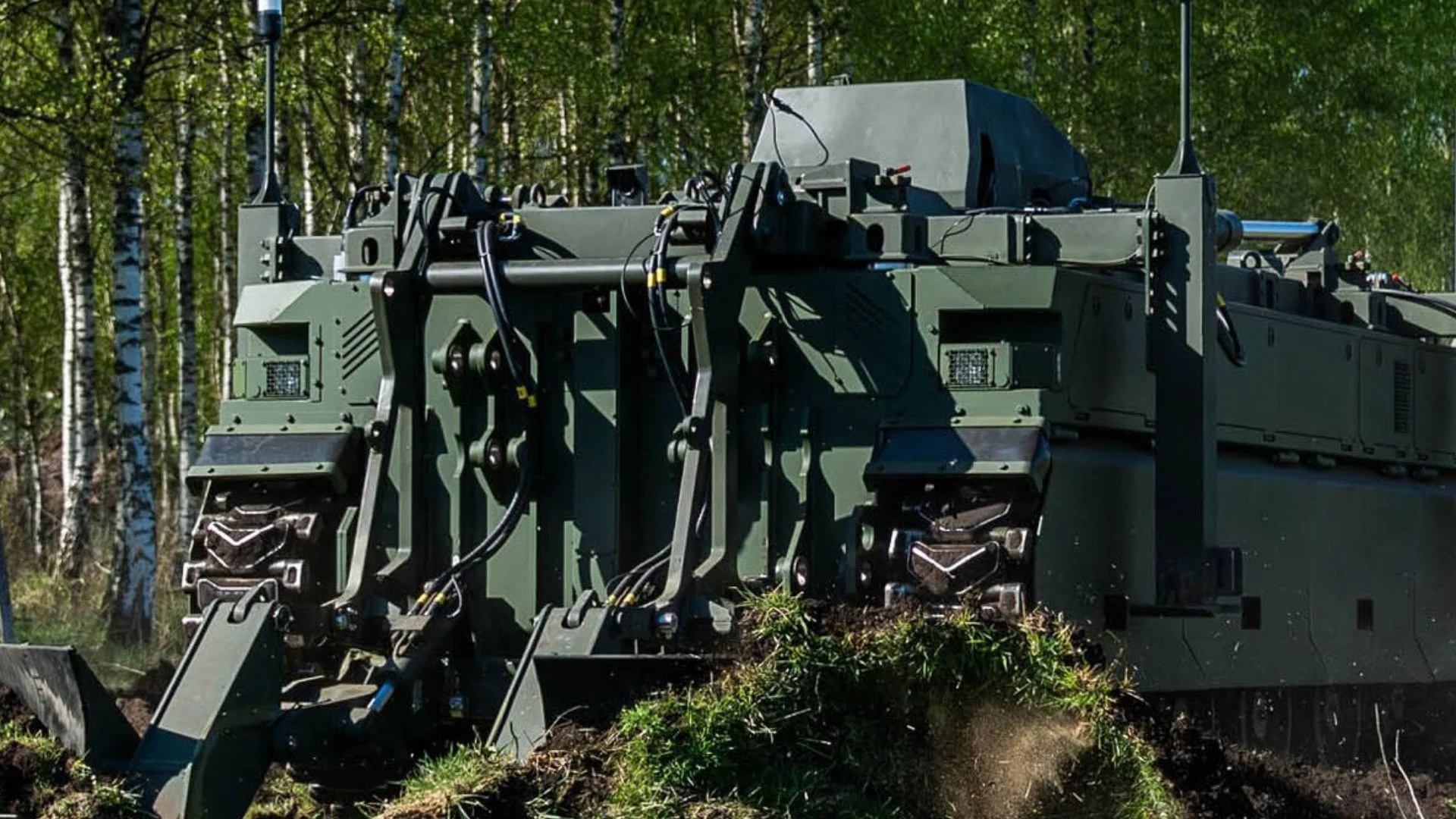
Rheinmetall has presented its new MV-8 KOMODO Unmanned Breaching System (UBS) at Eurosatory 2026.
The system is designed to clear minefields and battlefield obstacles while keeping soldiers at a safer distance. It addresses one of the most dangerous challenges faced by military forces during ground operations.
Modern battlefields often contain barriers, defensive positions, and hidden mines. These obstacles can slow troop movements and increase risks for frontline units.
The MV-8 KOMODO aims to solve this problem through its remote-controlled mine-clearance and route-opening capabilities.
The new platform is the result of cooperation between Rheinmetall and DOK.ING, and Pearson Engineering. Each company contributes a specific area of expertise to the project. The partnership combines vehicle engineering, unmanned systems technology, and mine-clearing equipment into a single platform.
Unmanned Platform for Battlefield Mobility
The MV-8 KOMODO is based on DOK.ING’s KOMODO MV-8 unmanned vehicle platform. It is designed to carry different mission systems on a common chassis. This allows military operators to adapt the vehicle for various battlefield tasks.
The platform uses a fully integrated 350-kilowatt diesel-electric hybrid powertrain. It has a gross vehicle weight of up to 15.5 tonnes and a payload capacity of up to 8.5 tonnes. The vehicle can also reach speeds of up to 55 kilometers per hour.
READ ALSO: US Army Converts Alaska Cavalry Unit Into Airborne Battalion for Arctic and Indo-Pacific Missions
Its rugged design allows operation in difficult terrain and harsh weather conditions. The vehicle is built for off-road mobility and demanding combat environments. Rheinmetall says the platform also features an open architecture that supports future upgrades.
One of the key advantages of the system is that it removes soldiers from the immediate danger zone. Operators can control the vehicle remotely while it performs hazardous tasks. This helps reduce casualties during mine-clearing and obstacle-breaching missions.
Mine Clearance and Obstacle Breaching
The MV-8 KOMODO combines mechanical and explosive methods to clear minefields. This gives military forces more flexibility when dealing with different types of threats. It also helps create safe routes for troops and vehicles moving behind the system.
For mechanical mine clearance, the vehicle carries a mine plow supplied by Pearson Engineering. The plough moves soil and safely displaces buried mines. This process creates a cleared path through contaminated areas.
The vehicle also uses a Lane Marking System to identify the safe route it has created. Clear markings help the following forces move through the area without confusion. This improves operational speed and reduces risk during combat operations.
An additional magnetic field duplicator can be fitted to the system. This device triggers magnetic mines before troops reach them. Premature detonation enhances personnel and vehicle safety on the cleared route.
The platform can also carry the Plofadder rocket-assisted mine-clearing system. This system launches an explosive detonation cord across a minefield. Once detonated, it clears a lane up to 160 meters long and nine meters wide.
The combination of these methods allows the vehicle to tackle a wide range of battlefield obstacles. Commanders can select the most suitable approach based on mission requirements. This flexibility is increasingly important in modern combat environments.
READ ALSO: Astrobotic Reveals Griffin-1 Lunar Lander Ahead of NASA’s Next Moon Base Mission
MV-8 KOMODO Leads Autonomy
Rheinmetall plans to expand the vehicle’s capabilities by integrating its PATH A-Kit technology. This upgrade will introduce advanced autonomous and semi-autonomous functions. The goal is to improve mission efficiency while reducing operator workload.
Once installed, the system will support autonomous waypoint navigation. It will also be able to avoid obstacles in real time as it moves through complex environments. These functions help the vehicle operate more effectively during demanding missions.
Additional features include Follow-Me and resupply modes for convoy operations. The system will also support leader-follower functions, allowing multiple vehicles to operate together. Rheinmetall says up to ten vehicles can be controlled cooperatively within a mission group.
The autonomous package also includes AI-supported sensor fusion and situational awareness tools. These technologies combine information from different sensors to provide a clearer operational picture. This helps maintain mission reliability even in areas where satellite navigation signals are unavailable.
WATCH ALSO: High-pressure monster gun can make 40-ton military vehicle more lethal on battlefields
The development reflects a growing military focus on unmanned ground systems. Armed forces around the world are investing in technologies that improve protection while maintaining operational effectiveness. Systems such as the MV-8 KOMODO are becoming important as battlefields grow more complex.
The introduction of the MV-8 KOMODO at Eurosatory 2026 highlights the continued shift toward unmanned combat support vehicles. By combining mine clearance, obstacle breaching, and future autonomous capabilities, the platform offers a safer way to maintain battlefield mobility.