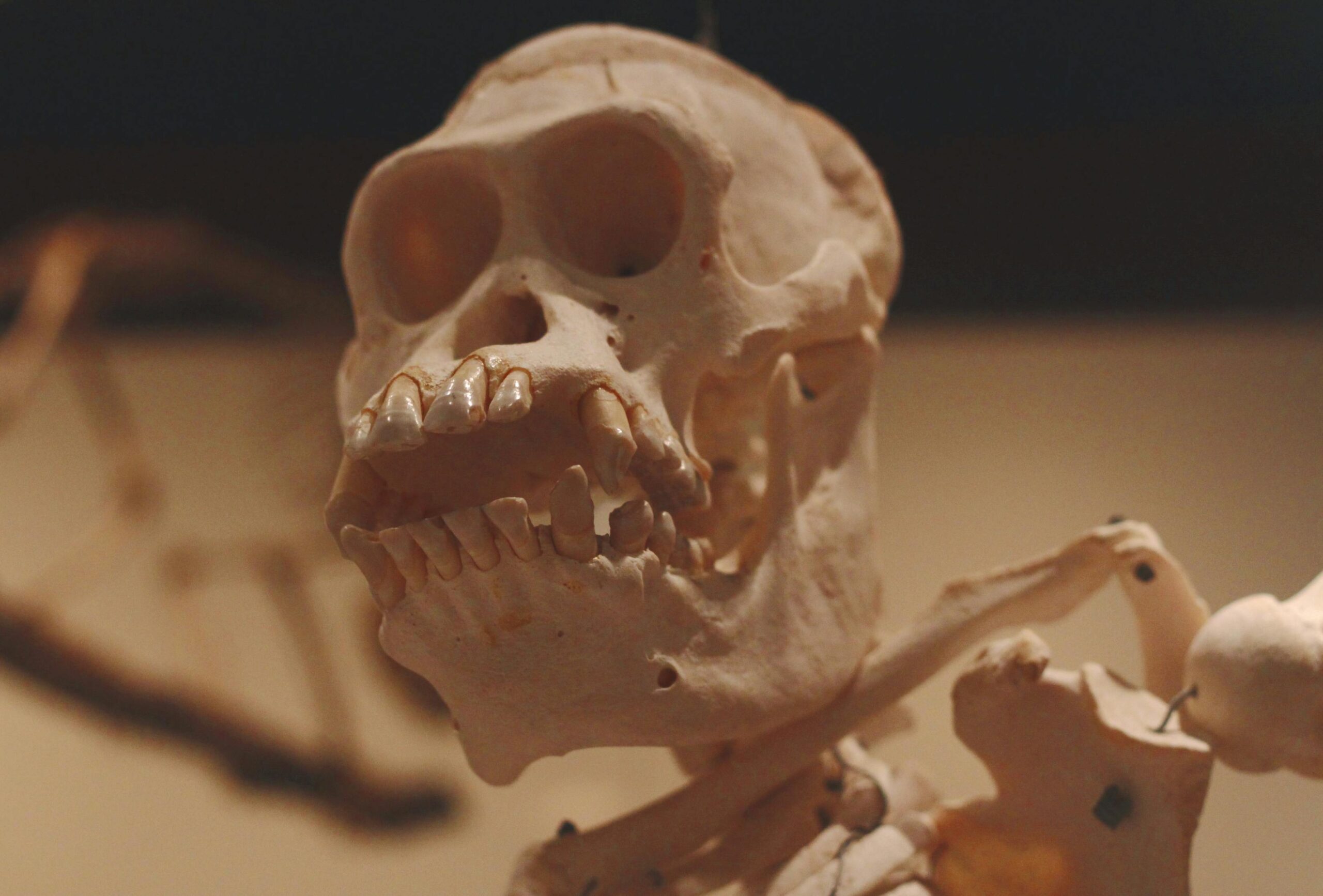
University at Buffalo biological anthropologist Dr. Noreen von Cramon-Taubadel and her team have demonstrated that the human chin—a bony projection unique to Homo sapiens among all primates—is an evolutionary byproduct, not an adaptation for chewing or speech. Published in PLOS One, the study tested the null hypothesis of neutral evolution and found that chin traits better fit the spandrel model: an unintended consequence of natural selection acting on other parts of the skull. The research challenges decades of adaptationist assumptions in anthropology and reframes how scientists interpret distinctive human features in the fossil record.
The problem Dr. von Cramon-Taubadel and her colleagues set out to solve is not whether humans have chins—every living member of our species does, and no other primate does. The problem is why. For generations, anthropologists proposed functional explanations: the chin buttressed the jaw against chewing forces, or it evolved to facilitate speech articulation, or it signaled sexual fitness. Each hypothesis carried the implicit assumption that because the chin is unique and universal, it must have been shaped by natural selection for some purpose.
What the University at Buffalo team built instead is an empirical test of that assumption. Using comparative cranial data from apes and humans, they asked whether the chin region evolved under direct selection or as a correlated response to selection on other parts of the jaw and skull. Dr. von Cramon-Taubadel, professor and chair of the UB Department of Anthropology, explained that the study explicitly tested the null hypothesis of neutral, random evolution. If selection were acting directly on the chin, its traits would show signatures inconsistent with random drift. The data did not support that.
READ ALSO: https://modernmechanics24.com/post/china-wing-loong-x-drone-eyes-global/
The basic function of this analytical approach, from a scientific perspective, is to distinguish adaptation from accident. The chin, the researchers concluded, is a spandrel—a term borrowed from architecture by the late evolutionary biologist Stephen Jay Gould to describe features that arise not for their own utility but as inevitable byproducts of other design choices. The triangular spaces under the arches supporting the dome of San Marco Cathedral have no architectural purpose; they exist because the arches exist. The human chin, the study argues, is analogous: a structural leftover from evolutionary remodeling of the face and jaw, not a feature nature deliberately installed.
Still, the achievement carries an honest limitation that the researchers themselves acknowledge. This is a single study testing a specific hypothesis with a particular comparative dataset. Dr. von Cramon-Taubadel told reporters that she and her team are not the first to suggest the chin is a spandrel, but previous arguments largely assumed selection and attempted to explain why the chin failed to fit adaptive models. This study instead reversed the burden of proof, treating neutrality as the default and requiring evidence of selection to overturn it. That methodological shift is significant, but it does not foreclose future discoveries. If new evidence emerges linking chin morphology to, for example, undiscovered biomechanical functions, the interpretation could be revised. Science proceeds by testing, not decree.
WATCH ALSO: https://modernmechanics24.com/post/biohybrid-robots-turn-food-waste-into-functional-machines/
What makes this matter, ultimately, is not the chin itself—though the chin is, as Hammett demonstrated, a convenient literary shorthand for character. What matters is what the chin reveals about how evolutionary biologists think. Dr. von Cramon-Taubadel noted that within anthropology, there is an “adaptationist bent,” an almost reflexive tendency to assume that observed differences between species must have been deliberately shaped by natural selection for specific functions. This study provides empirical counterweight. It demonstrates that some features, even universal and distinctive ones, are simply architecture’s leftover space. The human body is an amalgamation of adaptations and random byproducts. Recognizing which is which requires rigorous hypothesis testing, not narrative convenience.
The innovator of this specific research program is Dr. Noreen von Cramon-Taubadel, whose work at University at Buffalo has long focused on how cranial and mandibular traits evolve in integrated complexes rather than as independent units. But the engineers of the study’s methodology—the graduate students and postdoctoral researchers who compiled comparative measurements, ran statistical models, and tested alternative evolutionary scenarios—are the ones who transformed the conceptual argument into falsifiable science. The chin, after all, is not a hypothesis. It is a bone. Understanding why it exists required measuring hundreds of other bones first.
READ ALSO: https://modernmechanics24.com/post/tepco-niigata-reactor-restart-alarm/
Reported by EurekAlert! and other science news services, the PLOS One publication has already generated discussion within biological anthropology. Some researchers remain invested in adaptive explanations; others view the spandrel model as a more parsimonious fit with current understanding of craniofacial evolution. Dr. von Cramon-Taubadel emphasized that the findings underscore the importance of assessing physical characteristics with “trait integration in mind.” The jaw does not evolve in isolation. It evolves with the skull, the teeth, the muscles that attach to it, and the developmental pathways that build all of them. Change one element, and others shift in response. Some of those shifts will look, in retrospect, like design. They are not.
What comes next is the slow accumulation of comparative evidence across more species and more traits. The same methodological approach—testing neutrality as the null hypothesis—could be applied to other distinctive human features: our naked skin, our oversized brains, our bipedal gait. Some will prove to be adaptations. Others will reveal themselves as spandrels. Dr. von Cramon-Taubadel is not arguing that natural selection is unimportant. She is arguing that it is not the only explanation, and that assuming it by default obscures more interesting questions about how evolution actually proceeds.
WATCH ALSO: https://modernmechanics24.com/post/china-humanoid-robot-combat-moves/
For the rest of us, who will never measure a mandible or calibrate a phylogenetic comparative model, the significance is quieter. The next time you look in the mirror and see your chin—jutting, receding, cleft, or smooth—you are looking at evolutionary happenstance. It is not there because it made your ancestors better at chewing or speaking or attracting mates. It is there because other things changed, and the chin came along for the ride. That is not diminished dignity. It is a different kind of wonder: that so much of what we are was never planned at all.