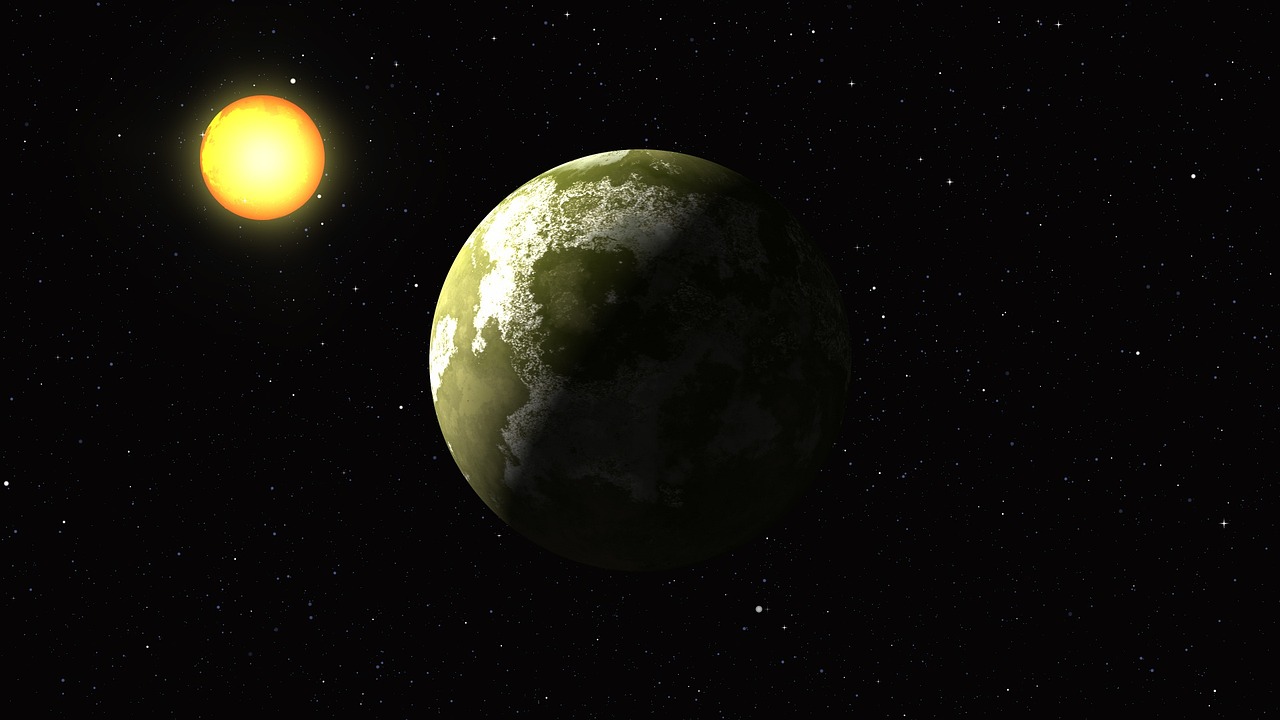
University of Cambridge astronomer Dr. Quentin Kral and his team have detected a curious wobble in a distant gas giant, pointing to the presence of a potential exomoon so massive—around 9 times the mass of Neptune—that it could force scientists to rethink what we call a “moon” in the first place.
Have you ever looked at our solar system’s largest moon, Jupiter’s Ganymede, and thought it was impressively big? Well, astronomers may have just found a moon that makes Ganymede look like a speck of cosmic dust. The discovery revolves not around a star, but around another planet: the gas giant HD 206893 B, located 133 light-years from Earth. Reported by Space.com, this intriguing finding came from meticulous observations using a powerful instrument called GRAVITY at the Very Large Telescope (VLT) in Chile.
So, how do you spot a moon in another star system, especially one that doesn’t give off its own light? You watch for a telltale wobble. Imagine a dancer spinning—if another dancer grabs their hand, their motion changes slightly. That’s the principle here. The planet HD 206893 B, which is itself a hefty object with about 28 times Jupiter’s mass, wasn’t following a perfectly smooth path around its star. Instead, it exhibited a small, rhythmic back-and-forth motion. “This kind of signal is exactly what you would expect if the object were being tugged by an unseen companion, such as a large moon,” explained Dr. Kral to Space.com.
READ ALSO: https://modernmechanics24.com/post/us-eyes-new-common-minigun-all-varients/
The team employed a precise technique called astrometry to measure the planet’s position over time, detecting these minuscule aberrations in its motion. They pushed the method to new limits, monitoring changes over days and months rather than years. The data revealed a compelling pattern: a wobble repeating roughly every nine months, with a physical “shove” comparable to the distance between Earth and our moon. This points strongly to a massive companion locked in orbit with the planet.
The inferred properties of this potential exomoon are what truly stretch the imagination. The data suggests an object with a mass around 40% of Jupiter’s. To put that in perspective, it would be thousands of times more massive than Ganymede. It’s so large that it blurs the line between a moon and a binary planetary system. “In our solar system, the most massive moon is Ganymede, which is still extremely small compared to what we are inferring here,” Kral noted. This discovery directly challenges our current, solar system-centric definitions.
WATCH ALSO: https://modernmechanics24.com/post/india-zorawar-light-tank-missile-test/
Adding to the mystery, the potential moon’s orbit appears to be tilted at a steep 60-degree angle relative to the planet’s orbital plane. Such a dramatic tilt often hints at a violent past, suggesting gravitational interactions with other bodies may have thrown the system into chaos long ago. While exomoons have been proposed before, none have been definitively confirmed, making this a potentially landmark detection. The team’s research, accepted for publication in Astronomy & Astrophysics, offers a promising new roadmap for finding these elusive objects by focusing on planets far from their host stars, where massive moons are more likely to survive.
Why does this matter? Confirming the first exomoon would open an entirely new chapter in planetary science. It would prove that complex, multi-body systems like our own are not unique and could be common across the galaxy. Furthermore, as Kral suggests, we are likely just seeing the tip of the iceberg. The first discoveries are always the most extreme, and as our technology improves, we may find a whole menagerie of moons, from tiny, icy worlds to giant planetary partners, forcing us to expand our cosmic vocabulary.
READ ALSO: https://modernmechanics24.com/post/fusion-energy-spinout-nextgen-microwaves/