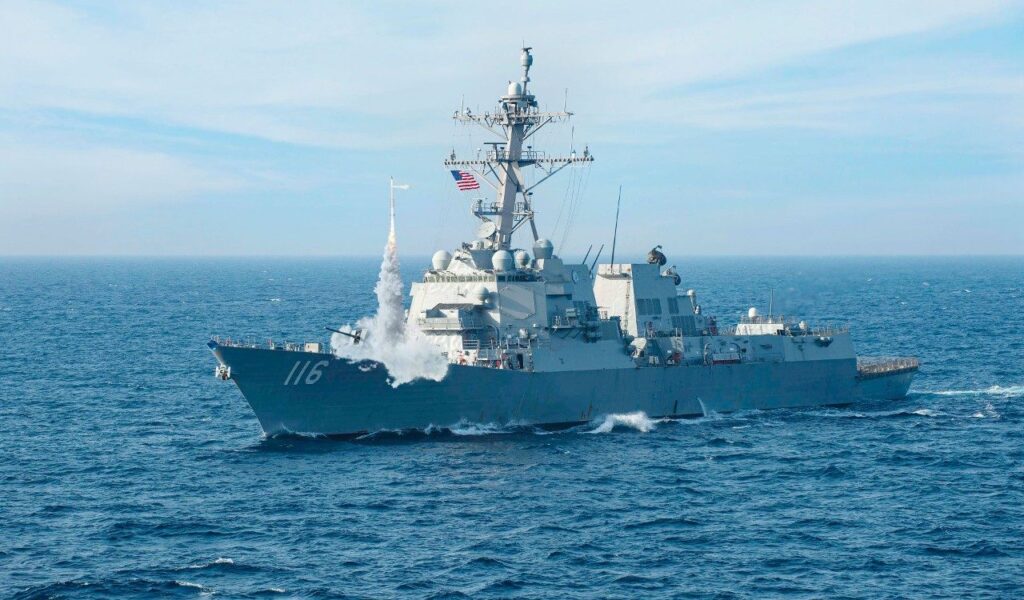
The U.S. Navy is defending the design of its new FF(X) frigate, which will forgo a traditional Vertical Launch System (VLS) and instead rely heavily on containerized weapon modules on its stern for extra firepower. Derived from the Coast Guard’s Legend-class cutter, the 4,750-ton warship will initially carry the same basic armament as the Littoral Combat Ship (LCS), betting that “capability in a box” will provide the flexibility and firepower needed for future missions.
In a bold departure from traditional warship design, the U.S. Navy is placing a major bet on shipping containers loaded with missiles to arm its next-generation frigate. The service is pushing back against criticism of its FF(X) frigate program, confirming that the ship will launch without an integrated Vertical Launch System (VLS)—the standard missile cells on most modern surface combatants. Instead, the Navy plans to use the ship’s large fantail as a “parking lot” for modular container launchers, a concept it says will offer unparalleled adaptability and rapid upgrades.
New details about the FF(X), derived from the proven U.S. Coast Guard Legend-class National Security Cutter (NSC), were revealed at the Surface Navy Association (SNA) symposium this week, as reported by The War Zone (TWZ). The design is the Navy’s latest attempt to field a capable, producible frigate after the troubled Littoral Combat Ship (LCS) and the cancelled Constellation-class program.
READ ALSO: https://modernmechanics24.com/post/sda-nine-missile-tracking-sats-ready/
Chris Miller, Executive Director at Naval Sea Systems Command (NAVSEA), defended the approach, telling the SNA audience: “We are pursuing a design that is producible, it has been proven, it is operationally in use today, and it will evolve.” He pitched the vision of “capability in a box,” leveraging advances in containerized systems. “I think you all will agree that we have come a long ways in our ability to use shipping containers, and I am excited.”
The FF(X) frigate will be 421 feet long, displace 4,750 tons, and have a range of 12,000 nautical miles. Its fixed, built-in armament is modest: a 57mm main gun, a 30mm cannon, and a 21-cell RIM-116 Rolling Airframe Missile (RAM) launcher for point defense. This is nearly identical to the final configuration of the LCS, a platform long criticized for being under-armed. The firepower gap is intended to be filled by the containerized systems on the stern.
WATCH ALSO: https://modernmechanics24.com/post/byd-seal-smooth-electric-power/
The Navy’s first containerized options include launchers for up to 16 Naval Strike Missiles (NSM), a potent anti-ship weapon, or as many as 48 AGM-114 Hellfire missiles for engaging small boats and drones. This modular approach, officials argue, is fundamentally different from the failed LCS “mission module” concept. “I want to distinguish between LCS mission modules and containerized payloads,” said Rear Adm. Derek Trinque, head of the Navy’s surface warfare division (N96). “We are going to take existing systems and… put them in a box with an interface to the ship’s combat system. That will make this work, and it will allow [for] rapid switch out of capability.”
The decision to omit an integrated VLS and other built-in systems like a hull sonar has drawn skepticism. Critics point to the Constellation-class, which was designed to be a larger, more heavily armed frigate specifically to remedy LCS shortcomings. Navy leaders, however, frame the FF(X) as a complementary vessel to high-end destroyers. “We have in the Flight III Arleigh Burke-class destroyers… the large surface combatants that are appropriate for today,” Rear Adm. Trinque stated.
READ ALSO: https://modernmechanics24.com/post/japan-first-floating-wind-farm-hybrid/
The containerized strategy is also seen as a way to manage risk and rapidly integrate new technologies, from anti-submarine warfare suites to electronic warfare systems, without costly shipyard modifications. “A system that does not prove itself… could simply be unloaded from the ship and readily replaced with something else,” Miller explained.
For the Navy, the FF(X) program represents a pragmatic, if controversial, pivot. It trades the traditional vision of a heavily armed, standalone frigate for a flexible, affordable hull that can be tailored with “plug-and-play” containers. The success of this billion-dollar bet now hinges on turning the promise of “capability in a box” into a reliable, combat-ready reality.
WATCH ALSO: https://modernmechanics24.com/post/cartoon-robot-learns-kitchen-chores/