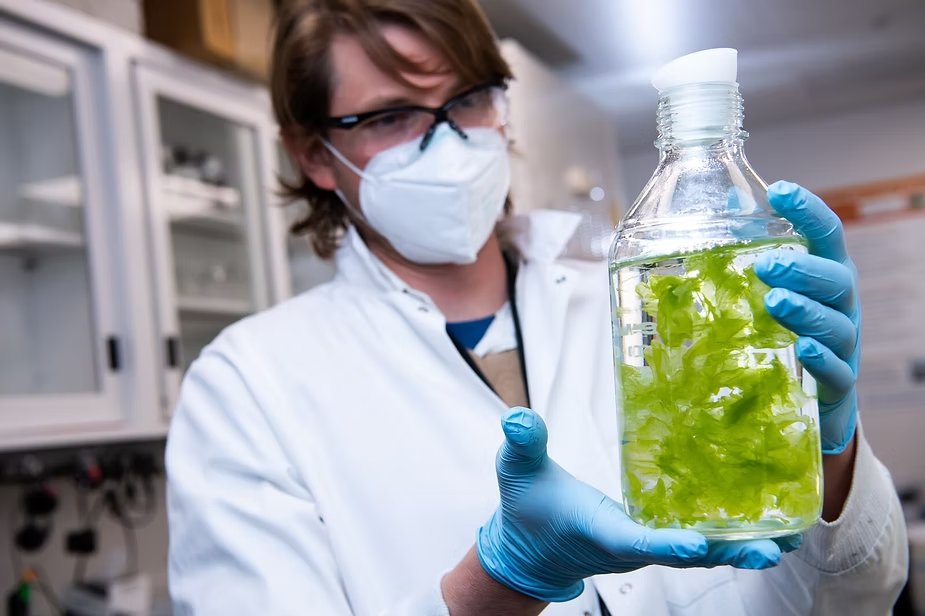
In a sunlit laboratory overlooking Washington State’s Sequim Bay, rows of glass flasks shimmer with seawater and vibrant green and purple seaweed. Here, scientists are exploring an unconventional path to secure the minerals essential to modern life.
Rare earth elements such as neodymium—key to powering smartphones, electric vehicles, and renewable energy technologies—are typically mined from the earth. But researchers at the Department of Energy’s Pacific Northwest National Laboratory (PNNL) are turning their attention to a surprising new source floating just offshore: seaweed.
At PNNL’s Sequim campus, several species of seaweed are being cultivated in local seawater as researchers test methods for pulling valuable minerals from their leaf-like blades.
“The ocean holds the largest reservoir of many critical minerals needed for advanced technologies,” explained Michael Huesemann, principal investigator of the biomining project at PNNL. “If we can responsibly tap into seawater, we could open the door to a sustainable, domestic supply of these materials.”
An Untapped Source of Critical Minerals
For years, scientists have speculated that the ocean could be a vast, largely unexplored reservoir of critical minerals, says Scott Edmundson, a research botanist at PNNL’s Sequim laboratory.
As rocks erode through wind, rain, and flowing water—and as human activities like farming add nutrients to soils—minerals are carried into the sea. At the same time, Earth itself delivers minerals into the ocean through underwater volcanoes and hydrothermal vents.
But the challenge lies in scale. With 300 million cubic miles of seawater, the ocean is so immense that mineral concentrations are far too diluted to recover with traditional methods. To make them usable, something needs to concentrate those minerals.
READ ALSO: Scientists Harness Graphene to Mature Brain Organoids Faster, Aiding Neurodegenerative Studies
READ ALSO: UK’s Royal Navy Launches First Autonomous Submarine for Future Battles at Sea
That’s where seaweed comes in. “Seaweeds are remarkable natural collectors of minerals,” Edmundson explained. Although the mechanisms remain unclear, scientists do know that the same seaweeds often seen along shorelines can accumulate a surprising array of critical minerals—sometimes in concentrations a million times higher than in seawater itself.
With support from DOE’s Advanced Research Projects Agency–Energy, Michael Huesemann and his colleagues have been testing different seaweed species to see which ones specialize in absorbing particular minerals. Their work shows that a tough, brown species called Fucus is especially good at drawing nickel into its tissues, while the leafy green Ulva—better known as sea lettuce—tends to capture rare earth elements. In fact, Ulva has emerged as the most promising candidate for concentrating several critical minerals at once.
Now that researchers know which species of seaweed excel at mineral collection, the next hurdle is extracting them. As Edmundson points out, elements like cobalt or dysprosium don’t simply coat the surface of seaweed—they’re locked deep within its tissues. Recovering them means finding ways to break the chemical bonds that hold those minerals in place.
READ ALSO: Tracing 8,000 Years of History in Great Salt Lake Sediments
READ ALSO: UMaine team discovers innovative way to enhance 3D-printed materials
Mining Seaweed for Minerals
To unlock the minerals stored inside seaweed, researchers have been testing different extraction methods, with a focus on finding the least energy-intensive process. After numerous trials, they’ve landed on a technique showing promising early results. Once the seaweed has grown, it is ground into a paste and then mixed with an acidic solution designed to release the target minerals.
These acidic solutions, called lixiviants, are commonly used in traditional mining to leach minerals from rock. When combined with seaweed paste, the lixiviant lowers the mixture’s pH, making it more acidic and encouraging the minerals to detach from the plant tissues. Applying heat further helps by breaking down the chemical bonds holding the minerals in place.
The team has set an initial benchmark: recover at least 50 percent of the critical minerals contained in the seaweed biomass. Achieving that goal has been far from simple, said Huesemann. The researchers have experimented with different lixiviants, varied the temperatures, and even repeated the extraction process multiple times—all in the effort to maximize mineral recovery.
Economics of Biomining
Perfecting the extraction process is only the first step, Huesemann explained. For biomining to become truly viable, researchers must also weigh the economic costs and benefits. Early on, the team experimented with drying seaweed samples using heat, but later abandoned the step to conserve energy. Lixiviants—the acidic solutions needed for mineral extraction—are another expense. To cut costs, the team is exploring the use of waste acids from other processes, such as ocean alkalinity enhancement.
READ ALSO: When a human jumped from space, setting world record for supersonic free fall
READ ALSO: World record for the longest lightning flash established
Seaweed itself offers some economic advantages. It grows quickly, requires no fresh water, and after the minerals are extracted, the leftover biomass can still be used. Possible applications range from biofuel feedstock to sustainable materials like bioplastics, construction products, and even adhesives.
Edmundson noted another advantage: seaweed’s diversity. Different species absorb different minerals, which means extraction could be tailored to match future technology needs.
“The diversity is so high that you can choose and cultivate the species that captures the mineral you’re after,” Edmundson said. “The critical mineral of today might not be the critical mineral of tomorrow. Seaweed’s flexibility gives us the ability to fine-tune this technology to whatever the moment demands.”