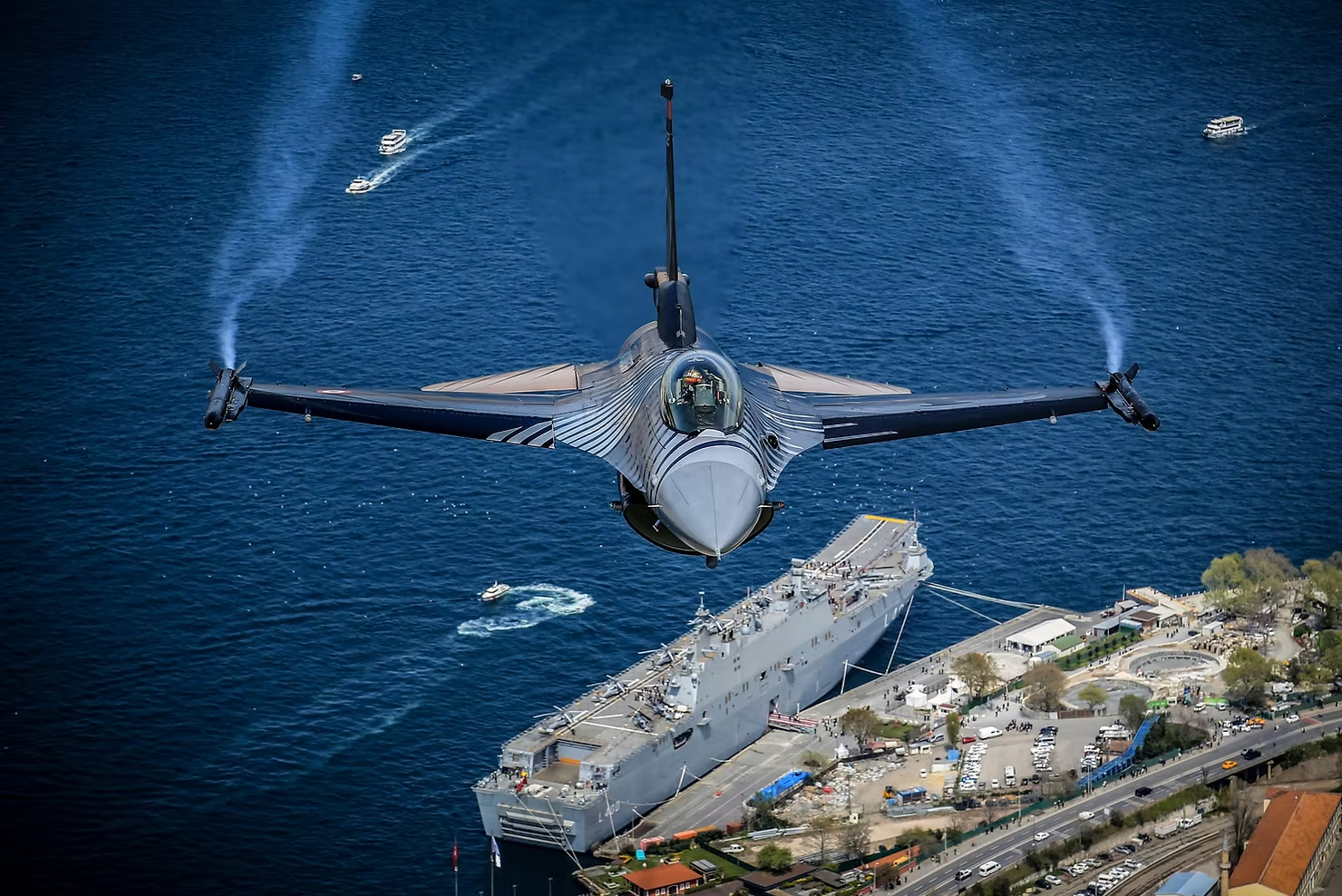
Japan’s Ministry of Defence has formally accused Chinese J-15 fighter jets of performing a high-risk fire-control radar lock-on against Japanese F-15J aircraft northeast of Taiwan, an act Japanese Defence Minister Shinjiro Koizumi called a “dangerous act.” China countered, alleging that the Japanese planes dangerously intruded on a People’s Liberation Army (PLA) Navy drill involving the Liaoning aircraft carrier.
The tense aerial encounter occurred over international airspace southeast of Okinawa on Saturday, according to Japan’s public allegations. This marks the first time Japan has publicly accused a Chinese military aircraft of using fire-control radar—a precise targeting system that precedes potential missile launch—against its forces. The Japanese Defence Ministry reported two separate incidents: the first between 4:32 pm and 4:35 pm local time, and a second, longer engagement between 6:37 pm and 7:08 pm.
The Chinese aircraft were operating from the Liaoning aircraft carrier, part of a carrier strike group that had just transited the Miyako Strait into the Pacific Ocean. The group included advanced escorts like the Type 055 destroyer Nanchang.
“Japan’s hype is completely inconsistent with the facts,” responded Wang Xuemeng, a spokesman for the PLA Navy, according to statements reported by the South China Morning Post. Wang asserted that Japanese Self-Defence Forces aircraft approached the announced training area, “creating disturbances” and “seriously endangering flight safety.”
READ ALSO: https://www.modernmechanics24.com/post/china-mountain-mine-robotic-trucks
Fire-control radar illumination is a severe escalation in military signaling, far beyond routine monitoring. Unlike broad surveillance radar, it involves a focused, precise beam that directly tracks a target to guide weapons. Its use is widely interpreted as a direct warning or a last-step pre-combat action. The incident underscores the heightened risks of miscalculation in a region already strained by geopolitical tensions over Taiwan.
Analysts note the backdrop of increasingly sharp rhetoric between Tokyo and Beijing. The friction was recently inflamed by remarks from Japanese Prime Minister Sanae Takaichi last month, suggesting a Taiwan Strait crisis could be “survival-threatening” for Japan and might justify military intervention—a statement Beijing said crossed a red line. While Takaichi later referenced Japan’s longstanding diplomatic stance, the damage to the atmosphere was done.
Furthermore, Japan’s plans to deploy medium-range missiles on Yonaguni Island, just 110 km east of Taiwan, have drawn stern warnings from Beijing. Senior Colonel Jiang Bin, a spokesman for China’s defence ministry, cautioned last month that Japan would “pay a heavy price” if it dared to “cross the red line.”
WATCH ALSO: https://www.modernmechanics24.com/post/leonardo-helicopters-add-shieldai-vidar-tech
The weekend’s events reveal a dangerous cycle of action and reaction. From China’s perspective, as some analysts on Chinese social media noted, foreign military aircraft operating near an active carrier group conducting live flight ops could be seen as a direct provocation. For Japan, the use of targeting radar in international airspace represents an unacceptable threat to its pilots’ safety.
Both sides have lodged formal protests, with Japan condemning the act and China urging Japan to “restrain frontline activities.” The PLA Navy vowed to “take necessary measures” to safeguard its security. This standoff, happening near a critical chokepoint and involving core assets like an aircraft carrier, signals that the tactical military friction between China and Japan is intensifying, raising the stakes for any future encounter in the crowded skies and waters near Taiwan.
READ ALSO: https://www.modernmechanics24.com/post/scientists-detect-rare-lightning-side-bursts